


CNC Milling

- Home
- Capabilities
- Solution
- Material
- Industry
- Resources
- Request a Quote

CNC Milling
3-axis, 4-axis, and 5-axis CNC milling for stainless steel parts with complex profiles, pockets, holes, threads, and tight-tolerance features.

CNC Turning
Precision CNC turning for stainless steel shafts, bushings, fittings, sleeves, threaded parts, and other round components requiring consistent dimensions and surface quality.

5-Axis CNC Machining
5-axis machining allows complex stainless steel components with multiple features and angled surfaces to be produced in fewer setups, helping improve accuracy and consistency.

Swiss CNC Machining
Swiss CNC machining for small-diameter, long, and high-precision stainless steel parts. It is well suited for shafts, pins, fittings, fasteners, medical components, and other intricate turned parts requiring tight tolerances and repeatability.

304L is a low-carbon austenitic stainless steel used for welded and fabricated components that require good general corrosion resistance, excellent formability and reduced sensitization risk in heat-affected zones. It is closely related to 304 but is particularly valuable where extensive welding is part of the manufacturing route.

430 is a magnetic ferritic stainless steel that combines moderate corrosion resistance, good sheet formability and relatively low alloy cost. It is commonly used for appliance components, panels, covers, trim and general fabricated parts where the higher corrosion resistance of 304 or 316L is not required.

410 is a heat-treatable martensitic stainless steel that combines moderate corrosion resistance with adjustable strength and hardness through quenching and tempering. It is commonly used for shafts, valve components, fasteners and other mechanical parts where a general-purpose heat-treatable stainless steel is required.

420 is a heat-treatable martensitic stainless steel used where high hardness, mechanical strength and wear resistance are more important than maximum corrosion resistance or weldability. It is commonly machined in the annealed condition, hardened and tempered, then finish ground or polished where required.

316 is a molybdenum-alloyed austenitic stainless steel with better resistance to chloride-induced localized corrosion than 304. It is commonly selected for corrosion-resistant industrial components, process equipment and fabricated assemblies where the additional corrosion margin justifies its higher alloy content.

17-4 PH is a precipitation-hardening stainless steel that combines high strength, good corrosion resistance and controllable mechanical properties through aging heat treatment. It is commonly used for precision mechanical components where significantly higher strength is required than standard austenitic stainless steels can provide.

303 is a sulfur-modified austenitic stainless steel developed for improved machinability and chip breaking. It is best suited to high-volume or precision-machined components where machining efficiency is more important than the higher corrosion resistance, weldability and formability provided by 304.

316L is a low-carbon Cr-Ni-Mo austenitic stainless steel with better chloride corrosion resistance than 304 and excellent welding performance. It is commonly used for welded and corrosion-resistant equipment in chemical, food, pharmaceutical and fluid-handling applications.

304 stainless steel is a general-purpose austenitic stainless steel selected for its balanced corrosion resistance, formability, weldability and manufacturing versatility.
Best for machinability. 303 is well suited for precision turned and milled parts where machining efficiency and cost control are important.
Best for general-purpose applications. 304 offers a good balance of corrosion resistance, availability, and cost for a wide range of industrial components.
Best for corrosion resistance. 316 is commonly selected for marine, chemical, food-processing, and other environments exposed to moisture or chlorides.
Best for higher strength. 17-4PH combines high mechanical strength with good corrosion resistance for demanding and high-load components.
303 for machinability, 304 for general-purpose parts, 316 for enhanced corrosion resistance, and 17-4PH for higher-strength applications.
For a deeper comparison, read our 303 vs 304 vs 316 vs 17-4PH Stainless Steel for CNC Machining guide.
Our stainless steel CNC machining capabilities cover small precision parts, large machined components, and complex multi-axis geometries. Final capability depends on part design, material grade, and tolerance requirements.
Standard Machining Tolerance — ±0.05 mm (±0.002")
Suitable for many general stainless steel CNC machined features and dimensions.
Tight-Tolerance Features — Down to ±0.025 mm (±0.001")
Available for selected critical features after drawing, geometry, and inspection review.
Maximum CNC Milling Size — 3000 × 1500 × 1000 mm
Supports large-format stainless steel parts and oversized machined components.
Maximum 5-Axis Machining Size — Ø650 × 300 mm
Suitable for complex stainless steel parts requiring multi-sided and angled machining.
Maximum CNC Turning Capacity — Ø500 × 600 mm
Supports large-diameter shafts, sleeves, flanges, and other rotational components.
Swiss Machining Bar Diameter — Ø3–20 mm
Designed for small-diameter, high-precision stainless steel turned parts and long slender components.
Minimum Hole Diameter — Ø0.5 mm
Small precision holes can be machined depending on hole depth, accessibility, and material grade.
Minimum Wall Thickness — Part-Dependent
Thin-wall capability is evaluated based on part geometry, workholding, material, and dimensional requirements.


Electropolishing smooths and brightens the stainless steel surface while reducing microscopic surface irregularities. It is often selected for medical, food-processing, chemical, and clean-environment components.
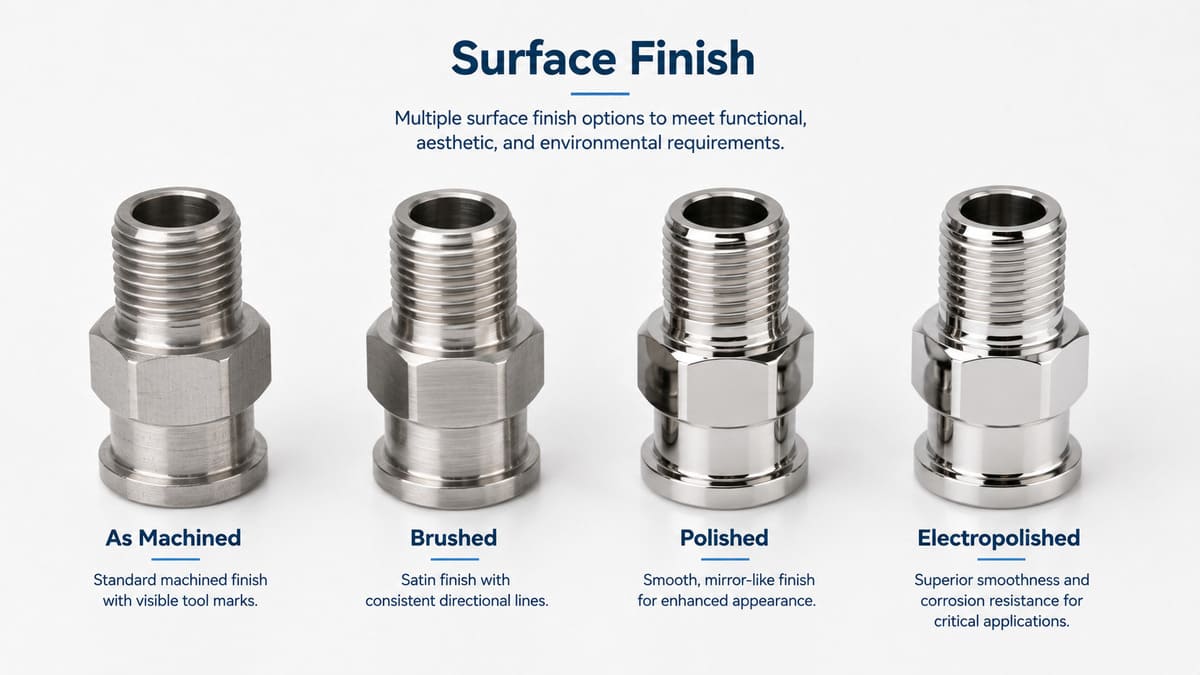
Bead blasting creates a uniform matte or satin appearance and can help reduce visible machining marks on non-critical surfaces.


