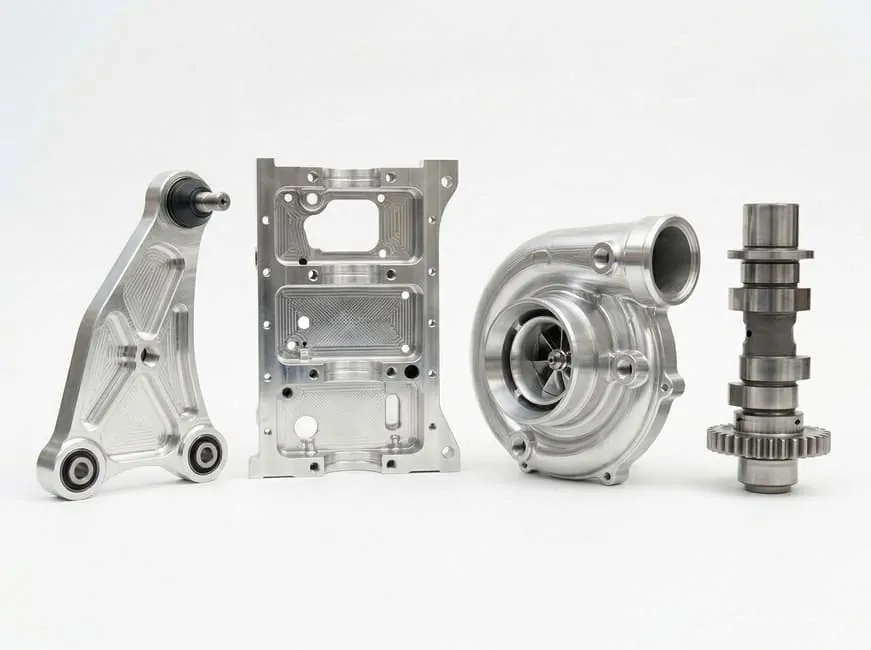
Engine housings,Pistons,Shafts,Gear components
Designed for high performance and durability under extreme operating conditions.
Precision CNC machining and custom manufacturing solutions for high-performance automotive components — from rapid prototyping to batch production.
We provide reliable, scalable manufacturing solutions tailored to automotive industry requirements, ensuring consistent quality and cost efficiency.
Tolerance Capability: Up to ±0.01 mm for precision automotive parts
Surface Roughness: As low as Ra 0.8 μm (depending on process)
Minimum Feature Size: Down to 0.3 mm
Lead Time: As fast as 3–7 days for prototyping
Production Volume: From 1 piece to mid- and high-volume production
Material Support: Aluminum, steel, stainless steel, engineering plastics
Surface Finishing: Anodizing, powder coating, painting, plating, sandblasting
Inspection Capability: CMM inspection and full dimensional reports
We help automotive manufacturers achieve high consistency, cost control, and production reliability across every stage of manufacturing.
Maintaining competitive pricing while ensuring precision is one of the biggest challenges in automotive manufacturing. Inefficient machining strategies, material waste, or excessive secondary operations can significantly increase unit costs.
Optimizing process selection and production workflow is essential to reduce overall manufacturing cost.
Automotive projects often involve hundreds or thousands of parts. Ensuring each component meets the same quality standard requires strict process control and repeatable manufacturing systems.
Even minor deviations can lead to assembly issues or performance inconsistencies.
Critical automotive parts such as engine components, transmission elements, and connectors require high dimensional accuracy to ensure proper fit and functionality.
Achieving tight tolerances consistently across batches is technically demanding and requires advanced machining capability.
CNC Machining
3D Printing (Rapid Prototyping)
Sheet Metal Fabrication
Micro Machining
| Requirement | Recommended Process |
| High precision functional parts | CNC Machining |
| Complex geometries | 5-Axis CNC |
| Thin-wall structures | Sheet Metal |
| Fast prototyping | 3D Printing |
Lightweight | Good Strength | Corrosion Resistance
Aluminum is widely used in automotive manufacturing due to its excellent strength-to-weight ratio and machinability. It is ideal for reducing overall vehicle weight while maintaining structural performance.
Lightweight material for improved fuel efficiency
Good corrosion resistance for outdoor environments
Excellent machinability for precision components
Suitable for anodizing and surface treatments
Typical applications: housings, brackets, structural components
High Strength | Durability | Cost-Effective
Steel is one of the most commonly used materials in automotive applications due to its high strength and reliability under mechanical stress.
High load-bearing capacity for structural parts
Excellent wear resistance for mechanical components
Cost-effective for large-volume production
Suitable for heat treatment processes
Typical applications: shafts, gears, mechanical parts
Corrosion Resistance | Strength | Stability
Stainless steel offers excellent corrosion resistance and mechanical performance, making it suitable for harsh environments and long-term use.
Strong resistance to corrosion and oxidation
Good mechanical strength and durability
Suitable for high-temperature environments
Compatible with passivation and polishing
Typical applications: exhaust components, connectors, fittings
Lightweight | Cost-Effective | Design Flexibility
Engineering plastics are widely used for non-structural automotive components where weight reduction and cost efficiency are important.
Lightweight alternative to metal components
Good impact resistance and toughness
Suitable for complex shapes and custom designs
Cost-effective for medium to high-volume production
Typical applications: interior components, covers, housings
High Strength-to-Weight Ratio | Corrosion Resistance | Performance
Titanium is used in high-performance automotive applications where strength, weight reduction, and durability are critical.
Exceptional strength with low density
Excellent corrosion resistance in harsh environments
Suitable for high-temperature and high-stress applications
Ideal for precision machining of complex parts
Typical applications: performance components, racing parts, high-end automotive systems
Electrical Conductivity | Corrosion Resistance | Machinability
Brass and copper alloys are commonly used in automotive electrical and fluid systems due to their excellent conductivity and corrosion resistance.
High electrical and thermal conductivity
Good corrosion resistance
Easy to machine for precision components
Suitable for connectors and fittings
Typical applications: electrical connectors, terminals, fluid system components
| Material | Strength | Weight | Cost | Corrosion Resistance | Best For |
| Aluminum | Medium–High | Lightweight | Medium | Good | Lightweight structural parts |
| Steel | High | Heavy | Excellent | Moderate | Load-bearing components |
| Stainless Steel | High | Heavy | Excellent | Excellent | Harsh environments |
| Plastics | Low–Medium | Very Light | Low | Good | Interior & non-structural parts |
| Titanium | Very High | Lightweight | Very High | Excellent | High-performance applications |
Choose aluminum for lightweight and corrosion resistance
Choose steel for strength and cost efficiency
Choose stainless steel for harsh environments
Choose plastics for lightweight and low-cost parts
Choose titanium for high-performance and extreme conditions

Corrosion Resistance | Wear Resistance | Surface Hardness
Anodizing is widely used for aluminum automotive parts to enhance corrosion resistance and surface durability while maintaining a lightweight structure. Both Type II and Type III anodizing are commonly applied.
Improved corrosion resistance for outdoor environments
Increased surface hardness and wear resistance
Maintains lightweight characteristics of aluminum
Supports color customization and aesthetic finishes
Typical applications: aluminum housings, brackets, structural components

Durability | Impact Resistance | Cost-Effective
Powder coating provides a thick, durable protective layer that resists chipping, scratching, and corrosion. It is ideal for automotive parts exposed to harsh environments.
Strong adhesion and uniform coating thickness
Excellent resistance to impact and abrasion
Cost-effective for medium to high-volume production
Wide range of colors and finishes available
Typical applications: frames, brackets, exterior components
Aesthetic Finish | Custom Colors | Surface Protection
Painting is commonly used for visual components requiring specific colors and finishes, while also offering basic protection against environmental factors.
Flexible color and finish options
Suitable for branding and visual parts
Provides basic corrosion protection
Compatible with complex geometries
Typical applications: visible automotive parts, panels, covers
Corrosion Protection | Conductivity | Wear Resistance
Plating enhances surface properties such as corrosion resistance, electrical conductivity, and wear performance. Different plating types are selected based on application needs.
Excellent corrosion resistance for metal components
Improved electrical conductivity for connectors
Enhanced wear resistance and surface durability
Suitable for high-precision functional parts
Typical applications: fasteners, connectors, functional components
Surface Preparation | Uniform Texture | Matte Finish
Sandblasting is used to create a consistent surface texture and prepare parts for further finishing processes such as coating or painting.
Removes surface impurities and oxidation
Creates uniform matte or textured finish
Improves coating adhesion
Suitable for pre-treatment processes
Typical applications: pre-coating treatment, aesthetic surface finishing
Smooth Finish | Reduced Roughness | Enhanced Appearance
Polishing improves surface smoothness and visual quality, making it suitable for both functional and aesthetic automotive components.
Reduces surface roughness (Ra can be significantly improved)
Enhances visual appearance and surface quality
Improves cleanliness and contact performance
Suitable for precision components
Typical applications: decorative parts, precision components
Ensuring consistent quality and compliance is critical in medical device manufacturing. We implement strict quality control processes and inspection standards to meet the high requirements of precision, reliability, and traceability.
Accuracy | Verification | Compliance
All parts are inspected using advanced measurement equipment to ensure dimensional accuracy and compliance with design requirements.
CMM inspection for complex geometries
High-precision measuring tools (calipers, micrometers, gauges)
Tolerance verification up to ±0.01 mm
Full dimensional inspection reports available
Ensuring every critical dimension is verified before delivery.
Automotive Electronics Housing
Transmission Shaft Component
Automotive Structural Bracket
Process: CNC Machining + Anodizing
Material: Aluminum 6061
A client in the automotive electronics sector required precision housings with tight tolerances and consistent surface quality for sensor integration.
Achieved tolerance up to ±0.01 mm
Improved surface durability and corrosion resistance with anodizing
Reduced machining time by 20% through process optimization
Result: Delivered high-precision housings with consistent quality for batch production
Process: CNC Turning + Grinding
Material: Alloy Steel
A manufacturer required high-strength transmission shafts with tight dimensional control and excellent wear resistance.
Maintained tight tolerance within ±0.01 mm
Enhanced surface finish for improved wear performance
Ensured stable quality across batch production
Result: Achieved reliable performance and long service life in mechanical systems
Process: CNC Machining + Powder Coating
Material: Aluminum 7075
The client needed lightweight yet strong structural brackets for automotive assemblies, with corrosion protection for outdoor use.
Optimized design for weight reduction
Improved surface protection with powder coating
Delivered consistent parts for medium-volume production
Result: Reduced overall component weight while maintaining structural strength
Simply upload your drawings or 3D files and provide basic requirements such as material, quantity, and surface finish. Our engineering team will review and provide a quotation within 12–24 hours.
Tip: Providing clear tolerances and application details helps speed up the quoting process.
We accept STEP, STP, IGES, X_T, and STL files. 2D drawings (PDF/DWG) are also recommended for tolerance and technical requirements.
We utilize advanced CNC equipment, optimized tooling strategies, and precision inspection methods to ensure complex geometries and tight tolerances are achieved consistently.
Yes. We provide design for manufacturability (DFM) feedback to help reduce cost, improve machinability, and minimize production risks before manufacturing begins.
Lead time depends on part complexity and quantity. Prototypes can be delivered in as fast as 3–7 days, while production orders typically range from 1–3 weeks.
We offer a variety of finishes including anodizing, powder coating, polishing, sandblasting, plating, and passivation. Surface treatments improve corrosion resistance, durability, and visual appearance.
Yes. We can provide full dimensional inspection reports, CMM reports, and material certifications upon request. Documentation ensures transparency and traceability for every order.
We implement standardized machining processes, first article inspection (FAI), in-process quality monitoring, and final inspection. This ensures stable quality and repeatability across all production batches.
We offer CNC machining (3-axis, 4-axis, and 5-axis), CNC turning, sheet metal fabrication, and limited 3D printing for prototyping. Processes are selected based on part complexity, tolerance, and production volume.
Yes. We support everything from rapid prototyping (as fast as 3–7 days) to low- and mid-volume production. Our processes are optimized to ensure consistency when scaling from prototype to batch manufacturing.
We support a wide range of automotive-grade materials, including aluminum alloys (6061, 7075), stainless steel (303, 304, 316), alloy steels, brass, and engineering plastics such as PEEK and nylon. Material selection depends on strength, weight, corrosion resistance, and application requirements.
We typically achieve tolerances up to ±0.01 mm depending on part geometry, material, and manufacturing process. For critical components, tighter tolerances can be evaluated based on drawings and technical requirements.