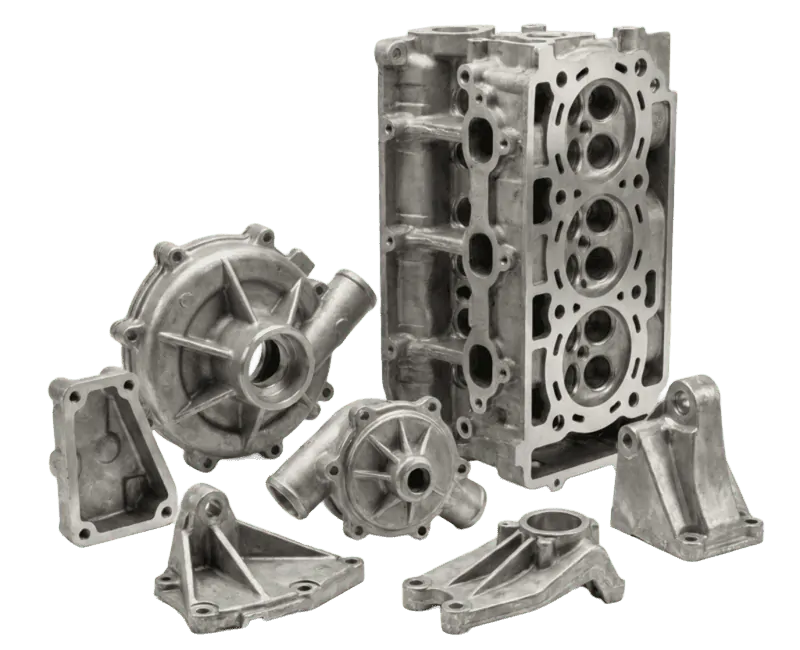
NAITE TECH provides professional aluminum casting services for producing complex, high-strength, and cost-effective aluminum components.
From prototype tooling to low- and high-volume production, we deliver reliable aluminum cast parts with consistent quality, supported by CNC post-machining and surface finishing.
Our aluminum casting solutions are ideal for applications where structural integrity, design complexity, and production efficiency are critical.
NAITE TECH offers end-to-end aluminum casting capabilities designed to support complex geometries, structural requirements, and scalable production.
By combining proven casting processes with CNC post-machining and surface finishing, we deliver aluminum cast parts that meet both performance and dimensional expectations.
We provide multiple aluminum casting processes to match different part designs and production requirements:
Aluminum Die Casting for high-volume, thin-wall components
Low-Pressure Aluminum Die Casting (LPDC) for improved mechanical properties and reduced porosity
Gravity / Permanent Mold Casting for structural and medium-volume parts
Sand Casting for large components and complex internal geometries
Process selection is guided by part geometry, performance requirements, and target production volume.
A wide range of aluminum casting alloys is available to meet strength, weight, and corrosion resistance requirements, including:
A356 / A357
A380 / ADC12
AlSi10Mg
Other aluminum alloys can be specified based on application needs.
Material certifications and traceability are available upon request.
Casting tolerances are determined by the selected process and part geometry.
For critical dimensions, CNC machining is applied after casting to achieve tighter tolerances and functional accuracy required for assembly and performance.
As-cast surface condition
Shot-blasted or sand-blasted surfaces for improved uniformity
Precision-machined surfaces for functional and mating features
Surface quality is optimized based on both functional and cosmetic requirements.
Our aluminum casting services support a wide range of production volumes, including:
Prototype and pilot tooling
Low-volume and bridge production
Medium to high-volume manufacturing
This flexibility allows smooth transition from initial samples to full-scale production.
Tooling: typically 2–6 weeks, depending on casting process and part complexity
Production: 2–4 weeks after tooling approval
Lead times can be optimized through early design review and process planning.
Aluminum casting is a highly efficient manufacturing method for producing complex parts with excellent mechanical performance and cost control.
Key advantages include:
Ability to form complex internal and external geometries
Lower unit cost for medium to high production volumes
Excellent strength-to-weight ratio
Good corrosion resistance and thermal performance
Suitable for structural and functional end-use components
NAITE TECH offers a comprehensive range of aluminum casting processes to support different part geometries, performance requirements, and production volumes.
Our engineering team works closely with customers to select the most suitable casting method, balancing cost, mechanical properties, and dimensional requirements.
| Alloy | Casting Process Compatibility | Key Properties | Typical Applications |
| A356 | Gravity Casting Low-Pressure Die Casting | Good strength-to-weight ratio Excellent ductility Heat-treatable | Automotive structural parts Machine housings Load-bearing components |
| A357 | Gravity Casting Low-Pressure Die Casting | Higher strength than A356 Good fatigue resistance | Structural components High-performance mechanical parts |
| A380 / ADC12 | Die Casting | Excellent castability Good dimensional stability Cost-effective for high volume | Housings & enclosures Brackets Thin-wall die cast parts |
| AlSi10Mg | Gravity Casting Sand Casting (Optional LPDC) | High strength Good corrosion resistance Good thermal properties | Structural components Functional aluminum parts |
| Other Alloys (On Request) | Based on alloy & process | Optimized for specific needs Wear / thermal / corrosion resistance | Custom industrial applications |
Purpose:
Corrosion resistance, wear protection, enhanced surface hardness
Details:
Type II anodizing provides standard corrosion protection and improved surface appearance.
Type III (hard anodizing) creates a thicker and harder oxide layer, offering superior wear resistance for demanding applications.
Typical Applications:
Aerospace components, automotive parts, industrial machinery
Purpose:
Enhanced corrosion resistance, decorative finish, environmental protection
Details:
Powder coating applies a durable polymer layer to aluminum cast parts, offering uniform coverage and strong resistance to chipping, chemicals, and weather exposure.
A wide range of colors and textures is available.
Typical Applications:
Automotive housings, consumer products, outdoor equipment, enclosures
Purpose:
Surface protection, aesthetic appearance, color identification
Details:
Industrial painting provides an economical solution for corrosion protection and cosmetic enhancement.
Suitable for parts requiring specific colors, markings, or branding.
Typical Applications:
Industrial components, equipment housings, structural parts
Purpose:
Surface cleaning, texture uniformity, preparation for secondary finishing
Details:
Blasting removes surface residues and improves surface consistency of aluminum cast parts.
Often used as a preparatory step before anodizing, coating, or painting.
Typical Applications:
Cast housings, structural components, functional industrial parts
Purpose:
Improved surface smoothness, enhanced appearance
Details:
Mechanical polishing reduces surface roughness and enhances visual quality.
Often applied to visible or customer-facing aluminum cast parts.
Typical Applications:
Decorative components, consumer products, visible housings
Purpose:
Removal of sharp edges, improved safety and assembly performance
Details:
Deburring processes eliminate burrs and sharp edges formed during casting or post-machining, ensuring safe handling and proper part fit.
Typical Applications:
All aluminum cast parts requiring assembly or handling
Purpose:
Dimensional accuracy, functional performance, assembly precision
Details:
CNC machining is applied to critical features such as holes, threads, and mating surfaces to achieve tight tolerances not possible through casting alone.
Typical Applications:
Precision assemblies, load-bearing components, functional interfaces
Purpose:
Permanent identification, traceability, branding
Details:
Laser marking provides permanent, high-contrast markings without affecting part integrity.
Ideal for serial numbers, logos, and traceability codes.
Typical Applications:
Industrial components, automotive parts, traceable assemblies
Overview:
Lightweight and strong aluminum cast parts help improve vehicle performance, fuel efficiency, and durability.
Typical Components:
Engine brackets, transmission housings, structural supports, suspension components
Overview:
High-strength, lightweight aluminum castings meet the strict demands of aerospace applications, including fatigue resistance and corrosion protection.
Typical Components:
Aircraft brackets, landing gear components, structural supports, engine mounts
In aluminum casting, quality is not inspected in at the end — it is engineered into every stage of the process. At NAITE TECH, we implement a structured quality control system that aligns casting design, tooling development, molten metal control, and post-processing inspection into one closed-loop workflow. This ensures dimensional stability, metallurgical integrity, and repeatable production performance.
At NAITE TECH, quality is engineered into every stage of aluminum casting — from alloy verification and melt control to final dimensional inspection. We ensure consistent casting integrity, controlled porosity, and reliable dimensional performance for both prototype and production runs.
As-cast tolerances vary by process:
Die Casting: typically ±0.05–±0.15 mm
Gravity Casting: typically ±0.2–±0.5 mm
Sand Casting: typically ±0.5 mm and above
For functional or critical features, secondary CNC machining can achieve tighter tolerances down to ±0.01 mm where required.
As-cast tolerances vary by process:
Melt composition verification and process monitoring
In-process inspection during casting production
Final dimensional verification using calibrated equipment (CMM upon request)
Material traceability and inspection reports available upon request
Compliance with specified tolerances, GD&T requirements, and technical drawings
This structured quality approach ensures dimensional accuracy, mechanical reliability, and repeatable performance across batches.
Safe, Reliable, and Worldwide Delivery for Every Custom Part
Each product is securely packed using industry-grade materials such as EPE foam, bubble wrap, vacuum-sealed bags, and reinforced cartons.
For high-value or heavy metal components, we use custom wooden crates with moisture-proof linings to prevent damage during transit.
We offer multiple shipping options to meet your budget and schedule — from express courier for prototypes to bulk sea freight for mass production.
Our logistics team assists with customs documentation and ensures your order arrives on time, anywhere in the world.
Choosing the right aluminum casting partner directly impacts part performance, cost control, and long-term production stability. At NAITE TECH, we combine casting expertise, machining integration, and structured quality management to deliver reliable, production-ready components — not just raw castings.
Engineering-First Approach
We provide DFM analysis before tooling begins, optimizing gating systems, shrinkage control, and machining allowances. Early engineering involvement reduces defects, improves yield, and prevents costly redesigns.
From die casting to gravity and sand casting, we select the right process based on geometry, volume, and mechanical requirements — ensuring cost-efficiency without compromising structural integrity.
Unlike standalone foundries, we combine casting with precision CNC machining. Critical features can achieve tight tolerances (down to ±0.01 mm when required), eliminating the need for secondary suppliers.
Material verification, melt monitoring, in-process inspection, and final dimensional validation are built into every production run. Full traceability and inspection reports are available upon request.
Whether you need prototypes, low-volume bridge production, or mass manufacturing, our structured process ensures consistent quality across every stage of your product lifecycle.
Casting, machining, surface finishing, and secondary processing are coordinated under one management system — reducing lead times, communication gaps, and overall procurement risk.
NAITE TECH delivers aluminum casting solutions that balance cost, structural performance, and dimensional precision — engineered for real-world industrial applications.