
- Home
- Capabilities
- Solution
- Material
- Industry
- Resources
- Request a Quote
Lightweight, corrosion-resistant, and easy to machine, aluminum is ideal for precision CNC parts that require strength, efficiency, and tight tolerances.
Common Grades:
· 6061 / 6061-T6
· 7075 / 7075-T6
· 2024 · 5052
· 5083 · 6063
· 6082
· ADC12 (A380)
Key Advantages:
· Excellent machinability
· Cost-efficient
· Tight tolerances supported
Typical Lead Time:
~5 business days
Known for its strength and corrosion resistance, stainless steel is widely used for CNC components that must perform reliably in demanding environments.
Common Grades:
·304
· 316L
· 303
· 17-4PH
Key Advantages:
· Corrosion-resistant
· High strength
· Dimensional stability
Typical Lead Time:
~7 business days
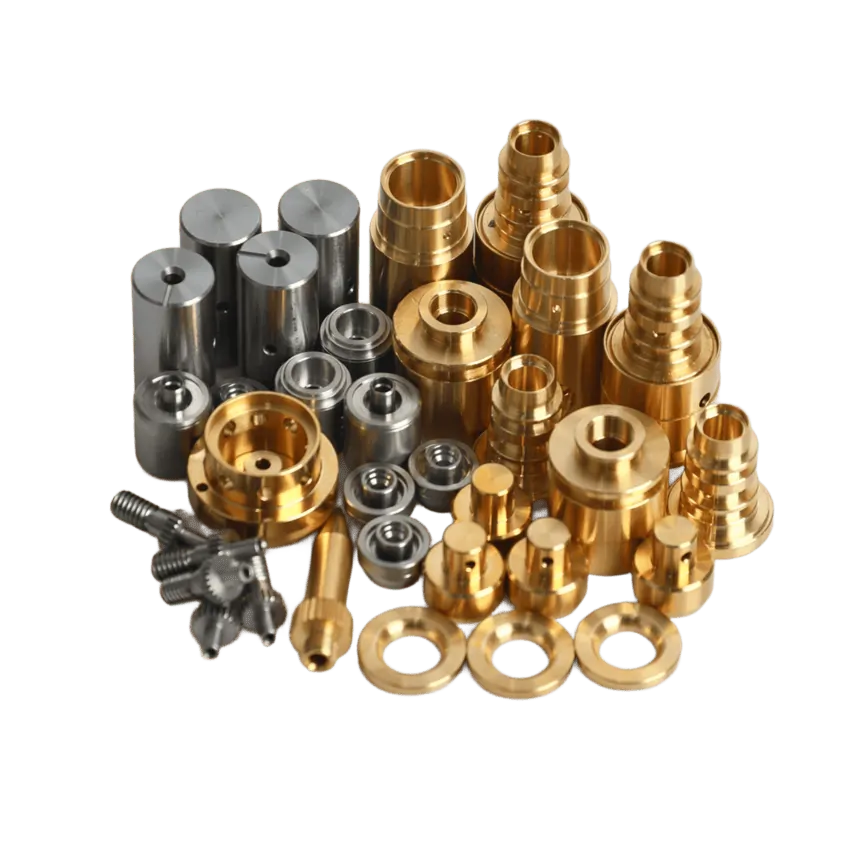
Brass offers excellent machinability and a clean surface finish, making it well suited for precision fittings, connectors, and aesthetic components.
Common Grades:
· C360
· C260
· C280
Key Advantages:
· Superior machinability
· Good conductivity
· Smooth surface finish
Typical Lead Time:
~5 business days
Carbon steel provides high strength and cost efficiency, making it a practical choice for structural and mechanical CNC machined parts.
Common Grades:
· 1018
· 1020
· 1045
· A36
Key Advantages:
· High strength
· Cost-effective
· Widely used
Typical Lead Time:
~7 business days
With outstanding electrical and thermal conductivity, copper is ideal for CNC machining of electrical components and heat-transfer parts.
Common Grades:
· C110
· C101
· C102
Key Advantages:
· Excellent conductivity
· Thermal efficiency
· High purity options
Typical Lead Time:
~7 business days
Bronze combines wear resistance with low friction, making it a preferred material for bearings, bushings, and moving mechanical components.
Common Grades:
· C932
· C954
· C836
Key Advantages:
· Wear-resistant
· Low friction
· Corrosion-resistant
Typical Lead Time:
~7 business days
Iron offers high rigidity and vibration damping, commonly used for heavy-duty industrial components and structural CNC applications.
Common Grades:
· Cast Iron
· Ductile Iron
Key Advantages:
· High rigidity
· Vibration damping
· Suitable for heavy parts
Typical Lead Time:
~7–10 business days
Steel is a versatile CNC machining material that delivers strength, durability, and flexibility across a wide range of industrial applications.
Common Grades:
· 4140
· 4130
· Mild Steel
· Tool Steel
Key Advantages:
· High strength
· Versatile use
· Reliable performance
Typical Lead Time:
~7 business days
Extremely lightweight and highly machinable, magnesium alloys are ideal for CNC parts where weight reduction is a critical requirement.
Common Grades:
· AZ31
· AZ91
Key Advantages:
· Ultra-lightweight
· Excellent machinability
· High strength-to-weight ratio
Typical Lead Time:
~7 business days
Titanium alloys deliver exceptional strength-to-weight performance and corrosion resistance for high-demand, precision CNC applications.
Common Grades:
· Ti-6Al-4V (Grade 5)
· Grade 2
Key Advantages:
· High strength-to-weight
· Corrosion-resistant
· Aerospace-grade performance
Typical Lead Time:
~10 business days
ABS is a versatile thermoplastic with excellent impact resistance and dimensional stability, suitable for functional prototypes and industrial components.
Common Grades:
· Standard ABS
· ABS-M30
· ABS+
Key Advantages:
· Impact-resistant
· Good machinability
· Cost-efficient
Typical Lead Time:
~5 business days
PMMA offers high optical clarity, excellent surface finish, and UV resistance, ideal for transparent parts and display applications.
Common Grades:
· Cast PMMA
· Extruded PMMA
Key Advantages:
· Transparent
· Scratch-resistant
· UV-stable
Typical Lead Time:
~5 business days
PC is a strong, transparent engineering plastic with high impact resistance and heat resistance, ideal for durable functional prototypes.
Common Grades:
· Standard PC
· PC-ABS blend
Key Advantages:
· High strength
· Transparent
· Heat-resistant
Typical Lead Time:
~5 business days
PE is lightweight, chemically resistant, and easy to machine, suitable for containers, insulation parts, and general prototypes.
Common Grades:
· HDPE
· LDPE
· UHMWPE
Key Advantages:
· Chemical-resistant
· Lightweight
· Easy to machine
Typical Lead Time:
~5 business days
Nylon is a strong, flexible engineering plastic with excellent wear resistance, ideal for functional parts like gears, bushings, and mechanical components.
Common Grades:
· PA6
· PA66
· Glass-filled PA
Key Advantages:
· Wear-resistant
· Strong
· Low friction
Typical Lead Time:
~5 business days
PEEK is a high-performance polymer with excellent thermal stability, chemical resistance, and mechanical strength for demanding applications.
Common Grades:
· Unfilled PEEK
· Carbon-filled PEEK
· Glass-filled PEEK
Key Advantages:
· High-temperature resistant
· Chemically resistant
· High strength
Typical Lead Time:
~7 business days
PTFE provides exceptional chemical resistance, low friction, and non-stick properties, ideal for seals, gaskets, and sliding components.
Common Grades:
· Virgin PTFE
· Filled PTFE
Key Advantages:
· Non-stick
· Chemically resistant
· Low friction
Typical Lead Time:
~5 business days
PET is a strong, dimensionally stable plastic with good chemical resistance, commonly used for structural parts and containers.
Common Grades:
· Standard PET
· PETG
Key Advantages:
· Strong
· Chemically resistant
· Dimensionally stable
Typical Lead Time:
~5 business days
PP is a lightweight, chemically resistant plastic suitable for functional parts, packaging prototypes, and fluid handling components.
Common Grades:
· Homopolymer PP
· Copolymer PP
Key Advantages:
· Lightweight
· Chemical-resistant
· Easy to machine
Typical Lead Time:
~5 business days
PPS is a high-performance engineering plastic with excellent chemical and heat resistance, ideal for industrial and electronic applications.
Common Grades:
· Standard PPS
· Glass-filled PPS
Key Advantages:
· Heat-resistant
· Chemically resistant
· High dimensional stability
Typical Lead Time:
~7 business days
PVC is a cost-effective plastic with good chemical resistance and electrical insulation properties, used for enclosures, tubing, and protective components.
Common Grades:
· Rigid PVC
· Flexible PVC
Key Advantages:
· Chemical-resistant
· Electrically insulating
· Cost-effective
Typical Lead Time:
~5 business days
PEI is a high-performance thermoplastic with excellent mechanical strength, thermal resistance, and dimensional stability for engineering applications.
Common Grades:
· Standard PEI
· Glass-filled PEI
Key Advantages:
· High strength
· Heat-resistant
· Dimensionally stable
Typical Lead Time:
~7 business days
FR4 and G-10 are fiberglass-reinforced epoxy laminates, ideal for PCB substrates and structural components requiring electrical insulation.
Common Grades:
· FR4
· G-10 standard
Key Advantages:
· Electrically insulating
· High rigidity
· Heat-resistant
Typical Lead Time:
~7 business days
Carbon fiber reinforced plastics offer exceptional stiffness-to-weight ratio and high strength for aerospace, automotive, and industrial prototypes.
Common Grades:
· CF-PA
· CF-PET
· CF-PPS
Key Advantages:
· Lightweight
· High strength
· Stiffness
Typical Lead Time:
~7 business days
Bakelite is a thermosetting plastic with excellent electrical insulation, dimensional stability, and heat resistance, suitable for electrical and mechanical parts.
Common Grades:
· Standard Bakelite
· Filled Bakelite
Key Advantages:
· Heat-resistant
· Electrically insulating
· Dimensionally stable
Typical Lead Time:
~7 business days
PPSU is a high-performance plastic with excellent impact resistance, thermal stability, and chemical resistance, ideal for medical and industrial applications.
Common Grades:
· Standard PPSU
· Glass-filled PPSU
Key Advantages:
· Impact-resistant
· Heat-resistant
· Chemically resistant
Typical Lead Time:
~7 business days
PU is a flexible, durable plastic suitable for prototyping parts that require elasticity, abrasion resistance, or cushioning.
Common Grades:
· Rigid PU
· Flexible PU
· Cast PU
Key Advantages:
· Elastic
· Wear-resistant
· Durable
Typical Lead Time:
~5 business days
HIPS is a lightweight, cost-effective plastic with good impact resistance and machinability, ideal for prototypes and consumer products.
Common Grades:
· Standard HIPS
· ABS-HIPS blends
Key Advantages:
· Impact-resistant
· Cost-efficient
· Easy to machine
Typical Lead Time:
~5 business days
Transmission and drive shafts
Engine bushings and spacers
Threaded fasteners and fittings
Sensor housings and connectors
Why CNC Turning
High concentricity and repeatability for rotating parts
Stable dimensional control for batch production
Cost-effective for aluminum, steel, and brass
components
Procurement Advantages
Flexible order quantities
Secondary operations (drilling, tapping, surface finishing) supported
Hydraulic fittings
Actuator components
Structural fasteners
Precision sleeves
Why CNC Turning
Tight tolerances and excellent roundness
Consistent surface finish for sealing applications
Suitable for aluminum and stainless steel alloys
Quality & Compliance
First Article Inspection (FAI)
Full dimensional inspection reports available
Medical connectors
Instrument shafts
Precision sleeves
Threaded fittings
Why CNC Turning
High accuracy for functional assemblies
Smooth surface finishes to meet hygiene requirements
Compatible with stainless steel and engineering plastics
Quality Support
Material traceability
Cosmetic and dimensional inspections upon request
Drive shafts and rollers
Bushings and couplings
Sleeves and collars
Why CNC Turning
Robust machining for load-bearing components
Stable repeatability for long-term supply programs
Suitable for custom geometries and mid-volume production
Value for Buyers
Engineering support for manufacturability (DFM)
Consistent quality for repeat orders
Why CNC Turning
High precision for tight assemblies
Excellent surface quality for conductive materials
Ideal for brass, copper, and aluminum alloys
Added Capabilities
Surface finishing (anodizing, electroplating)
Deburring and cosmetic inspection
Precision shafts and spacers
Coupling components
Motion control parts
Why CNC Turning
Tight tolerances for mechanical alignment
Excellent concentricity and repeatability
Suitable for both prototyping and small-batch production
Engineering Benefits
Design feedback to reduce deformation on slender parts
Multi-material compatibility


