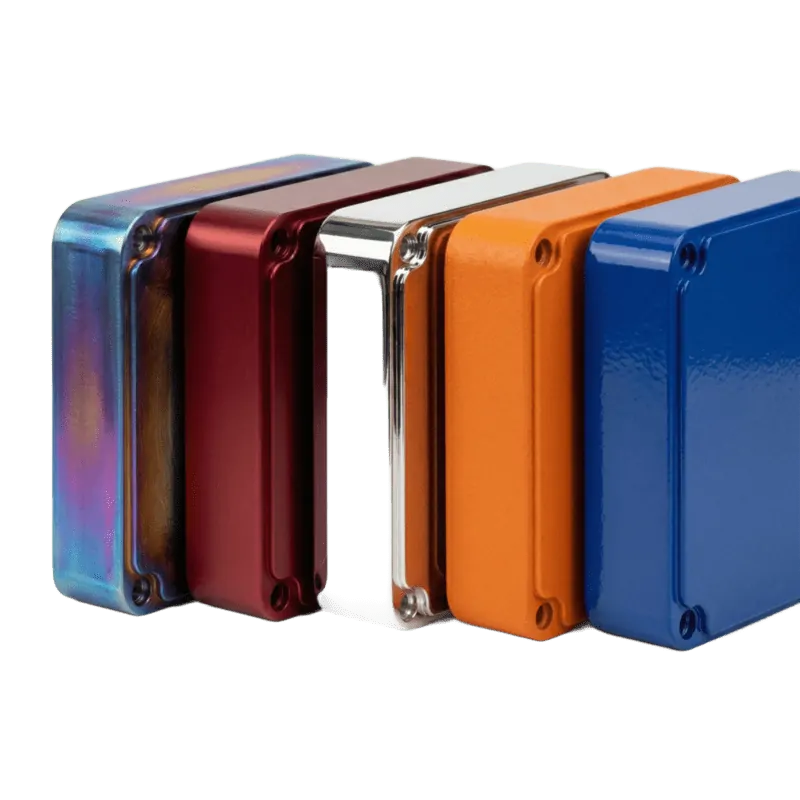
— CNC, 3D Printed & Sheet Metal& Cast Parts
NAITE TECH provides professional surface finishing services designed to transform precision-machined, 3D-printed, sheet-metal fabricated, and cast parts into production-ready components. From cosmetic enhancement to functional protection, our finishing solutions improve durability, corrosion resistance, wear performance, and visual quality to meet the standards of demanding industrial applications.
By integrating surface finishing directly with our CNC machining, sheet metal fabrication, 3D printing, and casting operations, we ensure consistent quality, shorter lead times, and full engineering control across every stage of production — from raw part to final product.
Surface finishing is not a decorative step — it is a critical engineering process that determines how a part performs, lasts, and is perceived in the final product.
In real-world manufacturing, surface treatment directly affects:
Corrosion resistance in outdoor, marine, and chemical environments
Wear and friction for moving and mating components
Electrical and thermal behavior in electronic and aerospace systems
Cleanability and biocompatibility for medical and laboratory equipment
Brand appearance and visual consistency for customer-facing products
A poorly finished part may meet dimensional requirements but fail in service, assembly, or market acceptance. At NAITE TECH, surface finishing is engineered as part of the manufacturing process, not treated as an afterthought.
NAITE TECH provides integrated surface finishing services for all major manufacturing processes, including CNC machining, 3D printing, metal casting, and sheet metal fabrication. This unified workflow allows us to deliver consistent surface quality, reliable coating performance, and fast turnaround from prototype to mass production.
We provide finishing solutions for:
NAITE TECH offers a full range of industrial surface finishing processes designed to enhance the appearance, durability, and functional performance of CNC machined, 3D printed, cast, and sheet metal parts. Each process is selected based on material type, application environment, and end-use requirements to ensure long-term reliability and production-grade quality.
Our finishing technologies are organized into four functional categories:
The table below shows how common manufacturing materials are matched with suitable finishing processes and the benefits they provide:
| Material | Compatible Finishes | Performance Benefits | Typical Applications |
| Aluminum (6061, 7075, Cast Al) | Anodizing, powder coating, polishing, bead blasting | Corrosion resistance, surface hardness, color coding, improved wear | CNC housings, aerospace parts, consumer enclosures |
| Steel & Carbon Steel | ★★★★★ (excellent for complex geometries) | ★★★☆☆ (limited by tool access) | ★★☆☆☆ (geometry constrained by forging dies) |
| Dimensional Accuracy | Zinc plating, black oxide, powder coating, painting | Rust protection, wear resistance, cost-effective protection | Sheet metal frames, brackets, machinery parts |
| Stainless Steel | Electropolishing, brushing, passivation | Cleanability, corrosion resistance, smooth surface | Medical devices, food equipment, electronics |
| Titanium | Anodizing, polishing, passivation | Color identification, corrosion resistance, premium appearance | Aerospace, medical implants, precision components |
| Cast Alloys | Sandblasting, coating, plating | Surface uniformity, environmental protection | Structural cast parts, automotive components |
| Engineering Plastics (ABS, Nylon, PC) | Painting, dyeing, vapor smoothing, coating | Appearance, moisture resistance, improved surface finish | 3D printed housings, functional prototypes |
| Sheet Metal (Al, Steel, SS) | Powder coating, plating, anodizing, painting | Electrical insulation, corrosion protection, visual consistency | Electrical enclosures, cabinets, industrial panels |
By engineering the surface finish together with the base material and manufacturing process, NAITE TECH ensures that every component meets its mechanical, environmental, and visual performance targets.
We measure coating and anodizing thickness to ensure:
Consistent corrosion and wear protection
Proper electrical and thermal performance
No interference with critical tolerances and assembly fits
This is especially critical for aerospace, electronics, and precision mechanical parts.
All applied coatings are evaluated for:
Adhesion strength
Resistance to peeling, cracking, and delamination
Long-term stability under thermal and mechanical stress
This guarantees that finishes remain intact throughout the product life cycle.
For parts used in harsh environments, we provide:
Salt spray testing
Humidity and chemical exposure evaluation
Coating performance verification
These tests simulate real operating conditions to confirm long-term reliability.
Our surface finishing services support compliance with:
RoHS & REACH for electronics and consumer products
Medical-grade cleanliness and corrosion resistance
Aerospace and industrial durability standards
By integrating inspection, testing, and documentation into every finishing project, NAITE TECH delivers production-ready surface quality that meets global industrial requirements.
High-performance surface finishes are used to improve corrosion resistance, fatigue life, and environmental durability. Anodizing, conversion coatings, and wear-resistant treatments are applied to aluminum and titanium parts for long-term reliability in extreme operating conditions.
Typical parts: structural brackets, housings, mounting plates, aerospace machined components
Surface treatments focus on cleanability, corrosion resistance, and biocompatibility. Electropolishing, passivation, and precision coatings ensure hygienic surfaces and long-term stability for medical and laboratory components.
Typical parts: device enclosures, surgical tool housings, fluid handling components, precision mechanical parts
Surface finishing is used to control electrical insulation, EMI shielding, and heat dissipation. Anodizing, conductive coatings, and protective painting help maintain performance and protect sensitive electronic assemblies.
Typical parts: electronic housings, frames, heat sinks, precision brackets
Automotive components require durable, corrosion-resistant, and visually consistent finishes. Powder coating, electroplating, and anodizing are applied to CNC, cast, and sheet metal parts to meet both functional and aesthetic requirements in volume production.
Typical parts: mounting brackets, structural frames, enclosures, trim components
Heavy-duty machinery demands surface finishes that resist abrasion, chemicals, and long-term exposure. Protective coatings and surface treatments extend service life and reduce maintenance for frames, mounts, and motion system components.
Typical parts: machine frames, covers, mounting plates, motion system parts
Surface finishing defines the look, feel, and brand quality of consumer-facing products. Polishing, painting, anodizing, and texture control are used to create premium visual appearance and durable surfaces for housings, panels, and electronic enclosures.
Typical parts: product housings, control panels, decorative aluminum parts, plastic enclosures
We evaluate the base material, manufacturing process (CNC, 3D printing, casting, or sheet metal), and the operating environment of the part. This ensures the surface finish is selected based on real functional requirements, not just appearance.
All surface treatments are selected based on material properties, functional requirements, and operating conditions. This engineering-first approach ensures optimal performance without unnecessary cost or over-processing.
Each finished part is inspected for coating thickness, adhesion, surface quality, and visual consistency. Our finishing processes are controlled to meet both prototype validation and mass production requirements.
We provide surface finishing for aluminum, steel, stainless steel, titanium, cast alloys, and engineering plastics across CNC, 3D printing, casting, and sheet metal processes without compromising performance.
Our finishing systems support rapid prototyping, low-volume production, and full-scale manufacturing. The finish approved on early samples can be reliably repeated in volume production.