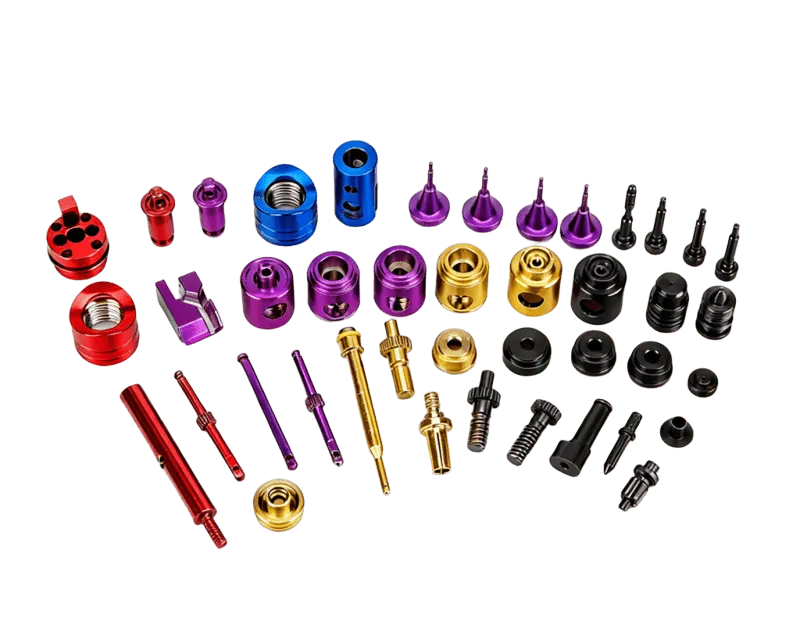
Swiss CNC Machining Services

Precision Turning for Small, Complex Parts

NAITE TECH offers Swiss CNC machining services for precision components requiring extreme accuracy, consistency, and fine surface finishes.

Using advanced CITIZEN, STAR, and TSUGAMI Swiss-type lathes, we specialize in producing small, slender, high-tolerance parts for industries such as medical, electronics, aerospace, and instrumentation.
All your designs are secure and confidential

What Is Swiss CNC Machining?

Swiss CNC machining, also known as Swiss screw machining or sliding-headstock turning, is a precision process where the material bar stock moves through a guide bushing while the cutting tool remains stationary.
This design minimizes vibration, allowing the production of extremely slender, precise, and complex parts.


In Swiss machining, the bar stock is clamped and guided close to the cutting tool, ensuring consistent rigidity and minimal deflection.
Each machine can perform multiple operations—turning, milling, drilling, threading, and slotting—all in a single setup.

Swiss CNC Machining Capabilities at NAITE TECH

NAITE TECH provides advanced Swiss CNC machining capabilities for small, complex, and tight-tolerance components. Our Swiss-type lathes with guide bushing support are optimized for long, slender parts, ensuring exceptional dimensional accuracy, surface quality, and production consistency.
 Capability Specification
Process Capabilities Swiss turning, live-tool milling, drilling, tapping, threading, knurling, cross-working, back-working
Feature Capability Micro holes, cross-holes, slots, internal features, miniature threads
Typical Part Types Long shafts, small-diameter parts, thin-wall geometries, complex micro components
Turning Diameter Range Approx. Ø 1–32 mm
Machining Length Typically 50–300 mm
Tolerance Capability ±0.01 mm (standard), up to ±0.002–0.005 mm depending on design
Surface Finish Up to Ra 0.4 μm (as machined)
Material Scope Metals & engineering plastics (see materials section)
Production Volume Prototype, low-volume, and repeat production with bar feeding

Tolerance Capability for Swiss CNC Machining

Swiss CNC machining is specifically designed for producing small, long, and complex parts with tight dimensional tolerances. By supporting the workpiece with a guide bushing close to the cutting zone, Swiss-type lathes significantly reduce deflection and vibration, enabling superior accuracy and consistency compared to conventional CNC turning.

At NAITE TECH, tolerance capability is controlled through optimized machining strategies, stable tooling systems, and in-process inspection to ensure repeatable precision from prototype to production.
Tolerance Item Standard Tolerance Achievable Tolerance Description
Outer Diameter (OD) ±0.005mm Up to ±0.002 mm For precision turned shafts & pins
Inner Diameter (ID) ±0.01–0.015 mm Up to ±0.003–0.005 mm Depends on bore depth, tool access, and material
Part Length ±0.01mm Up to ±0.005 mm Controlled via guide bushing support and automatic length stop
Thread Accuracy ISO Metric / UNC / UNF Class 2–3 / ±0.005 mm Verified using thread gauges or optical measurement
Surface Finish Ra ≤ 0.8 μm Up to Ra 0.2–0.4 μm Achieved with optimized cutting parameters and tooling
Positional Accuracy ±0.01 mm Up to ±0.005 mm Maintained through live tooling synchronization
Achievable tolerances depend on part geometry, material selection, and machining strategy. Our engineers review each design to ensure optimal manufacturability and cost efficiency.

Precision Control & Engineering Support


Factors Affecting Swiss CNC Machining Tolerances

 
Achievable tolerances in Swiss CNC machining are influenced by multiple technical factors.
At NAITE TECH, these are evaluated during engineering review to ensure stable and repeatable results.

Material Properties – Hardness, thermal expansion, and machinability affect dimensional stability.

Part Geometry – Length-to-diameter ratio, wall thickness, and feature density influence rigidity during machining.

Tooling & Machining Strategy – Tool selection, cutting parameters, and operation sequencing impact accuracy.

Inspection & Process Control – In-process measurement ensures consistency across production batches.


Tolerance & GD&T Support

 
We support standard GD&T practices and manufacture parts strictly according to customer drawings and specifications.
For critical or unclear tolerances, our engineers provide DFM feedback to optimize designs for Swiss CNC machining.


When to Specify Tight Tolerances for Swiss CNC Machining

 
Swiss CNC machining is particularly suitable when your part requires:

Small diameters with tight concentricity or roundness

Long, slender geometries prone to deflection

Complex features completed in a single setup

High repeatability for medium to high production volumes

Our engineering team reviews tolerance requirements to balance functional performance and manufacturing cost.


Ready to Control Tight Tolerances with Confidence?

Upload your drawings for an engineering review and tolerance feasibility analysis.
Our team helps validate designs, optimize machining strategies, and deliver precision Swiss CNC parts reliably.
 
✔ Tolerances down to ±0.002 mm
✔ Engineering review before production
✔ Prototype to high-volume Swiss machining

Advantages of Swiss CNC Machining

Swiss-type CNC machining at NAITE TECH is engineered for complex, small-scale, and high-precision components where conventional turning falls short. Our Swiss lathes integrate multi-axis tooling, guide-bushing support, and continuous bar feeding, delivering unmatched accuracy, consistency, and productivity for demanding industries such as medical, aerospace, and electronics manufacturing.


Ultra-Tight Micro Precision


Swiss turning allows us to maintain ±0.005 mm tolerances with exceptional concentricity—ideal for micro components, miniature shafts, connectors, and functional parts requiring absolute accuracy.


Stable Machining for Long & Slender Parts

 
With a guide-bushing supported design, Swiss lathes greatly reduce vibration, ensuring straightness and stability when machining thin-wall or high length-to-diameter ratio components.


Multiple Operations in a Single Setup

 
Our Swiss CNC machines integrate turning, milling, drilling, slotting, threading, tapping, and back-working in one continuous cycle. This reduces setups, eliminates cumulative errors, and guarantees consistent quality.


High Efficiency for Volume Production

 
Swiss turning supports continuous bar feeding, fast cycle times, and long unattended machining—making it ideal for medium to high-volume production with competitive per-unit cost.


Superior Surface Quality

 
The rigidity and fine control of Swiss machines produce exceptionally smooth surfaces, reducing secondary finishing and meeting cosmetic-critical requirements for medical, aerospace, and electronics applications.


Versatile Multi-Material Compatibility

 
We process stainless steel, carbon steel, brass, copper, aluminum, titanium, and engineering plastics such as POM, PEEK, PTFE, ensuring flexibility for various functional performance requirements.


Perfect for Complex Micro Features

 
SLive-tooling and synchronized spindles allow intricate cross-features, miniature slots, deep micro-holes, and precise threads that conventional lathes cannot achieve as efficiently.


Designed for Mission-Critical Industries

 
Swiss machining at NAITE TECH supports sectors where reliability is non-negotiable:
Medical, aerospace, automotive sensors, robotics, telecom connectors, instrumentation, and electronics.

Swiss Machining vs. Conventional Machining

How does Swiss machining compare to conventional CNC turning, milling, or multi-axis machining?
Here’s how it outperforms other processes when precision, small size, and efficiency matter most.
 Project Swiss CNC Machining CNC Turning CNC Milling 5-Axis CNC  
Best For Small, slender precision parts Medium-size rotational parts Flat or prismatic parts Complex 3D surfaces
Tolerance ±0.002–0.005mm ±0.01mm ±0.02mm ±0.005mm
L/D Ratio Capability Excellent (up to 20:1) Limited (up to 5:1) N/A Moderate
Surface Finish Ra 0.2–0.4μm Ra 0.8μm Ra 1.6μm Ra 0.4μm
Setup Times Single setup Multiple setups Multiple setups Single setup
Automation Fully automatic bar-fed Semi-automatic Manual Semi-automatic
Cycle Time Fastest continuous run Moderate Longer Moderate
Cost Efficiency for Small Parts ★★★★★ ★★★ ★★ ★★★★
Ideal Industries Medical, electronics, watchmaking Automotive, general machining Industrial housings Aerospace, tooling
Swiss CNC machining is unmatched for micro-scale, high-precision, long slender parts - providing the perfect blend of accuracy, automation, and cost-efficiency.

Swiss CNC Machining Industries & Applications

Swiss CNC machining excels in the production of small, complex, and high-precision parts. With outstanding accuracy, repeatability, and surface quality, it is the preferred solution for industries requiring tight tolerances and reliable mass production.
Medical Devices Typical Swiss CNC Machined Parts

Medical Devices


Typical Swiss CNC Machined Parts
Surgical screws and bone pins
Orthopedic fasteners and connectors
Catheter components and micro shafts
Precision medical fittings


Why Swiss CNC Machining
Exceptional precision for small-diameter parts
Superior surface finish for medical applications
Excellent concentricity and dimensional stability
Ideal for stainless steel and titanium


Procurement Advantages
Stable quality for regulated industries
Prototype to small-batch production support
Secondary operations and surface finishing available
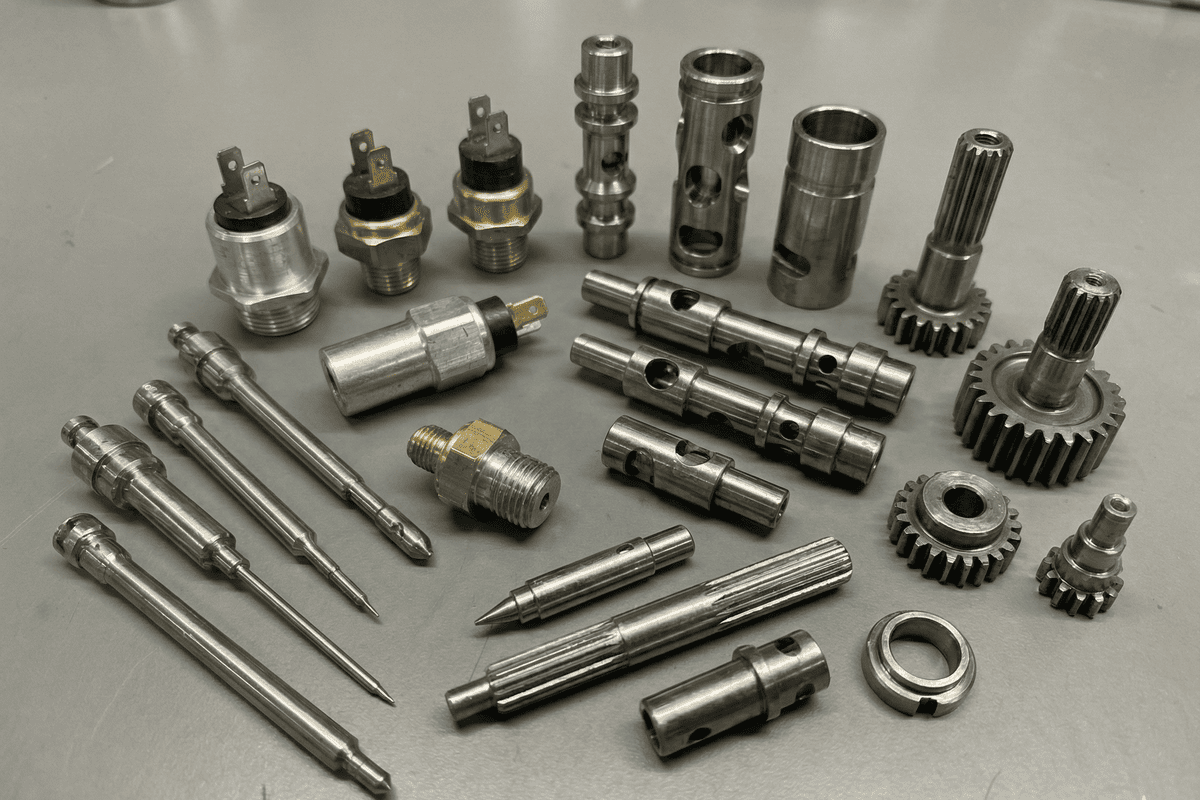
Automotive Typical Swiss CNC Machined Parts

Automotive


Typical Swiss CNC Machined Parts
Fuel system pins and shafts
Sensor housings and connectors
Valve components and precision sleeves
Small transmission and drivetrain parts


Why Swiss CNC Machining
High repeatability for mass-produced precision parts
Tight tolerance control for critical components
Efficient machining of long, slender geometries
Cost-effective for high-volume production


Procurement Advantages
Scalable production capacity
Consistent batch-to-batch quality
Integrated machining and secondary processes
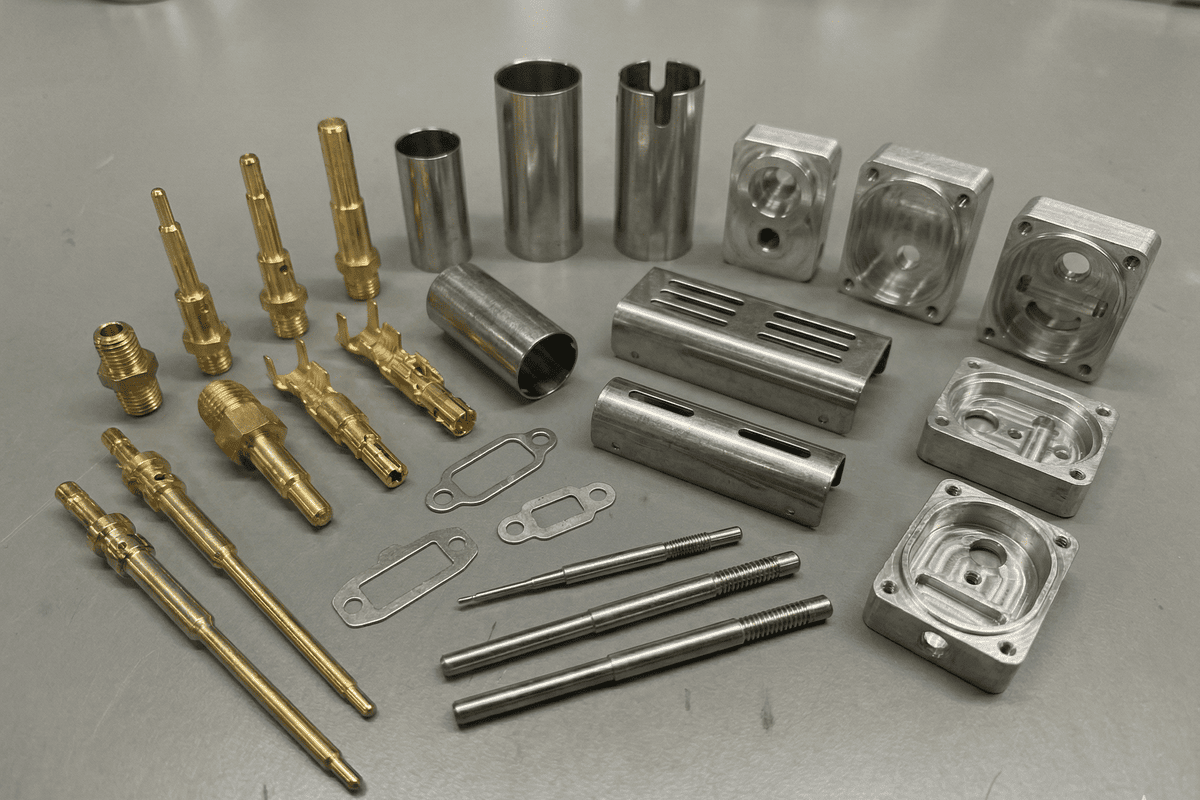
Electronics Typical Swiss CNC Machined Parts

Electronics


Typical Swiss CNC Machined Parts
Connector pins and terminals
Shielding components and sleeves
Precision spacers and micro shafts
Sensor and device housings


Why Swiss CNC Machining
High precision for micro-scale components
Excellent dimensional consistency for assemblies
Smooth surface finish for electrical performance

Suitable for brass, copper, and aluminum


Procurement Advantages
Fast turnaround for high-mix electronics parts
Flexible order quantities
Secondary operations including drilling and tapping

Watchmaking & Instruments Typical Swiss CNC Machined Parts

Watchmaking & Instruments


Typical Swiss CNC Machined Parts
Watch case components and crowns
Precision shafts and gear pins
Instrument connectors and adjustment screws
Micro mechanical components


Why Swiss CNC Machining
Ultra-high precision for micro mechanical parts
Superior surface finish for aesthetic components
Stable machining of very small tolerances
Ideal for complex, small-diameter designs


Procurement Advantages
High consistency for premium products
Support for low-volume and custom designs
Fine surface finishing options available
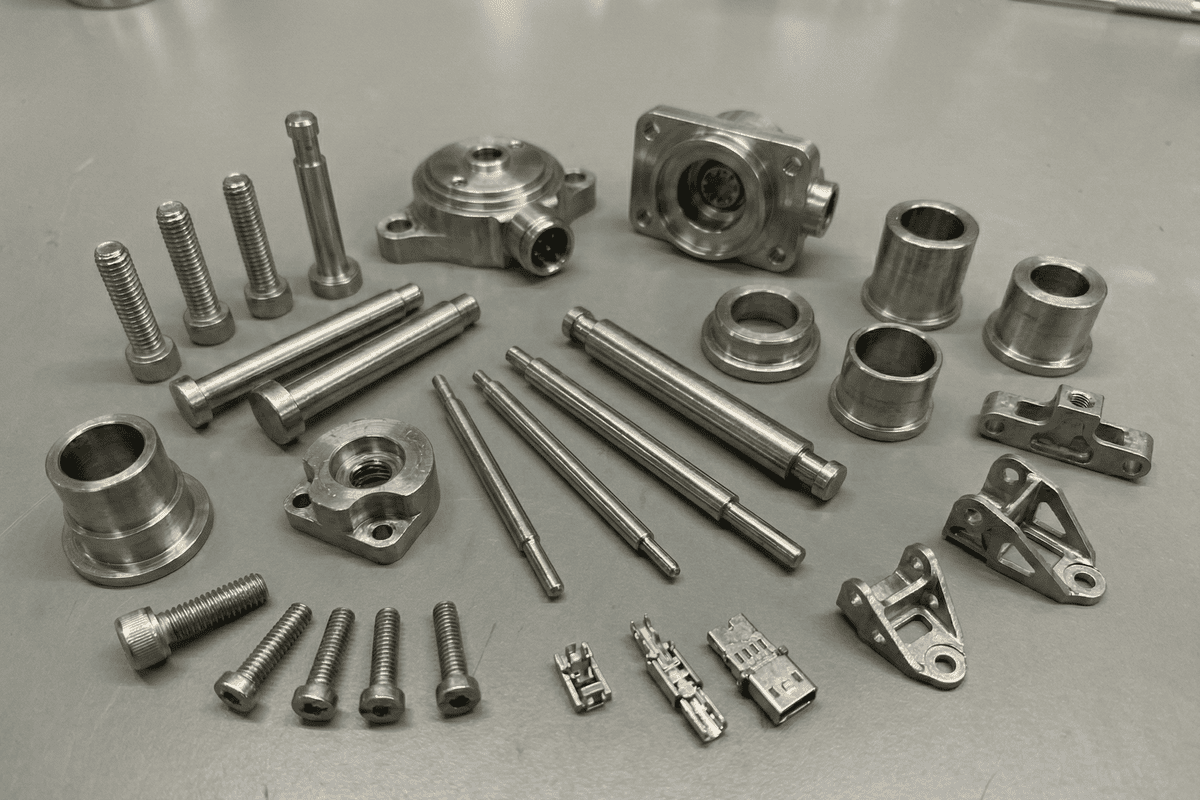
Aerospace Typical Swiss CNC Machined Parts

Aerospace


Typical Swiss CNC Machined Parts
Aerospace fasteners and pins
Sensor components and bushings
Precision shafts and connectors
Small structural fittings


Why Swiss CNC Machining
High precision for safety-critical components
Excellent concentricity and repeatability
Efficient machining of long, slender aerospace parts
Suitable for titanium and high-performance alloys


Procurement Advantages
Strict quality control and inspection support
Consistent output for aerospace programs
Full secondary machining and finishing services
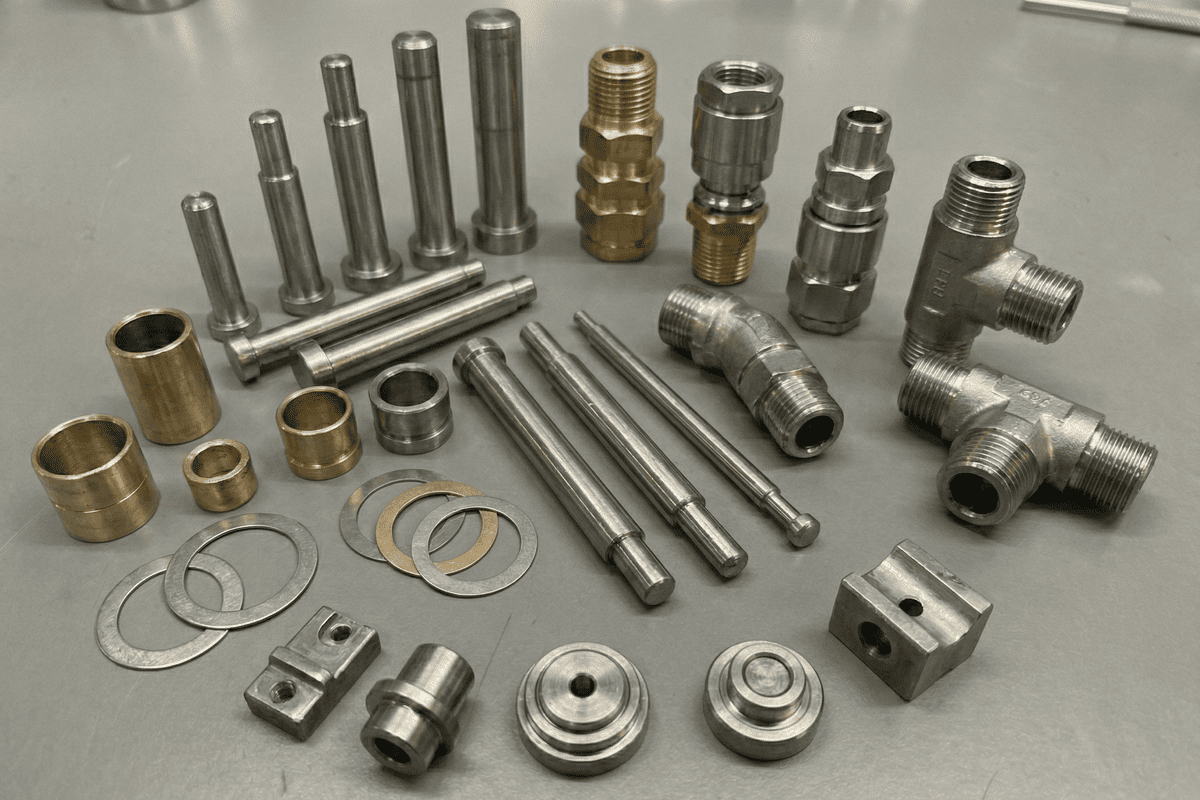
Industrial Equipment Typical Swiss CNC Machined Parts

Industrial Equipment


Typical Swiss CNC Machined Parts
Precision shafts and pins
Bushings and spacers
Hydraulic and pneumatic fittings
Wear-resistant mechanical components


Why Swiss CNC Machining
Reliable machining for high-precision functional parts
Strong dimensional stability for long production runs
High efficiency for repetitive components
Suitable for steel, stainless steel, and brass


Procurement Advantages
Flexible production volumes
Cost-effective solutions for precision parts
One-stop machining and post-processing support

Swiss CNC Machining Materials

At NAITE TECH, we offer a comprehensive range of metal and plastic materials to meet different mechanical, thermal, and surface finish requirements. Every material is carefully selected from certified suppliers to ensure durability, consistency, and machinability.

Metals

  • Aluminum alloy CNC machined parts
     

    Aluminum

    Lightweight, corrosion-resistant, and highly machinable, aluminum is widely used in Swiss CNC machining for small-diameter, high-precision parts requiring tight tolerances and excellent surface quality.

    Common Grades:
    · 6061 / 6061-T6
    · 7075 / 7075-T6
    · 2024
    · 5052
    · 5083
    · 6063
    · 6082
    · ADC12 (A380)

    Key Advantages:
    · Excellent machinability for small and slender parts
    · Stable dimensional control in Swiss turning
    · Cost-effective for prototype to volume production

    Typical Lead Time:
    ~5 business days

    Learn more about CNC machining capabilities for Aluminum.


  • Stainless steel CNC machined parts
     

    Stainless Steel


    Stainless steel is one of the most common materials for Swiss CNC machining, offering excellent strength, corrosion resistance, and dimensional stability for precision shafts and medical components.

    Common Grades:
    · 303
    · 304
    · 316 / 316L
    · 17-4 PH
    · 420
    · 440C

    Key Advantages:
    · Excellent strength for small-diameter parts
    · Stable machining for long, slender geometries
    · Ideal for medical and precision mechanical components

    Typical Lead Time:
    ~5–7 business days

  • Brass CNC machined parts
     

    Brass

    Brass offers outstanding machinability and surface finish, making it ideal for high-speed Swiss CNC machining of precision connectors and fittings.

    Common Grades:
    · C360
    · C260
    · C280
    · C464

    Key Advantages:
    · Exceptional machinability for micro features
    · Excellent surface finish as machined
    · Highly efficient for volume production

    Typical Lead Time:
    ~4–6 business days

  • CNC machined carbon steel parts
     

    Carbon Steel

    Carbon and alloy steels are commonly used in Swiss CNC machining for precision shafts and mechanical components requiring strength and cost efficiency.

    Common Grades:
    · 1018
    · 1020
    · 1045
    · 4140
    · 4340

    Key Advantages:
    · Good strength-to-cost ratio
    · Suitable for precision turned shafts
    · Compatible with secondary heat treatment

    Typical Lead Time:
    ~5–7 business days

  • CNC machined copper parts
     

    Copper

    Copper is used in Swiss CNC machining for electrical and thermal components requiring high conductivity and precision.

    Common Grades:
    · C110
    · C101

    Key Advantages:
    · Excellent electrical and thermal conductivity
    · Suitable for precision electrical components
    · Good surface finish with optimized parameters

    Typical Lead Time:
    ~5–7 business days

  • Bronze CNC machined parts
     

    Bronze

    Bronze alloys are well suited for Swiss CNC machining of wear-resistant precision components such as bushings and bearings.

    Common Grades:
    · C932
    · C954
    · C863

    Key Advantages:
    · Excellent wear resistance
    · Good machinability for precision parts
    · Stable performance in sliding applications

    Typical Lead Time:
    ~5–7 business days

  • CNC machined iron parts
     

    Iron

    Iron offers high rigidity and vibration damping, commonly used for heavy-duty industrial components and structural CNC applications.


    Common Grades:
    · Cast Iron 

    · Ductile Iron

    Key Advantages:
    · High rigidity 

    · Vibration damping 

    · Suitable for heavy parts

    Typical Lead Time:
    ~7–10 business days

  • CNC machined steel parts
     

    Nickel Alloys (upon request)

    Nickel-based alloys can be Swiss machined for high-temperature and corrosion-resistant applications with specialized tooling.

    Common Grades:
    · Inconel 625
    · Inconel 718
    · Monel 400

    Key Advantages:
    · High temperature and corrosion resistance
    · Suitable for critical precision components
    · Engineered machining strategies required

    Typical Lead Time:
    ~10–15 business days

  • CNC machined magnesium alloy parts
     

    Magnesium Alloy (upon request)

    Magnesium alloys can be Swiss machined for lightweight precision components under controlled machining conditions.

    Common Grades:
    · AZ31B
    · AZ91D

    Key Notes:
    · Excellent machinability with low cutting forces
    · Specialized machining and safety controls required
    · Available upon request

    Typical Lead Time:
    ~7–10 business days

  • CNC machined titanium alloy parts
     

    Titanium Alloy

    Titanium alloys are used in Swiss CNC machining for mission-critical components requiring high strength, corrosion resistance, and biocompatibility.

    Common Grades:
    · Ti-6Al-4V (Grade 5)
    · Grade 2

    Key Advantages:
    · Excellent strength-to-weight ratio
    · Suitable for medical and aerospace parts
    · Stable machining with optimized Swiss tooling

    Typical Lead Time:
    ~7–10 business days

Plastics

  • Parts made of POM (Acetal)
     

    POM (Acetal)

    POM provides excellent dimensional stability and low friction, making it one of the most commonly used plastics for Swiss CNC machining of precision mechanical components.

    Common Grades:
    · Delrin® 500
    · Acetal Copolymer

    Key Advantages:
    · Excellent dimensional stability
    · Low friction and wear resistance
    · Ideal for small gears, pins, and precision components

    Typical Lead Time:
    ~5 business days


  • Parts made of PEEK
     

    PEEK

    PEEK is a high-performance engineering plastic used in Swiss CNC machining for components requiring high temperature resistance, chemical stability, and tight tolerances.

    Common Grades:
    · Virgin PEEK
    · Glass-filled PEEK

    Key Advantages:
    · High temperature and chemical resistance
    · Excellent mechanical strength
    · Suitable for medical and aerospace applications

    Typical Lead Time:
    ~7–10 business days

  • Parts made of PTFE (Teflon)
     

    PTFE (Teflon®)

    PTFE is suitable for Swiss CNC machining of low-friction and chemically resistant precision components with optimized tooling strategies.

    Common Grades:
    · Virgin PTFE
    · Filled PTFE

    Key Advantages:
    · Extremely low friction
    · Excellent chemical resistance
    · Ideal for seals and insulation components

    Typical Lead Time:
    ~6–8 business days

  • Parts made of Nylon (PA)
     

    Nylon (PA)

    Nylon offers good toughness and wear resistance, making it suitable for Swiss CNC machining of small functional plastic components.

    Common Grades:
    · PA6
    · PA66

    Key Advantages:
    · Good toughness and impact resistance
    · Wear-resistant
    · Cost-effective engineering plastic

    Typical Lead Time:
    ~5–7 business days

  • Parts made of PPS (Polyphenylene Sulfide)
     

    PPS (Polyphenylene Sulfide)

    PPS is used in Swiss CNC machining for precision parts requiring excellent dimensional stability and chemical resistance.

    Common Grades:
    · PPS (Virgin / Filled)

    Key Advantages:
    · Excellent dimensional stability
    · High chemical resistance
    · Suitable for electronic and industrial components

    Typical Lead Time:
    ~7–9 business days

  • Parts made of PMMA (Acrylic) material
     

    PMMA (Acrylic)

    PMMA offers high optical clarity, excellent surface finish, and UV resistance, ideal for transparent parts and display applications.

    Common Grades:
    · Cast PMMA 

    · Extruded PMMA

    Key Advantages:
    · Transparent 

    · Scratch-resistant 

    · UV-stable

    Typical Lead Time:
    ~5 business days

  • Parts made of PC (Polycarbonate)
     

    PC (Polycarbonate)

    PC is suitable for Swiss CNC machining of transparent or impact-resistant precision components with controlled machining parameters.

    Common Grades:
    · Optical-grade PC

    Key Advantages:
    · High impact resistance
    · Good dimensional accuracy
    · Transparent parts achievable

    Typical Lead Time:
    ~5–7 business days

  • Parts made of PET
     

    PET / PETG

    PET and PETG provide good machinability and dimensional stability for Swiss CNC machining of precision plastic parts.

    Common Grades:
    · PET
    · PETG

    Key Advantages:
    · Good dimensional stability
    · Smooth surface finish
    · Suitable for precision housings

    Typical Lead Time:
    ~5–7 business days

  • Parts made of PEI
     

    PEI (Ultem®)

    PEI is a high-strength, heat-resistant plastic suitable for Swiss CNC machining of precision components in demanding environments.

    Common Grades:
    · Ultem® 1000

    Key Advantages:
    · High strength at elevated temperatures
    · Good dimensional stability
    · Flame-retardant properties

    Typical Lead Time:
    ~7–10 business days

  • PVC
    Parts made of PVC
     

    PVC

    PVC can be Swiss machined for precision industrial components where chemical resistance and cost efficiency are required.

    Common Grades:
    · Rigid PVC

    Key Advantages:
    · Chemical resistance
    · Cost-effective
    · Suitable for industrial applications

    Typical Lead Time:
    ~5–7 business days

  • Parts made of PP (Polypropylene)
     

    PP (Polypropylene)

    PP is suitable for Swiss CNC machining of lightweight precision components with good chemical resistance.

    Common Grades:
    · Homopolymer PP

    Key Advantages:
    · Lightweight
    · Chemical resistant
    · Cost-effective for simple precision parts

    Typical Lead Time:
    ~5–7 business days

  • Parts made of FR4 & G-10
     

    FR4 / G-10

    FR4 and G-10 are glass-fiber-reinforced laminates used in Swiss CNC machining for electrically insulating precision components.

    Common Grades:
    · FR4
    · G-10

    Key Advantages:
    · Excellent electrical insulation
    · Good dimensional stability
    · Suitable for precision electronic parts

    Typical Lead Time:
    ~6–8 business days

  • Parts made of PPSU (Polyphenylsulfone)
     

    PPSU (Polyphenylsulfone)

    PPSU is used in Swiss CNC machining for medical and high-temperature applications requiring excellent toughness and chemical resistance.

    Common Grades:
    · Medical-grade PPSU

    Key Advantages:
    · Excellent impact resistance
    · High temperature tolerance
    · Suitable for medical components

    Typical Lead Time:
    ~7–10 business days

  • ab86f8cd-1078-42f3-b0b9-0b31e7404c41
     

    PU (Polyurethane)

    PU can be Swiss machined for precision flexible or wear-resistant components with controlled cutting parameters.

    Common Grades:
    · Rigid PU

    Key Advantages:
    · Good wear resistance
    · Elastic properties
    · Suitable for special functional parts

    Typical Lead Time:
    ~6–8 business days

  • ab86f8cd-1078-42f3-b0b9-0b31e7404c41
     

    HIPS (High Impact Polystyrene)

    HIPS is suitable for Swiss CNC machining of lightweight precision plastic parts for non-structural applications.

    Common Grades:
    · HIPS

    Key Advantages:
    · Easy to machine
    · Lightweight
    · Cost-effective

    Typical Lead Time:
    ~5–7 business days

  • Bakelite
     

    Bakelite

    Bakelite is used in Swiss CNC machining for electrically insulating and heat-resistant precision components.

    Common Grades:
    · Phenolic laminate

    Key Advantages:
    · Heat-resistant
    · Electrical insulation
    · Dimensionally stable

    Typical Lead Time:
    ~6–8 business days

  • Parts made of PE (Polyethylene)
     

    PE (Polyethylene)


    PE can be Swiss machined for simple precision components where chemical resistance and cost efficiency are prioritized over ultra-tight tolerances.

    Common Grades:
    · HDPE
    · UHMW-PE

    Key Advantages:
    · Excellent chemical resistance
    · Lightweight and easy to machine
    · Cost-effective for non-critical parts

    Limitations:
    · Low rigidity and dimensional stability
    · Not suitable for tight-tolerance Swiss machining

    Typical Lead Time:
    ~5–7 business days

  • ABS
    Parts made of ABS material
     

    ABS

    ABS is a cost-effective plastic that can be Swiss machined for simple precision parts where tight tolerances and high thermal stability are not critical.

    Common Grades:
    · ABS

    Key Advantages:
    · Low material cost
    · Easy to machine for simple geometries
    · Suitable for prototyping and non-critical parts

    Limitations:
    · Limited dimensional stability
    · Not recommended for ultra-tight tolerances

    Typical Lead Time:

Surface Finishing Options for Swiss CNC Parts

Surface finishing plays a critical role in enhancing the functionality, durability, and appearance of Swiss CNC machined components. At NAITE TECH, all finishing processes are carefully selected and controlled to preserve tight tolerances and dimensional accuracy, especially for small-diameter and high-precision parts.

As-Machined

 
naite-tech-As-Machined-Surface-treatment-services
Swiss CNC machining delivers excellent surface quality directly from the machine, making as-machined parts suitable for many functional applications without additional finishing.

Typical Surface Roughness: Ra 0.4–0.8 μm
Maintains original machining tolerances
Ideal for precision shafts, pins, and micro components
 

Polishing

 
naite-tech-polishing-surface-treatment-services
Polishing is used to further improve surface smoothness and edge quality for parts requiring enhanced appearance or reduced friction.

Improves micro-feature definition
Commonly used for medical, optical, and instrument components
Applied with controlled material removal


Anodizing (Aluminum Only)

 
naite-tech-anodizing-surface-treatment-services
Anodizing increases corrosion resistance and surface hardness for aluminum Swiss CNC parts while maintaining dimensional stability.

Clear and black anodizing available
Thin, controlled coating thickness
Suitable for precision aluminum components


Electroplating (Nickel / Chrome / Zinc)

 
Naite-Tech-Electroplating-Surface-Treatment-Services
Electroplating enhances wear resistance, corrosion protection, and electrical performance for Swiss CNC parts.

Nickel plating for wear and corrosion resistance
Chrome plating for hardness and durability
Zinc plating for cost-effective corrosion protection

Heat Treatment

 
Naite-Tech-Heat-Treatment-Treatment-Services
Heat treatment is applied to improve mechanical properties such as hardness and strength without compromising dimensional accuracy.

Suitable for carbon steel and stainless steel parts
Controlled processes to minimize distortion
Common for functional and load-bearing components

Tumbling & Deburring

 
Naite-Tech-Tumbling-Treatment-Services
Used to remove sharp edges and micro-burrs from small precision parts while maintaining dimensional integrity.

Ideal for high-volume Swiss CNC components
Improves handling and assembly consistency


Passivation (Stainless Steel)

 
Naite-Tech-Brushing-Treatment-Services
Passivation removes surface contaminants and enhances corrosion resistance of stainless steel Swiss CNC parts.

Improves surface cleanliness and longevity
Widely used in medical and aerospace applications
Does not affect part dimensions
 

Light Bead Blasting

 
Naite-Tech-Bead-Blasting-Treatment-Services
Provides a uniform matte surface finish when visual consistency is required.

Applied with low-pressure control
Not recommended for tight cosmetic or functional surfaces


Technical Guide for Swiss CNC Machining

This technical guide provides essential engineering considerations to help determine whether Swiss CNC machining is the optimal manufacturing solution for your precision components.


Swiss CNC Design Guidelines

 
Swiss CNC machining is best suited for small-diameter, high-precision parts that require exceptional dimensional stability.

Recommended Design Practices:


Optimize length-to-diameter ratios for enhanced rigidity
Maintain uniform wall thickness where possible
Minimize unsupported features to reduce deflection
Combine turning and milling features into a single setup when feasible


Material Selection Guide

 
Material properties directly influence machining stability, surface quality, and achievable tolerances in Swiss CNC machining.

Best-Suited Materials:

Stainless steel, carbon steel, brass, aluminum
Engineering plastics such as POM, PEEK, PPS, and PEI

Engineering Considerations:

Higher rigidity materials offer better dimensional stability
Softer plastics may require adjusted cutting strategies
Material selection should align with functional and tolerance requirements


Feature-Specific Guidelines

 
Swiss CNC machines excel at producing complex micro features with high repeatability.

Commonly Machined Features:

Micro holes and cross-holes
Fine threads and miniature profiles
Slots, flats, and milled surfaces
Internal features machined with live tooling

Designs with multiple features benefit from reduced setups and improved accuracy.


Tolerance & GD&T Considerations

 
Swiss CNC machining supports tight tolerances and consistent repeatability when tolerances are properly specified.

Typical Capabilities:

Dimensional tolerances down to ±0.005 mm
Excellent concentricity and positional accuracy
Support for standard GD&T requirements

Avoid over-specifying tolerances where they are not functionally required, as this may increase manufacturing cost without performance benefits.


When to Choose Swiss CNC Machining

 
Swiss CNC machining is the ideal choice when your part requires:

Small diameters with tight concentricity
Long, slender geometries prone to deflection
Complex features completed in a single setup
High repeatability for medium to high production volumes

For parts with large diameters or loose tolerances, conventional CNC turning may be more cost-effective.


Engineering Support for Swiss CNC Projects

Our engineers review part designs, material choices, and tolerance requirements to ensure your Swiss CNC components are manufactured efficiently and accurately.

Quality Assurance at NAITE TECH

Our Quality Commitment

Quality is at the core of every part we produce. NAITE TECH follows a rigorous, standardized quality control process to ensure precision, reliability, and consistency from the first prototype to the final production run.

Why Choose NAITE TECH for Swiss CNC Machining

  Comprehensive Machining Solutions
From 2-axis to 5-axis Swiss CNC, we handle prototypes and low-to-medium volume production with high precision.
  Multi-Material Expertise
Skilled in metals, plastics, and engineering plastics, ensuring material-specific precision and finish.
  High-Precision
Achieve tight tolerances up to ±0.002 mm with
  Capabilities
superior concentricity and surface finish.
  Engineering Support & DFM
Our engineers provide DFM review, material consultation, and design optimization for manufacturability.
  Certified Quality System
ISO 9001:2015 compliant, first article inspection, full/partial inspections, and complete inspection reports.
  Fast & Reliable Delivery
Flexible production schedules, low-volume manufacturing, and stable supply chain ensure timely delivery worldwide.

Precision Swiss CNC Machining FAQs

  • 1. What is Swiss CNC machining?

    Swiss CNC machining, also known as Swiss turning or Swiss-type machining, is a precision manufacturing process that uses a sliding headstock and guide bushing to support the workpiece close to the cutting tool. This design enables exceptional accuracy when machining small, complex, and slender parts.
  • 2. How is Swiss machining different from traditional CNC turning?

    Unlike traditional CNC lathes where the workpiece is held at one end, Swiss machining supports the material near the cutting zone using a guide bushing. This minimizes deflection and vibration, making Swiss machining ideal for long, thin, and high-precision components.
  • 3. What types of parts are best suited for Swiss CNC machining?

    Swiss CNC machining is best suited for small-diameter, high-precision parts such as medical pins, connectors, shafts, bushings, fasteners, and electronic components. It is especially effective for parts requiring tight tolerances, fine features, and high repeatability.
  • 4. What diameter and length ranges can Swiss CNC machines handle?

    Swiss CNC machining typically supports diameters ranging from approximately Ø1 mm to Ø32 mm, with machining lengths commonly between 50 mm and 350 mm. Actual capacity depends on material type, part geometry, and machining strategy.
  • 5. What tolerances can Swiss CNC machining achieve?

    Swiss machining can achieve very tight tolerances, often up to ±0.005 mm or better, depending on part geometry and material. It also excels in maintaining concentricity, roundness, and surface consistency on precision components.
  • 6. What materials are commonly used in Swiss CNC machining?

    Common Swiss machining materials include stainless steel, aluminum alloys, brass, copper, titanium, and engineering plastics such as PEEK, POM, and Nylon. Material selection is based on precision requirements, mechanical properties, and end-use applications.
  • 7. Can Swiss CNC machining perform milling and secondary operations?

    Yes. Modern Swiss CNC machines are equipped with live tooling and multiple spindles, enabling milling, drilling, tapping, and cross-hole operations in a single setup. This reduces secondary operations and improves overall accuracy.
  • 8. Is Swiss CNC machining suitable for prototyping and low-volume production?

    Swiss CNC machining is suitable for both prototyping and low- to medium-volume production, particularly for complex precision parts. While setup costs are higher than standard turning, reduced cycle times and higher repeatability make it cost-effective for ongoing production.
  • 9. How is quality ensured in Swiss CNC machining?

    Quality assurance includes incoming material inspection, first article inspection (FAI), in-process quality control, and final dimensional inspection. Precision measurement tools such as CMMs, optical comparators, and micrometers are used to verify critical dimensions.


  • 10. How do I request a quote for Swiss CNC machining services?

    To request a Swiss CNC machining quote, upload your CAD files (STEP, STP, or SolidWorks formats preferred) and specify material, quantity, tolerance, and surface finish requirements. Our engineering team will review your design and provide a fast, accurate quotation.

Start Your Swiss CNC Machining Project Today

Upload your CAD or 3D model today and get a quote within hours.
Experience precision engineering designed for your most demanding micro parts — with NAITE TECH.
If there are any CNC machining issues.
Please contact us.
Capabilities
Service
Support
COPYRIGHT © 2025 CHANGZHOU NAITE METAL TECHNOLOGY CO., LTD. ALL RIGHTS RESERVED.