


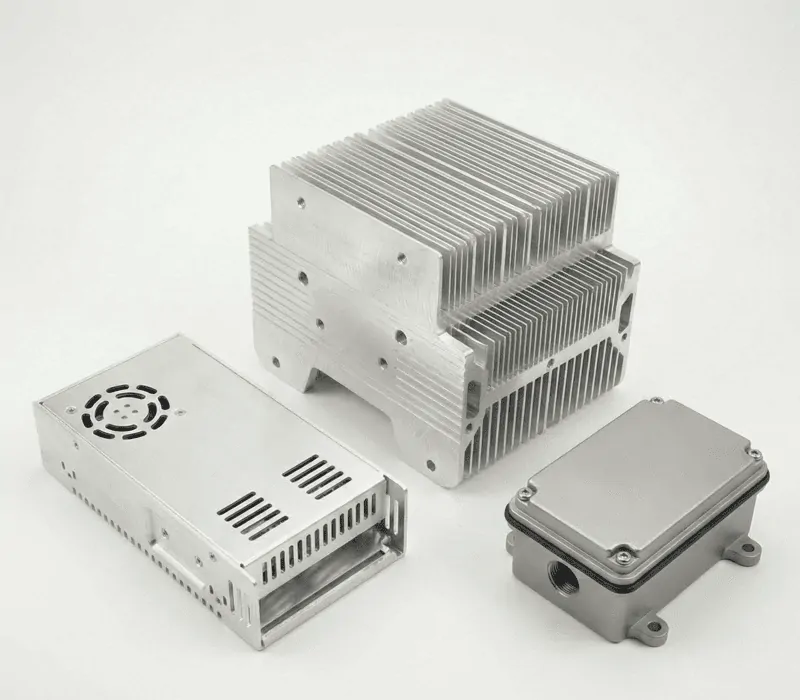

Electronic components are becoming smaller and more complex, requiring tight tolerances and stable machining capabilities for intricate geometries and fine features.

- Home
- Capabilities
- Solution
- Material
- Industry
- Resources
- Request a Quote
High-precision CNC machining for electronic housings, connectors, and structural components with tolerances up to ±0.01 mm and support for complex geometries.
Custom electronic enclosures, chassis, and mounting structures with support for 20+ finishing options and consistent cosmetic quality for visible parts.
Aluminum and zinc die casting for electronic housings and structural parts, suitable for stable production from prototypes to 100,000+ units.
Lightweight | Thermal Management | Structural Stability
Aluminum alloys are widely used in electronic manufacturing for their balance of strength, weight reduction, and thermal performance. They are ideal for both functional and cosmetic electronic components.
High strength-to-weight ratio for compact electronic systems
Excellent heat dissipation for thermal-sensitive applications
Strong corrosion resistance for industrial environments
High machinability for complex CNC geometries
Supports anodizing, powder coating, and polishing
Typical applications: heat sinks, electronic housings, control enclosures, mounting structures
High Strength | Corrosion Resistance | Durability
Stainless steel is used in electronics manufacturing for its superior mechanical strength, corrosion resistance, and long-term durability. It is ideal for structural and protective components in demanding environments.
High mechanical strength for structural support parts
Excellent corrosion resistance for harsh environments
Stable performance under long-term usage
Suitable for precision machining and forming
Supports polishing and surface finishing
Typical applications: protective housings, brackets, structural frames, fastening components
High Conductivity | Precision Machinability | Electrical Stability
Copper and brass are widely used in electronics manufacturing for their excellent electrical conductivity and stable signal transmission performance. They are essential materials for precision electronic connectors and conductive components.
Excellent electrical conductivity for signal transmission applications
Stable performance for high-frequency electronic systems
Good machinability for precision CNC parts
Suitable for plating and surface protection treatments
High dimensional stability for connector components
Typical applications: connectors, terminals, shielding components, conductive parts
Bronze | Wear Resistance | Stable Electrical Performance
Bronze is used in specialized electronic and industrial components requiring excellent wear resistance and stable electrical contact performance under repeated mechanical stress.
Good wear resistance for long-life contact components
Stable electrical conductivity for contact applications
Excellent fatigue resistance under repeated motion
Suitable for precision machining of functional parts
Typical applications: electrical contacts, wear-resistant connectors, industrial contact components
Ultra Lightweight | Good Strength | Vibration Damping
Magnesium alloys are used for ultra-lightweight electronic structures where weight reduction is critical.
Extremely lightweight for portable electronics
Good vibration damping properties
Suitable for complex structural designs
Used in high-performance devices
Typical applications: laptop frames, portable devices, lightweight housings
High Strength | Lightweight | Corrosion Resistance
Titanium alloys are used in high-end electronics applications requiring extreme strength, corrosion resistance, and long-term reliability.
Excellent strength-to-weight ratio for premium electronic devices
Strong corrosion resistance for harsh environments
High mechanical stability for precision assemblies
Suitable for aerospace-grade electronic components
Typical applications: high-end device housings, precision structural parts, specialty electronics
Anodizing is widely used for aluminum electronic components to improve surface durability, corrosion resistance, and appearance consistency. It is especially important for visible enclosures and heat dissipation parts.
Enhances corrosion resistance for long-term stability
Improves surface hardness and wear resistance
Provides stable and consistent color finish
Compatible with precision CNC aluminum parts
Suitable for functional and cosmetic components
Typical applications: electronic housings, heat sinks, device enclosures
Powder Coating | Durable Protection | Color Stability
Powder coating provides a strong, uniform protective layer for electronic enclosures and structural components, ensuring resistance to wear, corrosion, and environmental exposure.
Strong surface protection for industrial environments
High color stability and aesthetic consistency
Good impact and scratch resistance
Suitable for large or complex enclosure parts
Environment-friendly finishing process
Typical applications: electronic cabinets, control panels, structural housings
Electroplating | Conductivity Enhancement | Surface Performance
Electroplating is used to improve electrical conductivity, wear resistance, and surface appearance of precision electronic components such as connectors and functional metal parts.
Improves electrical conductivity for signal stability
Enhances wear resistance for long-term use
Provides smooth and decorative surface finish
Suitable for precision small metal components
Supports multiple metal plating options
Typical applications: connectors, terminals, conductive components
Sandblasting | Surface Uniformity | Adhesion Improvement
Sandblasting creates a uniform matte surface texture that improves coating adhesion and enhances cosmetic consistency for electronic components.
Creates uniform surface texture for finishing preparation
Improves coating adhesion performance
Reduces surface imperfections and marks
Enhances visual consistency of metal parts
Common pre-treatment for anodizing and coating
Typical applications: electronic housings, panels, aluminum parts
Laser Marking | Permanent Identification | Traceability
Laser marking provides high-precision, permanent marking for logos, serial numbers, and traceability codes without affecting material structure or performance.
Permanent marking with high precision
No damage to material surface integrity
Supports branding and traceability requirements
Suitable for metals and plastics
High-speed and contactless process
Typical applications: electronic components, housings, identification parts
Passivation is used to enhance corrosion resistance of stainless steel electronic components by removing surface contaminants and improving chemical stability.
Improves corrosion resistance of stainless steel parts
Enhances long-term material stability
Maintains electrical and mechanical performance
Ideal for precision stainless steel components
Supports clean and stable surface condition
Typical applications: stainless steel brackets, electronic enclosures, precision structural parts


