
- Home
- Capabilities
- Solution
- Material
- Industry
- Resources
- Request a Quote
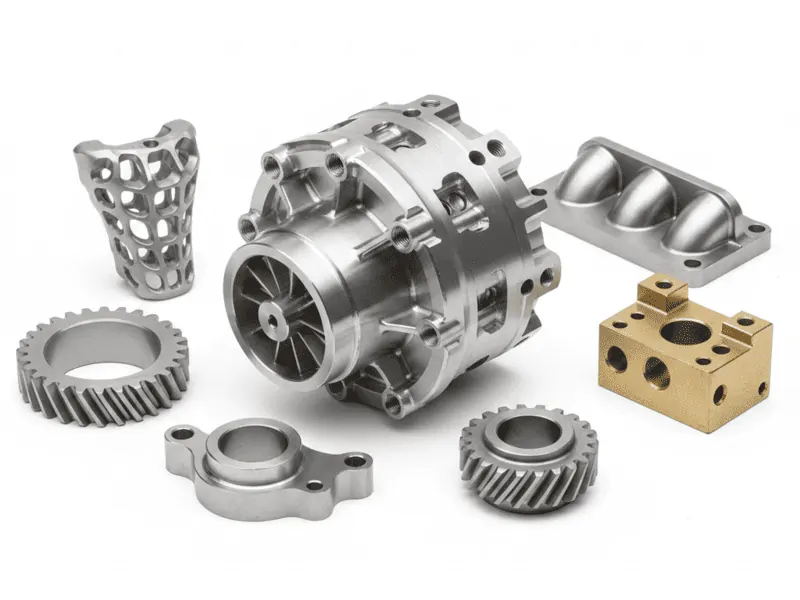
Cost-effective machining solution for standard geometries, flat surfaces, slots, and common structural components with stable precision and fast turnaround.
Best For:
✔ Flat surfaces & 2.5D parts
✔ Brackets, blocks, and panels
✔ Simple housings and fixtures
✔ Low to medium complexity components
| Category | 3-Axis CNC | 4-Axis CNC | 5-Axis CNC |
|---|---|---|---|
| Machining Freedom | ★★☆☆☆ | ★★★★☆ | ★★★★★ |
| Surfaces Machinable | 3–4 faces | 4–5 faces (with rotary axis) | 5+ faces, almost any angle |
| Setup Count | Multiple setups (≥3) | 1–2 setups | Usually 1 setup |
| Complex Geometry Capability | Low | Medium | Extremely high |
| Undercuts / Deep Features | Limited | Moderate support | Excellent support |
| Precision for Complex Features | Standard | High | Highest (aerospace-grade) |
| Machining Efficiency | Lower | Medium | Highest |
| Best For | Flat surfaces, simple 2.5D parts | Cylindrical & multi-face parts | Aerospace, medical, ultra-complex parts |
| Cost | Lowest | Medium | Highest |
Start your CNC machining project with fast quotation and engineering review.
Lightweight, corrosion-resistant, and easy to machine, aluminum is ideal for precision CNC parts that require strength, efficiency, and tight tolerances.
Common Grades:
· 6061 / 6061-T6
· 7075 / 7075-T6
· 2024 · 5052
· 5083 · 6063
· 6082
· ADC12 (A380)
Key Advantages:
· Excellent machinability
· Cost-efficient
· Tight tolerances supported
Typical Lead Time:
~5 business days
Known for its strength and corrosion resistance, stainless steel is widely used for CNC components that must perform reliably in demanding environments.
Common Grades:
·304
· 316L
· 303
· 17-4PH
Key Advantages:
· Corrosion-resistant
· High strength
· Dimensional stability
Typical Lead Time:
~7 business days
Brass offers excellent machinability and a clean surface finish, making it well suited for precision fittings, connectors, and aesthetic components.
Common Grades:
· C360
· C260
· C280
Key Advantages:
· Superior machinability
· Good conductivity
· Smooth surface finish
Typical Lead Time:
~5 business days
Carbon steel provides high strength and cost efficiency, making it a practical choice for structural and mechanical CNC machined parts.
Common Grades:
· 1018
· 1020
· 1045
· A36
Key Advantages:
· High strength
· Cost-effective
· Widely used
Typical Lead Time:
~7 business days
With outstanding electrical and thermal conductivity, copper is ideal for CNC machining of electrical components and heat-transfer parts.
Common Grades:
· C110
· C101
· C102
Key Advantages:
· Excellent conductivity
· Thermal efficiency
· High purity options
Typical Lead Time:
~7 business days
Bronze combines wear resistance with low friction, making it a preferred material for bearings, bushings, and moving mechanical components.
Common Grades:
· C932
· C954
· C836
Key Advantages:
· Wear-resistant
· Low friction
· Corrosion-resistant
Typical Lead Time:
~7 business days
Iron offers high rigidity and vibration damping, commonly used for heavy-duty industrial components and structural CNC applications.
Common Grades:
· Cast Iron
· Ductile Iron
Key Advantages:
· High rigidity
· Vibration damping
· Suitable for heavy parts
Typical Lead Time:
~7–10 business days
Steel is a versatile CNC machining material that delivers strength, durability, and flexibility across a wide range of industrial applications.
Common Grades:
· 4140
· 4130
· Mild Steel
· Tool Steel
Key Advantages:
· High strength
· Versatile use
· Reliable performance
Typical Lead Time:
~7 business days
Extremely lightweight and highly machinable, magnesium alloys are ideal for CNC parts where weight reduction is a critical requirement.
Common Grades:
· AZ31
· AZ91
Key Advantages:
· Ultra-lightweight
· Excellent machinability
· High strength-to-weight ratio
Typical Lead Time:
~7 business days
Titanium alloys deliver exceptional strength-to-weight performance and corrosion resistance for high-demand, precision CNC applications.
Common Grades:
· Ti-6Al-4V (Grade 5)
· Grade 2
Key Advantages:
· High strength-to-weight
· Corrosion-resistant
· Aerospace-grade performance
Typical Lead Time:
~10 business days
ABS is a versatile thermoplastic with excellent impact resistance and dimensional stability, suitable for functional prototypes and industrial components.
Common Grades:
· Standard ABS
· ABS-M30
· ABS+
Key Advantages:
· Impact-resistant
· Good machinability
· Cost-efficient
Typical Lead Time:
~5 business days
PMMA offers high optical clarity, excellent surface finish, and UV resistance, ideal for transparent parts and display applications.
Common Grades:
· Cast PMMA
· Extruded PMMA
Key Advantages:
· Transparent
· Scratch-resistant
· UV-stable
Typical Lead Time:
~5 business days
PC is a strong, transparent engineering plastic with high impact resistance and heat resistance, ideal for durable functional prototypes.
Common Grades:
· Standard PC
· PC-ABS blend
Key Advantages:
· High strength
· Transparent
· Heat-resistant
Typical Lead Time:
~5 business days
POM provides excellent dimensional stability, low friction, and wear resistance, making it ideal for gears, bearings, and precision mechanical parts.
Common Grades:
· Delrin® 500
· Acetal Copolymer
Key Advantages:
· Low friction
· Wear-resistant
· High dimensional stability
Typical Lead Time:
~5 business days
PE is lightweight, chemically resistant, and easy to machine, suitable for containers, insulation parts, and general prototypes.
Common Grades:
· HDPE
· LDPE
· UHMWPE
Key Advantages:
· Chemical-resistant
· Lightweight
· Easy to machine
Typical Lead Time:
~5 business days
Nylon is a strong, flexible engineering plastic with excellent wear resistance, ideal for functional parts like gears, bushings, and mechanical components.
Common Grades:
· PA6
· PA66
· Glass-filled PA
Key Advantages:
· Wear-resistant
· Strong
· Low friction
Typical Lead Time:
~5 business days
PEEK is a high-performance polymer with excellent thermal stability, chemical resistance, and mechanical strength for demanding applications.
Common Grades:
· Unfilled PEEK
· Carbon-filled PEEK
· Glass-filled PEEK
Key Advantages:
· High-temperature resistant
· Chemically resistant
· High strength
Typical Lead Time:
~7 business days
PTFE provides exceptional chemical resistance, low friction, and non-stick properties, ideal for seals, gaskets, and sliding components.
Common Grades:
· Virgin PTFE
· Filled PTFE
Key Advantages:
· Non-stick
· Chemically resistant
· Low friction
Typical Lead Time:
~5 business days
PET is a strong, dimensionally stable plastic with good chemical resistance, commonly used for structural parts and containers.
Common Grades:
· Standard PET
· PETG
Key Advantages:
· Strong
· Chemically resistant
· Dimensionally stable
Typical Lead Time:
~5 business days
PP is a lightweight, chemically resistant plastic suitable for functional parts, packaging prototypes, and fluid handling components.
Common Grades:
· Homopolymer PP
· Copolymer PP
Key Advantages:
· Lightweight
· Chemical-resistant
· Easy to machine
Typical Lead Time:
~5 business days
PPS is a high-performance engineering plastic with excellent chemical and heat resistance, ideal for industrial and electronic applications.
Common Grades:
· Standard PPS
· Glass-filled PPS
Key Advantages:
· Heat-resistant
· Chemically resistant
· High dimensional stability
Typical Lead Time:
~7 business days
PVC is a cost-effective plastic with good chemical resistance and electrical insulation properties, used for enclosures, tubing, and protective components.
Common Grades:
· Rigid PVC
· Flexible PVC
Key Advantages:
· Chemical-resistant
· Electrically insulating
· Cost-effective
Typical Lead Time:
~5 business days
PEI is a high-performance thermoplastic with excellent mechanical strength, thermal resistance, and dimensional stability for engineering applications.
Common Grades:
· Standard PEI
· Glass-filled PEI
Key Advantages:
· High strength
· Heat-resistant
· Dimensionally stable
Typical Lead Time:
~7 business days
FR4 and G-10 are fiberglass-reinforced epoxy laminates, ideal for PCB substrates and structural components requiring electrical insulation.
Common Grades:
· FR4
· G-10 standard
Key Advantages:
· Electrically insulating
· High rigidity
· Heat-resistant
Typical Lead Time:
~7 business days
Carbon fiber reinforced plastics offer exceptional stiffness-to-weight ratio and high strength for aerospace, automotive, and industrial prototypes.
Common Grades:
· CF-PA
· CF-PET
· CF-PPS
Key Advantages:
· Lightweight
· High strength
· Stiffness
Typical Lead Time:
~7 business days
Bakelite is a thermosetting plastic with excellent electrical insulation, dimensional stability, and heat resistance, suitable for electrical and mechanical parts.
Common Grades:
· Standard Bakelite
· Filled Bakelite
Key Advantages:
· Heat-resistant
· Electrically insulating
· Dimensionally stable
Typical Lead Time:
~7 business days
PPSU is a high-performance plastic with excellent impact resistance, thermal stability, and chemical resistance, ideal for medical and industrial applications.
Common Grades:
· Standard PPSU
· Glass-filled PPSU
Key Advantages:
· Impact-resistant
· Heat-resistant
· Chemically resistant
Typical Lead Time:
~7 business days
PU is a flexible, durable plastic suitable for prototyping parts that require elasticity, abrasion resistance, or cushioning.
Common Grades:
· Rigid PU
· Flexible PU
· Cast PU
Key Advantages:
· Elastic
· Wear-resistant
· Durable
Typical Lead Time:
~5 business days
HIPS is a lightweight, cost-effective plastic with good impact resistance and machinability, ideal for prototypes and consumer products.
Common Grades:
· Standard HIPS
· ABS-HIPS blends
Key Advantages:
· Impact-resistant
· Cost-efficient
· Easy to machine
Typical Lead Time:
~5 business days


