
- Home
- Capabilities
- Solution
- Material
- Industry
- Resources
- Request a Quote
Views: 0 Author: Site Editor Publish Time: 2026-06-12 Origin: Site
In CNC machining, internal corner radius is one of the most frequently overlooked design features. While sharp internal corners may appear ideal in CAD models, they are often difficult, expensive, or even impossible to produce efficiently using standard CNC cutting tools.
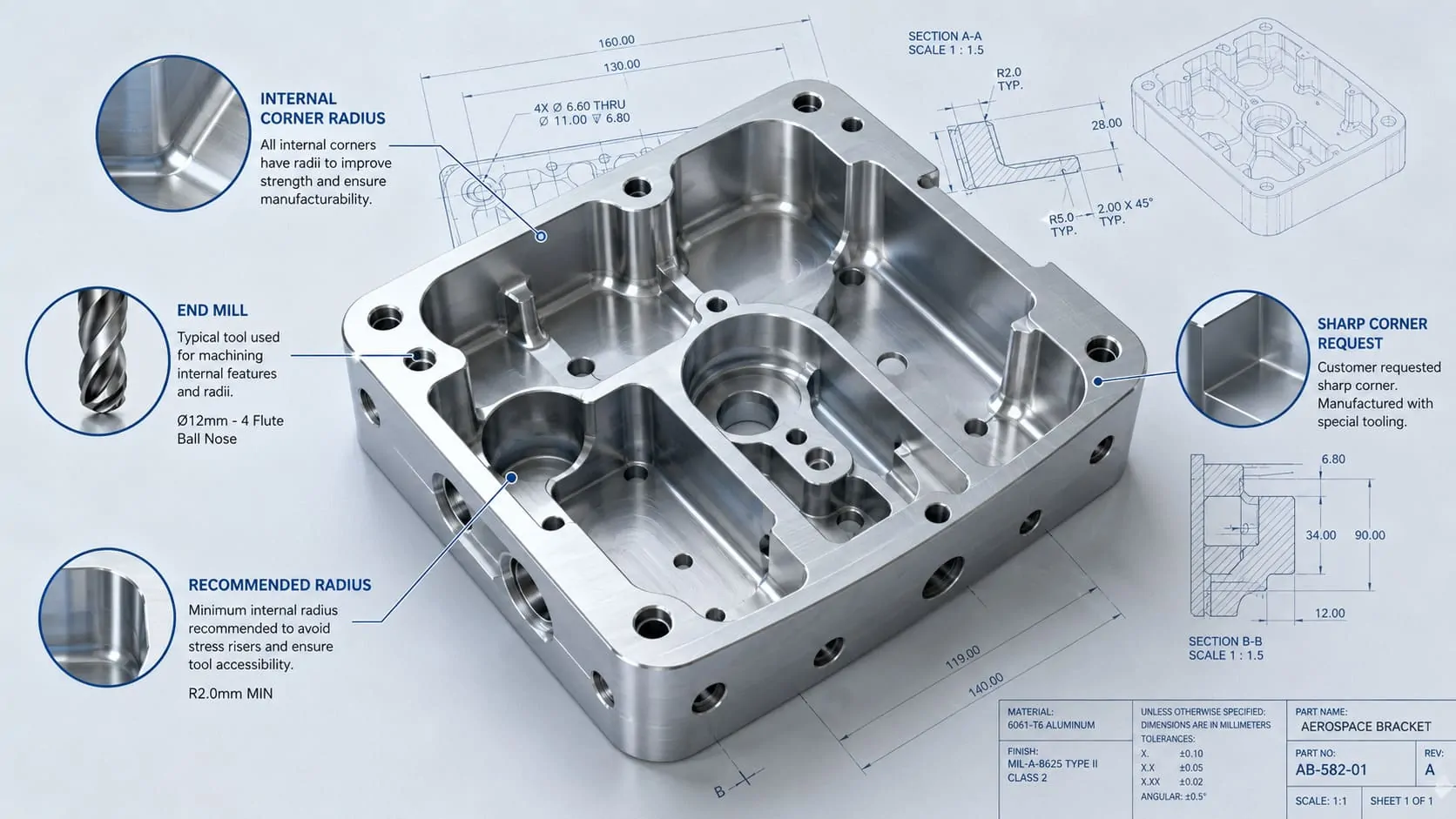
Understanding how internal corner radii are created during machining can help engineers improve part manufacturability, reduce machining time, and achieve more consistent production results. Proper corner radius design also plays an important role in tool life, surface finish quality, and overall production cost.
Whether you are designing precision prototypes or production components, following established CNC design guidelines can help prevent common manufacturing issues before production begins. Internal corner radius decisions should also be evaluated alongside wall thickness design, material selection, and overall Design for Manufacturability (DFM) considerations.
For applications requiring tight tolerances and complex geometries, experienced suppliers offering precision CNC machining services often review corner radius specifications during engineering evaluation to ensure optimal machining performance.
✔ Why CNC machines cannot create perfectly sharp internal corners ✔ Recommended corner radius guidelines for different tool sizes ✔ How corner radius affects machining speed and tool life ✔ Common internal corner radius design mistakes ✔ Dog bone corners vs standard corner radii ✔ Best practices for improving CNC manufacturability
An internal corner radius is the rounded transition created where two internal surfaces meet inside a CNC machined part. Unlike external edges, which can often be machined with sharp profiles, internal corners are produced using rotating cutting tools that naturally leave a radius equal to or larger than the cutting tool radius.
As a result, perfectly sharp internal corners are generally not achievable with conventional CNC milling processes. Instead, engineers must design corner radii that align with available cutting tool sizes and machining capabilities.
Understanding this limitation is an important part of effective CNC design guidelines, helping designers create parts that are easier to manufacture, more cost-efficient, and better suited for production-scale machining.
During CNC milling, material is removed using rotating end mills. Because these tools have a circular cutting profile, they cannot produce a perfectly square internal corner.
The smallest achievable internal corner radius is typically determined by the radius of the cutting tool being used. For example:
End Mill Diameter | Minimum Internal Radius |
|---|---|
2 mm | 1 mm |
4 mm | 2 mm |
6 mm | 3 mm |
8 mm | 4 mm |
In most applications, designers are encouraged to use corner radii larger than the minimum requirement whenever possible. Larger radii improve tool access, reduce machining stress, and often allow faster machining cycles.
For components requiring complex internal geometries, collaboration with suppliers providing custom CNC machining services can help identify the most practical corner radius specifications before production begins.
A common misconception is that CNC machines can reproduce every feature exactly as it appears in a CAD model. While modern CNC equipment offers exceptional precision, internal corners remain limited by cutting tool geometry.
Creating a perfectly sharp internal corner would require a cutting tool with zero diameter, which is physically impossible. Even advanced machining technologies typically rely on small-radius tools rather than true sharp-corner machining.
Attempting to specify perfectly sharp corners often results in:
Increased machining time
Additional tooling requirements
Higher manufacturing cost
Reduced tool life
Greater production complexity
For this reason, internal corner radius optimization is frequently included in Design for Manufacturability (DFM) reviews before production begins.
Many corner radius issues originate during the CAD design stage rather than during machining itself. Engineers often specify sharp internal corners without considering the cutting tools that will be used to manufacture the part.
From a manufacturing perspective, selecting corner radii that match standard tooling sizes can significantly improve machining efficiency, reduce setup complexity, and lower overall production cost. Experienced suppliers offering precision CNC machining services typically evaluate corner geometry early in the design review process to ensure the design aligns with real-world machining capabilities.
Although sharp internal corners may look clean and precise in a CAD model, they often create significant manufacturing challenges in CNC machining. Because cutting tools are round by nature, producing sharp internal geometry typically requires smaller tools, additional machining operations, or design modifications.
Understanding these limitations helps engineers create designs that are easier to manufacture, more cost-effective, and better suited for production.
CNC milling cutters remove material using a rotating circular cutting edge. As a result, every internal corner naturally inherits a radius based on the tool diameter.
Unlike external corners, which can often be machined to appear sharp, internal corners always require some level of radius unless secondary processes are introduced.
This geometric limitation is one of the fundamental principles covered in modern CNC machining guide and should be considered early in the design process.
As internal corner radii decrease, smaller cutting tools become necessary.
While small end mills can produce tighter radii, they also introduce several manufacturing challenges:
Reduced tool rigidity
Increased tool deflection
Slower material removal rates
Higher tool wear
Longer machining cycles
For example, reducing an internal radius from 3 mm to 1 mm may require a significantly smaller tool and additional machining passes.
In many cases, slightly increasing the corner radius can dramatically improve machining efficiency without affecting part functionality.
When very small radii or near-sharp corners are specified, machining strategies become more complex.
Additional finishing passes may be required to achieve the desired geometry, increasing:
Machine runtime
Programming complexity
Tool changes
Inspection requirements
These factors can contribute to longer lead times and higher production costs, especially for low-volume custom parts and precision components.
Corner radius requirements directly affect production efficiency.
Designs that use standard tooling-compatible radii generally require fewer machining operations and allow higher cutting speeds. Conversely, designs that require unusually small radii may increase cost due to:
Design Choice | Manufacturing Impact |
|---|---|
Larger Corner Radius | Faster machining and lower cost |
Standard Tool Radius | Improved efficiency |
Small Corner Radius | Longer machining time |
Near-Sharp Corner | Higher tooling and setup cost |
When evaluating cost optimization opportunities, corner radius selection is often reviewed alongside wall thickness design, material selection, and overall Design for Manufacturability (DFM) requirements.
Many engineers focus on achieving the smallest possible internal radius without evaluating whether the feature is functionally necessary.
From a manufacturing perspective, larger corner radii generally provide significant advantages. Standard tool sizes can be used more effectively, cutting forces are reduced, and machining operations become more stable.
In production environments, suppliers providing precision CNC machining services frequently recommend increasing internal corner radii wherever design requirements allow. Even small radius increases can reduce machining time, improve tool life, and lower overall production cost without affecting part performance.
For complex components, a design review performed during the DFM process can often identify corner radius optimizations before manufacturing begins.
Many internal corner radius issues can be resolved before production simply by aligning corner geometry with standard tooling sizes.
Early engineering review helps determine whether a specified radius is necessary for part function or whether a larger radius could improve manufacturability while maintaining design intent.
Selecting the proper internal corner radius is one of the simplest ways to improve CNC manufacturability. In most cases, the optimal radius is not the smallest achievable radius, but the largest radius that still meets functional and assembly requirements.
Larger corner radii allow the use of more rigid cutting tools, improve machining efficiency, reduce tool wear, and often lower overall manufacturing costs.
As a general rule, internal corner radii should be designed around standard cutting tool sizes whenever possible.
The minimum achievable internal corner radius is typically equal to the cutting tool radius. However, designing slightly larger radii is often preferred because it provides greater machining flexibility.
End Mill Diameter | Tool Radius | Recommended Internal Corner Radius |
|---|---|---|
2 mm | 1 mm | 1.0–1.5 mm |
4 mm | 2 mm | 2.0–3.0 mm |
6 mm | 3 mm | 3.0–4.5 mm |
8 mm | 4 mm | 4.0–6.0 mm |
10 mm | 5 mm | 5.0–8.0 mm |
For most CNC milled components, using a radius slightly larger than the minimum tool radius can improve cutting performance and reduce machining time.
Internal corner radius requirements should also be considered relative to overall part geometry.
Part Feature Size | Recommended Radius |
|---|---|
Small Features (<20 mm) | 1–2 mm |
Medium Features (20–100 mm) | 2–5 mm |
Large Features (>100 mm) | 5 mm+ |
Larger parts generally benefit from larger corner radii because larger tools can be used more effectively, improving machining efficiency and reducing cycle times.
Material selection can influence corner radius recommendations because different materials respond differently to cutting forces and tool wear.
Material | Typical Radius Recommendation |
|---|---|
Aluminum | Smaller radii generally achievable |
Stainless Steel | Moderate radii recommended |
Titanium | Larger radii preferred for stability |
PEEK | Larger radii improve machining consistency |
ABS | Moderate radii suitable |
When designing parts in different materials, radius selection should be evaluated alongside material selection and overall machining strategy.
A common best practice in CNC design is:
Use the largest internal corner radius that does not interfere with part function.
Larger radii provide several advantages:
Improved tool rigidity
Faster machining speeds
Reduced vibration
Better surface finish
Lower tooling costs
Longer tool life
Unless a small radius is required for assembly or functional reasons, larger radii generally lead to more efficient manufacturing.
Many designers specify corner radii based on CAD preferences rather than machining requirements. While small radii may appear visually cleaner, they often increase machining complexity without providing meaningful functional benefits.
From a manufacturing perspective, corner radii that align with standard tooling sizes usually deliver the best balance between precision, cost efficiency, and production speed.
Suppliers offering On-demand CNC manufacturing services frequently recommend adjusting corner radii during the DFM process to improve manufacturability and reduce unnecessary machining costs.
When evaluating CNC part designs, internal corner radii should be reviewed together with:
wall thickness design
material selection
tolerance requirements
tool accessibility
machining strategy
Optimizing these factors together often results in a more efficient and reliable manufacturing process.
Internal corner radius is more than a geometric feature. It directly influences cutting forces, tool engagement, machining stability, and overall production efficiency.
Selecting an appropriate radius can improve machining performance throughout the manufacturing process, while overly small radii often increase complexity and production risk.
Understanding these effects helps engineers make better design decisions and achieve more reliable machining results.
Tool life is heavily influenced by the size of the internal corner radius.
Small radii typically require smaller cutting tools, which are more susceptible to deflection, vibration, and wear. Because smaller tools have less rigidity, they experience higher cutting loads and often require reduced machining parameters.
Larger corner radii allow the use of stronger and more rigid cutting tools, resulting in:
Lower cutting stress
Reduced tool wear
Improved tool stability
Longer tool life
For production environments where tooling costs and machine utilization are important, larger radii often provide significant operational advantages.
Surface finish quality is closely related to machining stability.
When machining very small internal radii, cutting tools may experience increased vibration, leading to:
Visible tool marks
Chatter patterns
Inconsistent surface quality
Additional finishing requirements
Larger radii generally enable smoother cutting conditions, producing more consistent surface finishes and reducing the need for secondary finishing operations.
This is particularly important for high-precision components manufactured through precision CNC machining services.
Internal corner radius directly affects material removal efficiency.
When small radii are specified, smaller tools must be used, reducing allowable feed rates and increasing cycle times.
By contrast, larger radii allow larger cutters to remove material more efficiently, improving:
Radius Size | Machining Performance |
|---|---|
Small Radius | Slower Cutting Speed |
Small Radius | Longer Cycle Time |
Large Radius | Faster Material Removal |
Large Radius | Higher Productivity |
For many applications, modest increases in corner radius can significantly reduce total machining time without affecting functionality.
Dimensional accuracy depends on machine capability, tooling rigidity, and machining stability.
Smaller cutting tools are generally more vulnerable to:
Tool deflection
Thermal effects
Vibration-induced variation
These factors can make it more difficult to maintain tight tolerances, especially in deep pockets and complex internal geometries.
Using larger corner radii whenever practical helps improve machining stability and contributes to more consistent dimensional control.
For components requiring strict tolerances, radius selection should be evaluated together with wall thickness design, material behavior, and overall machining strategy.
Many designers focus primarily on achieving specific geometry while overlooking how corner radius affects production efficiency.
In real manufacturing environments, a small increase in internal corner radius can often improve several key performance factors simultaneously:
Tool life
Surface finish
Machining speed
Dimensional consistency
Because of these combined benefits, suppliers offering custom CNC machining services frequently review corner radius specifications during the Design for Manufacturability (DFM) process to identify opportunities for production optimization.
Internal corner radius should not be evaluated as an isolated design feature.
The most manufacturable CNC designs typically balance:
Corner radius
Feature depth
Tool accessibility
Material selection
Tolerance requirements
Wall thickness
Reviewing these factors together early in the design stage can help reduce machining risk and improve overall production efficiency.
Designing internal corner radii correctly can significantly improve manufacturability, reduce machining costs, and minimize production delays.
While every application has unique requirements, several proven design practices can help engineers create CNC-friendly parts without compromising functionality.
The following recommendations are widely used across aerospace, medical, industrial, and precision manufacturing applications.
One of the simplest ways to improve CNC manufacturability is to use the largest internal corner radius that the design allows.
Larger radii enable the use of larger cutting tools, which typically provide:
Greater rigidity
Higher material removal rates
Reduced vibration
Longer tool life
Improved surface finish
Unless a specific functional requirement demands a smaller radius, increasing corner size often results in a more efficient machining process.
A practical design rule is:
If the radius does not affect assembly, fit, or performance, make it larger.
Corner radii should ideally correspond to commonly available end mill sizes.
When non-standard radii are specified, additional tooling may be required, increasing setup time and manufacturing cost.
For example:
Internal Radius | Typical Tool Diameter |
|---|---|
1 mm | 2 mm End Mill |
2 mm | 4 mm End Mill |
3 mm | 6 mm End Mill |
4 mm | 8 mm End Mill |
5 mm | 10 mm End Mill |
Designing around standard tooling improves manufacturing efficiency and helps simplify production planning.
For components requiring high precision, suppliers offering precision CNC machining services often recommend reviewing corner radii against available tooling during design validation.
Perfectly sharp internal corners are rarely necessary in practical engineering applications.
In many cases, sharp corners are introduced unintentionally during CAD modeling rather than for functional reasons.
Specifying sharp corners can result in:
Smaller cutting tools
Longer machining cycles
Increased programming complexity
Higher manufacturing cost
Before requiring a sharp corner, engineers should determine whether the feature is truly necessary for assembly or performance.
If not, introducing an appropriate radius will usually improve manufacturability.
Although larger radii are generally preferred, design requirements should always take precedence.
Certain assemblies may require:
Component alignment features
Square mating surfaces
Inserted components
Internal pockets with geometric constraints
In these situations, radius selection should balance manufacturability with functional requirements.
When corner geometry directly affects assembly performance, early collaboration with manufacturing engineers can help identify practical design solutions.
Corner radius should be reviewed as part of a comprehensive Design for Manufacturability (DFM) evaluation.
Rather than assessing radius independently, engineers should consider its interaction with:
Feature depth
Tool access
Material properties
Tolerance requirements
Surface finish specifications
Reviewing these factors together often reveals opportunities to improve production efficiency without changing part functionality.
For complex parts, early DFM review can prevent costly redesigns later in the manufacturing process.
Many machining challenges originate from design features that have little impact on part functionality but significantly affect manufacturability.
Internal corner radius is a common example.
A relatively small increase in radius may allow the use of larger tools, reduce machining time, improve tool life, and lower production costs simultaneously.
Suppliers providing CNC contract manufacturing services frequently identify these opportunities during engineering review and recommend adjustments that improve manufacturing efficiency while maintaining the original design intent.
Before releasing a design for production, review the following questions:
✔ Can the radius be increased?
✔ Does the specified radius match a standard tool size?
✔ Is the corner required for function or only for appearance?
✔ Has the radius been evaluated during the DFM process?
✔ Could a larger radius reduce machining cost?
Answering these questions early can help avoid unnecessary manufacturing complexity and improve overall production performance.
In many CNC machined parts, internal corner radii are sufficient to meet functional and assembly requirements. However, certain applications require square mating features, inserted components, or tight-fitting assemblies where a standard internal radius may interfere with part function.
In these situations, engineers sometimes use a design feature known as a dog bone corner.
Dog bone corners create additional clearance in internal corners, allowing square or sharp-edged components to fit into CNC machined pockets that would otherwise contain a radius left by the cutting tool.
Understanding when to use dog bone corners can help improve assembly performance while maintaining manufacturability.
A dog bone corner is a relief feature added to an internal corner to compensate for the circular shape of CNC cutting tools.
Instead of attempting to machine a perfectly sharp corner, a small circular extension is added beyond the corner intersection.
This additional clearance allows:
Square components to fit properly
Sharp-edged inserts to seat correctly
Internal pockets to accommodate mating parts
Assembly interference to be reduced
Dog bone corners are commonly used in:
Mechanical assemblies
Fixtures and jigs
Precision enclosures
Inserted component designs
Wood and composite CNC applications
Feature | Standard Radius | Dog Bone Corner |
|---|---|---|
Machinability | Excellent | Good |
Tool Accessibility | Excellent | Good |
Assembly Clearance | Limited | Excellent |
Visual Appearance | Cleaner | More Functional |
Manufacturing Cost | Lower | Slightly Higher |
Standard internal radii are generally preferred whenever possible because they are simpler to machine and often provide better aesthetics.
Dog bone corners should be considered when assembly requirements cannot tolerate a standard internal radius.
Dog bone corners are most beneficial when:
A square component must fit into a machined pocket
Internal radii create assembly interference
Sharp mating geometry is required
Design constraints prevent increasing the corner radius
Typical examples include:
Electronic enclosures
Mechanical housings
Tooling fixtures
Alignment features
Inserted metal components
In these applications, dog bone corners can provide a practical solution without requiring secondary machining operations.
Despite their usefulness, dog bone corners should not be considered a default design solution.
For most CNC machined components, standard radii remain the preferred option because they:
Simplify machining
Reduce programming complexity
Improve aesthetics
Lower manufacturing cost
Support higher production efficiency
If a larger corner radius does not affect part function, it is usually the most efficient design choice.
Following established CNC design guidelines often eliminates the need for dog bone features altogether.
A common misconception is that dog bone corners improve machining performance.
In reality, dog bone corners are primarily an assembly-driven design feature.
From a manufacturing perspective, standard corner radii are usually easier and more cost-effective to machine. Dog bone corners become valuable when assembly requirements make standard radii impractical.
During the DFM process, experienced suppliers providing Made-to-order CNC parts services often evaluate whether assembly challenges can be solved by increasing corner radii before recommending dog bone features.
In many cases, a simple design modification can achieve the same functional result with less manufacturing complexity.
Before adding dog bone corners, consider the following:
✔ Can the mating component accommodate a radius?
✔ Can the corner radius be increased?
✔ Is the interference functionally significant?
✔ Will the dog bone feature affect appearance?
✔ Has the design been reviewed during Design for Manufacturability (DFM) evaluation?
If the answer to these questions suggests that assembly requirements truly demand square internal geometry, a dog bone corner may be the most practical solution.
Internal corner radius issues are among the most common design problems encountered during CNC manufacturing reviews.
Many of these mistakes originate during CAD modeling and may go unnoticed until machining begins. While some issues only increase production cost, others can directly affect machining quality, tool life, and overall manufacturability.
Understanding these common mistakes can help engineers create more production-friendly designs and avoid unnecessary manufacturing challenges.
One of the most frequent design errors is specifying an internal corner radius that requires an unusually small cutting tool.
While small tools can machine tighter radii, they often introduce:
Increased tool wear
Reduced rigidity
Longer cycle times
Higher manufacturing costs
Designing radii around standard tooling sizes generally provides a better balance between precision and manufacturability.
When tight corner requirements are unavoidable, suppliers offering precision Custom CNC milling and turning can help evaluate practical tooling options during the design review stage.
Perfectly sharp internal corners are one of the most common unrealistic expectations in CNC machining.
Because rotating cutting tools always create some degree of radius, specifying a sharp internal corner often results in:
Additional machining operations
Design revisions
Increased production complexity
Longer lead times
Before requiring a sharp corner, engineers should determine whether it is truly necessary for part function or assembly.
In many cases, a properly designed radius achieves the same objective with significantly lower manufacturing effort.
A corner radius may appear manufacturable on paper while still being difficult to machine due to limited tool access.
This issue is especially common in:
Deep pockets
Narrow cavities
Complex internal features
High aspect-ratio geometries
Even when the radius itself is acceptable, restricted tool access may require longer cutting tools, increasing the risk of tool deflection and vibration.
Corner radius decisions should always be evaluated together with overall feature geometry and machining strategy.
Not every corner radius requires the same level of dimensional precision.
Over-specifying tolerances can lead to:
Additional inspection requirements
Increased machining time
Higher production costs
More complex quality control procedures
Tolerance requirements should be applied only where they directly affect assembly, performance, or critical dimensions.
For many parts, functional tolerance analysis can reveal opportunities to simplify manufacturing without sacrificing performance.
Another common mistake is specifying numerous different radius values within the same component.
For example:
R1.0
R1.5
R2.0
R2.5
R3.0
Using multiple radius values may require:
Additional tool changes
More programming effort
Longer setup times
Increased manufacturing cost
Whenever practical, standardizing corner radii across the design can simplify machining and improve production efficiency.
Many radius-related problems are discovered only after the design has already been released for manufacturing.
At this stage, design changes may lead to:
Engineering revisions
Production delays
Additional cost
Extended lead times
Reviewing corner radius during the Design for Manufacturability (DFM) stage allows issues to be identified and resolved before production begins.
This proactive approach often reduces both manufacturing risk and project cost.
In production environments, the majority of corner radius challenges are not caused by machine limitations but by design decisions made without considering manufacturing requirements.
The most common issues include:
Excessively small radii
Unnecessary sharp corners
Inconsistent radius values
Limited tool accessibility
Suppliers providing Low volume custom CNC machining routinely identify these issues during engineering reviews and recommend modifications that improve manufacturability while preserving part functionality.
A relatively small design adjustment can often eliminate significant production challenges later in the process.
Before releasing a CNC design, verify the following:
✔ Radius matches available tool sizes
✔ Sharp corners are functionally required
✔ Tool access has been evaluated
✔ Radius values are standardized where possible
✔ Tolerances are applied only where necessary
✔ Radius has been reviewed during the DFM process
✔ Corner geometry supports efficient machining
Completing this review can help reduce production cost, improve machining efficiency, and shorten lead times.
Although both internal and external corner radii are common features in CNC machined parts, they affect manufacturing in very different ways.
Understanding the distinction between the two helps engineers make better design decisions and avoid unnecessary manufacturing constraints.
In general, internal radii are primarily limited by cutting tool geometry, while external radii are significantly easier to produce.
An internal corner radius is the rounded transition located inside a pocket, cavity, slot, or recessed feature.
Because CNC milling tools are round, internal corners naturally inherit a radius during machining.
As discussed throughout this guide, internal corner radii directly influence:
Tool selection
Machining efficiency
Tool life
Surface finish
Manufacturing cost
For this reason, internal radii are often reviewed during the Design for Manufacturability (DFM) process to ensure the design aligns with available tooling and machining capabilities.
An external corner radius is the rounded edge located on the outside of a component.
Examples include:
Outer edges
Exterior profiles
Rounded product corners
Structural edge transitions
Unlike internal radii, external radii are generally easier to machine because the cutting tool has unrestricted access to the feature.
External corner radii are commonly added to:
Improve aesthetics
Reduce stress concentrations
Enhance safety
Improve handling characteristics
Increase fatigue resistance
Feature | Internal Corner Radius | External Corner Radius |
|---|---|---|
Location | Inside pockets and cavities | Outside edges and profiles |
Tool Limitation | Highly dependent on tool size | Minimal limitation |
Manufacturing Difficulty | Higher | Lower |
Cost Impact | Significant | Usually minimal |
Tool Accessibility | Restricted | Open access |
DFM Importance | Critical | Moderate |
The most important distinction is that internal corner radii directly affect machinability, while external radii are generally much easier to manufacture.
For most CNC machined components, internal corner radii deserve greater engineering attention.
This is because internal corners directly influence:
Cutting tool selection
Cycle time
Tool wear
Machining stability
Production cost
External radii remain important from a product design perspective, but they rarely create the same manufacturing constraints as internal features.
As a result, engineering reviews performed by suppliers offering precision CNC machining services typically focus more heavily on internal corner geometry during design evaluation.
Many designers spend considerable time refining external geometry while overlooking internal features that have a greater impact on production.
In practice, internal corner radii often influence manufacturability more than external edge details.
During engineering reviews, suppliers providing custom CNC machining services frequently identify internal geometry as a primary driver of machining time, tooling requirements, and production cost.
Optimizing internal features early in the design process can significantly improve manufacturing efficiency and reduce project risk.
When deciding where to focus design optimization efforts:
✔ Internal corner radius
✔ Pocket geometry
✔ Tool accessibility
✔ Feature depth
✔ Wall thickness design
✔ Tolerance requirements
Once these critical manufacturing features have been optimized, external radii can then be refined for appearance, ergonomics, or product-specific requirements.
Designing manufacturable CNC parts involves more than selecting the correct internal corner radius. Feature depth, tool accessibility, material selection, tolerances, and Minimum wall thickness design all play a critical role in machining efficiency and production cost.
At NAITE TECH, our engineering team reviews every project from a manufacturing perspective, helping customers identify potential machining challenges before production begins. Through our Design for Manufacturability (DFM) review process, we evaluate critical design features such as internal corner radii, pocket geometry, tool access, and tolerance requirements to improve manufacturability and reduce unnecessary costs.
Whether you are developing prototypes or preparing for production, our CNC machining services support a wide range of materials, complex geometries, and precision requirements.
✔ Internal Corner Radius Optimization ✔ Tool Accessibility Evaluation ✔ Pocket & Cavity Manufacturability Review ✔ Tolerance Analysis ✔ Material Selection Recommendations ✔ Wall Thickness Assessment ✔ Cost Reduction Opportunities ✔ Manufacturing Process Optimization
The minimum internal corner radius is typically determined by the radius of the cutting tool being used. For example, a 2 mm end mill generally produces a minimum internal radius of approximately 1 mm.
While smaller radii can sometimes be achieved using specialized tooling, doing so often increases machining time, tool wear, and manufacturing cost. In most cases, following established CNC design guidelines and selecting radii that match standard tool sizes results in a more efficient manufacturing process.
No. Conventional CNC milling uses rotating cutting tools that naturally leave a radius in internal corners.
Because a cutting tool cannot have a zero diameter, perfectly sharp internal corners are generally impossible to produce using standard CNC milling operations.
If a design requires square mating geometry, engineers may consider using dog bone corners or modifying the assembly design during a Design for Manufacturability (DFM) review.
A good internal corner radius is typically the largest radius that does not interfere with part functionality or assembly requirements.
As a general guideline:
Larger radii generally improve machining efficiency, reduce tool wear, and lower manufacturing costs.
Larger corner radii allow machinists to use larger and more rigid cutting tools.
This typically results in:
As a result, larger radii often lower overall production costs while improving manufacturing efficiency.
Corner radius directly influences the size of the cutting tool required.
Smaller radii generally require smaller tools, which experience greater cutting stress and are more susceptible to wear and deflection.
Larger radii allow stronger tooling to be used, improving cutting stability and extending tool life.
Yes.
Whenever possible, internal corner radii should be designed around commonly available end mill sizes.
Matching standard tooling helps:
Many engineering reviews identify opportunities to optimize corner radii simply by aligning them with standard cutting tools.
Dog bone corners are typically used when a square or sharp-edged component must fit into a CNC machined pocket that naturally contains a radius.
They are commonly used in:
If a standard internal radius creates assembly interference, a dog bone corner can provide the necessary clearance while maintaining machinability.
The best approach is to evaluate corner radii as part of a broader Design for Manufacturability (DFM) process.
Corner radius should be reviewed alongside:
Early engineering review often identifies opportunities to improve manufacturability while reducing production cost and lead time.


