
- Home
- Capabilities
- Solution
- Material
- Industry
- Resources
- Request a Quote
Views: 0 Author: Site Editor Publish Time: 2026-07-15 Origin: Site
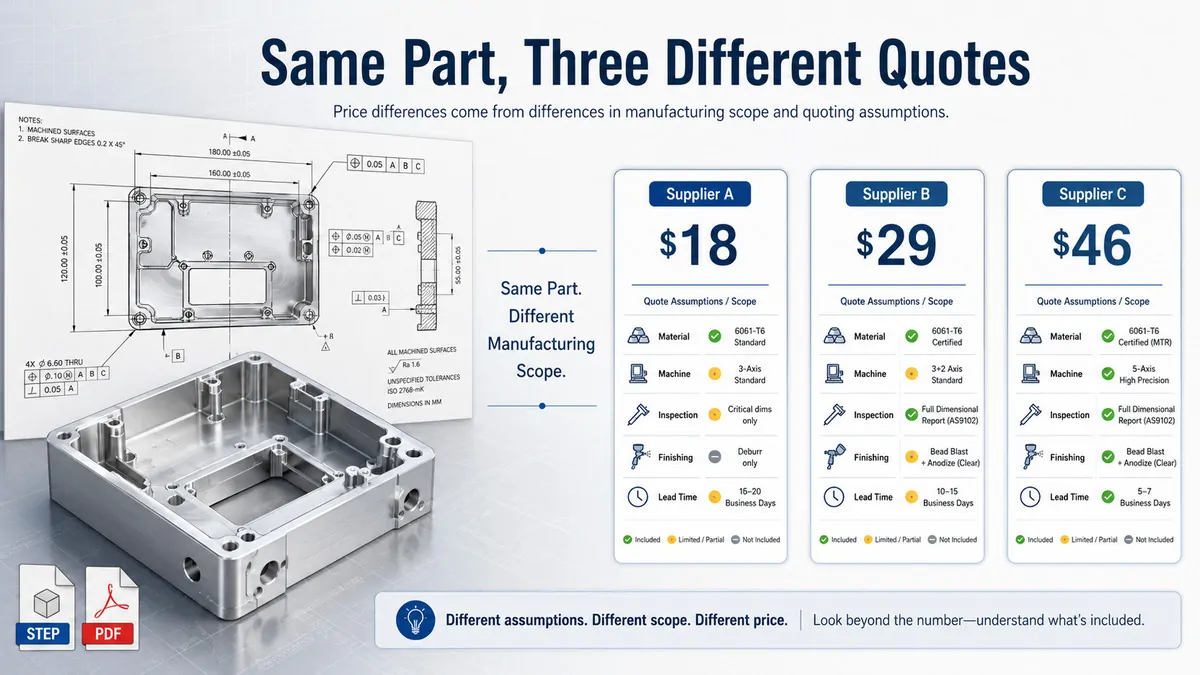
You send the same STEP file and engineering drawing to three CNC machining suppliers. A few days later, the quotations arrive—and the prices are nowhere near each other.
One supplier quotes $18 per part. Another quotes $29. A third comes back at $46.
At first glance, it may seem that one supplier is unusually cheap or another is charging too much. In reality, the three suppliers may not be quoting exactly the same manufacturing solution.
A CNC machining quote is not calculated from part size alone. Each supplier must decide how the part will be manufactured, which material stock will be used, how many setups are required, what equipment is suitable, how the tolerances will be controlled, and how much inspection is necessary. They must also account for finishing, packaging, production risk, and delivery requirements.
Different assumptions in any of these areas can create a significant price difference.
For example, one supplier may quote commercial-grade material without certification, while another includes full material traceability. One may plan to machine the part in several setups on a three-axis machine, while another uses five-axis machining to reduce repositioning and improve feature accuracy. One quotation may include only standard sampling inspection, while another includes a complete dimensional report and CMM measurement.
The unit prices may be different because the manufacturing scope is different.
Quotation factor | Why supplier prices may differ |
|---|---|
Material | Grade, stock size, source, certification, and material utilization |
Machining process | Machine type, number of setups, fixtures, and toolpath strategy |
Tolerances | Process stability, finishing passes, measurement, and scrap risk |
Inspection | Basic sampling, full inspection, FAI, or CMM reports |
Surface finishing | Masking, cosmetic standards, color control, and dimensional compensation |
Quantity | Programming and setup costs are distributed across different volumes |
Lead time | Rush production may require overtime, priority scheduling, or expedited sourcing |
Commercial scope | Packaging, shipping, tooling, and documentation may be included or excluded |
This is why comparing CNC machining quotes by unit price alone can be misleading.
A lower quotation is not automatically a poor choice. The supplier may have more suitable equipment, material already in stock, proven fixtures, or extensive experience producing similar parts. These advantages can reduce cost without reducing quality.
However, a low price may also result from missing requirements, optimistic machining-time estimates, limited inspection, or excluded finishing and documentation costs.
A higher quotation is not automatically better either. It may include services that your project does not need, use an unnecessarily expensive manufacturing process, or allow for more risk than the part actually presents.
The key question is therefore not:
Which supplier has the lowest price?
A more useful question is:
Are all suppliers quoting the same material, manufacturing requirements, quality standards, and delivery scope?
Before selecting a supplier, buyers should understand what is included, what is excluded, and which assumptions were used to calculate the price. This makes it possible to identify genuine cost advantages while avoiding unexpected charges, quality issues, or delivery delays after the order is placed.
For a closer look at how material, setup, machine time, tooling, inspection, and finishing contribute to the final price, see our CNC machining cost breakdown.
Two suppliers can study the same drawing and arrive at very different production plans. Both plans may be technically capable of producing the part, but they may require different amounts of material, machine time, tooling, setup work, and operator involvement.
This is one of the main reasons CNC machining quotations vary. The supplier is not only pricing the finished component. They are pricing the entire route required to turn raw material into a conforming part.
Material cost begins with the raw stock, not the weight of the finished part.
A completed component may weigh only 300 grams, but the supplier may need to start with a much larger block, plate, or bar. Material removed as chips still has to be purchased, handled, and machined. Parts with deep pockets, irregular profiles, or large amounts of material removal can therefore cost more than their finished weight suggests.
Suppliers may also select different stock dimensions. One supplier may have a suitable standard size available, while another must purchase an oversized block and machine away more material. This affects both the raw-material cost and the required machining time.
The specified alloy or material condition creates another source of variation. Examples include:
Aluminum 6061-T6 versus 7075-T6
Stainless steel 303 versus 304 or 316
Annealed material versus heat-treated material
Standard engineering plastic versus medical- or semiconductor-grade material
Commercial material versus customer-approved brands
These materials differ in purchase price, machinability, tool wear, cutting speed, and production risk.
For example, aluminum 6061 is generally easier and less expensive to machine than 7075. Stainless steel 316 offers strong corrosion resistance, but it is more difficult to cut than free-machining stainless steel 303. Titanium and high-performance plastics may require specialized tooling, controlled cutting parameters, and more careful handling.
Material documentation must also be considered. A basic quote may include standard commercial stock without additional records. Another quote may include:
Mill test certificates
Chemical composition reports
Heat or batch traceability
Country-of-origin documentation
RoHS or REACH declarations
Customer-specific material approvals
These documents add sourcing and administrative work, but they may be essential for aerospace, medical, automotive, or regulated industrial applications.
When comparing quotations, buyers should verify that every supplier is pricing the same material grade, condition, certification level, and traceability requirement. A lower price based on a different material specification is not a true cost advantage.
There is rarely only one way to manufacture a CNC component.
A supplier may choose a process based on the equipment available in its factory, previous experience with similar parts, fixture capability, production volume, and required accuracy. This means that two suppliers may use completely different methods to produce the same final geometry.
Consider a complex aluminum housing with features on five sides.
One supplier may use a three-axis machining center and reposition the part several times. Each setup requires locating, clamping, aligning, and checking the workpiece. Additional setups increase handling time and can introduce cumulative positional error between related features.
Another supplier may use multi-axis CNC milling services to reach more surfaces in fewer setups. The hourly machine rate may be higher, but the overall process may require less handling, fewer fixtures, and less intermediate inspection.
For parts with angled holes, compound surfaces, deep cavities, or closely related features on multiple faces, 5-axis CNC machining can reduce repositioning and improve consistency. In some cases, five-axis machining produces a lower total cost even though the machine itself is more expensive to operate.
The same principle applies to cylindrical components.
A shaft, fitting, connector, or valve component may be produced using:
CNC turning followed by secondary milling
A mill-turn machining center
Swiss-type machining
Multiple separate machines and operations
A supplier with suitable precision CNC turning services may complete most features in one process. Another supplier may need to transfer the part between several machines, increasing setup time, work-in-process handling, and inspection requirements.
Neither production route is automatically right or wrong. The important question is whether the selected process is appropriate for the part geometry, tolerance requirements, quantity, and delivery schedule.
Machine time is only one part of the quotation. Before the first production part can be completed, the supplier must prepare the entire machining process.
Typical setup work includes:
Reviewing the drawing and 3D model
Planning the machining sequence
Selecting tools and cutting parameters
Creating CAM programs
Designing or modifying fixtures
Manufacturing soft jaws
Installing and aligning the workpiece
Setting tool lengths and offsets
Running a first-off part
Inspecting and adjusting the process
For a simple part, this work may take only a short time. For a complex component with tight tolerances or several machining operations, preparation can take many hours.
The number of setups also matters. Every time a part is removed, rotated, and clamped again, the supplier must re-establish its position. More setups usually mean:
More operator time
Additional fixture requirements
More opportunities for positioning error
More in-process inspection
Longer total lead time
An experienced supplier may reduce the number of setups through better fixture design or more capable equipment. Another supplier may quote a lower hourly machine rate but require more manual operations. The final price depends on the complete process, not on the machine rate alone.
Complex CNC parts require more than loading a file into a machine.
The supplier must determine how to remove material safely and efficiently while maintaining dimensional accuracy and surface quality. This includes planning:
Roughing operations
Semi-finishing passes
Final finishing passes
Tool approach and retraction
Collision avoidance
Chip evacuation
Tool changes
Workpiece support
Machining sequence
Different CAM strategies can produce very different cycle-time estimates.
One supplier may use high-efficiency roughing tools and optimized toolpaths to remove material quickly. Another may use conservative cutting parameters because of older equipment, limited tooling, or concern about vibration and deformation.
Aggressive machining can reduce cycle time, but it must remain stable and repeatable. A quotation based only on ideal machine time may not include realistic allowances for tool changes, measurement, chip removal, operator handling, and process adjustments.
This is especially important for difficult features such as:
Deep pockets
Thin walls
Small internal radii
Long-reach machining
Hard materials
Interrupted cuts
High cosmetic requirements
A reliable quotation should be based on a production strategy that can repeatedly achieve the drawing requirements—not simply the fastest theoretical cutting time.
Some parts can be machined using standard vises, collets, and cutting tools. Others require special fixtures, custom jaws, long-reach tools, form cutters, or dedicated inspection gauges.
Suppliers may handle these costs differently.
One quotation may list fixture and tooling charges separately. Another may distribute them across the unit price. A third supplier may already have suitable tooling available and therefore quote a lower setup cost.
This can make quotations appear more different than they actually are.
For prototype orders, a supplier may choose a flexible setup that avoids expensive dedicated fixtures. This keeps the initial investment low but may result in a higher unit cost.
For repeat or production orders, a custom fixture may reduce:
Loading time
Setup variation
Operator involvement
Inspection frequency
Unit machining cost
Buyers should therefore ask whether tooling and fixture charges are one-time costs, recurring costs, or included in the part price. This is particularly important when comparing prototype quotations with expected future production pricing.
A higher-end machine does not automatically guarantee a better quotation, and a lower hourly rate does not automatically produce a lower part cost.
The most cost-effective process depends on:
Part geometry
Required tolerances
Material
Number of machined surfaces
Production quantity
Fixture complexity
Inspection requirements
Delivery schedule
A simple plate may be most economical on a standard three-axis machining center. A complex multi-sided housing may benefit from five-axis machining. A high-volume precision pin may be better suited to Swiss machining than conventional turning.
The supplier’s ability to match the process to the part is often more important than the hourly machine rate.
When reviewing quotations, ask suppliers to explain the proposed manufacturing method, number of setups, required tooling, and any major process risks. A clear process explanation helps determine whether the price difference comes from genuine efficiency, missing requirements, or a fundamentally different production strategy.
A CNC machining quote is only as accurate as the technical requirements behind it.
Two suppliers may receive the same part geometry but interpret the drawing differently. One may treat most dimensions as standard machining features, while another may assume that several dimensions require special process control, additional finishing passes, and full inspection.
This difference becomes especially important when the drawing includes tight tolerances, complex GD&T, detailed inspection documentation, or cosmetic finishing requirements.
Tighter tolerances do not simply require a more accurate machine. They can influence almost every stage of production, including process planning, fixture design, cutting strategy, inspection, and handling.
A dimension with a general tolerance may be achievable through a standard machining process. A very tight dimension may require:
Additional semi-finishing and finishing operations
Slower and more stable cutting parameters
More frequent tool-offset adjustments
Higher-quality or dedicated cutting tools
Temperature-controlled measurement
Additional in-process inspection
More careful part handling
Greater allowance for scrap and rework
The location of the tolerance also matters.
A tight tolerance on an easily accessible outside diameter may be relatively straightforward. The same tolerance on a deep internal bore, thin wall, long unsupported feature, or dimension affected by multiple setups may be much more difficult to maintain.
This is why suppliers may react differently to the same drawing. One supplier may have experience with the feature and understand how to control it efficiently. Another may add a larger risk allowance because the process is unfamiliar or difficult to verify.
Buyers should also distinguish between functionally critical dimensions and dimensions that have been assigned tight tolerances without a clear assembly or performance requirement.
Applying tight tolerances to every feature can increase cost without improving part performance.
Our CNC machining tolerance design guide explains how standard and tight tolerances affect process complexity, inspection, and manufacturing cost.
Geometric Dimensioning and Tolerancing can help suppliers understand how a part must function in an assembly. When used correctly, GD&T can be more effective than applying tight coordinate tolerances to every individual dimension.
However, unclear or incomplete GD&T can make a quotation more difficult.
Common issues include:
Missing or inconsistent datums
Datum references that do not match the functional assembly
Position tolerances without clearly defined basic dimensions
Flatness or parallelism requirements applied to unstable surfaces
Concentricity requirements where runout may be more practical
Conflicting controls between the drawing and CAD model
Geometric tolerances that cannot be measured with the proposed inspection method
When requirements are unclear, suppliers generally take one of three approaches.
The first supplier may quote based on the most basic interpretation. This can produce a lower price, but technical questions may appear after the order is placed.
The second may assume the strictest interpretation and include additional machining and inspection. This creates a higher but more conservative quotation.
The third may pause the quotation and request clarification before pricing.
For complex parts, the third approach is usually the most reliable. Resolving drawing questions before production reduces the risk of later price changes, rejected parts, and disagreement over acceptance criteria.
Machining and inspection should not be treated as separate concerns. A tolerance only has practical value if the supplier can measure it reliably.
Basic inspection may include standard tools such as:
Calipers
Micrometers
Height gauges
Pin gauges
Thread gauges
Surface plates
More complex requirements may need:
Coordinate measuring machines
Optical measuring systems
Roundness or concentricity equipment
Surface roughness testers
Custom fixtures or gauges
Controlled measurement environments
The cost difference between basic sampling inspection and complete dimensional verification can be significant.
One quotation may include inspection of several critical dimensions from each production batch. Another may include full dimensional inspection for every part. A third may include a First Article Inspection report, CMM data, material certificates, and batch traceability.
These quotations do not represent the same quality scope.
Before comparing prices, buyers should confirm:
Which dimensions are considered critical?
Will inspection be based on sampling or 100% measurement?
Which measuring equipment will be used?
Is a First Article Inspection report required?
Is a full dimensional report included?
Are material certificates and traceability documents required?
Will inspection records be supplied with every shipment?
Our CNC machining quality control and inspection process combines incoming-material verification, first-piece inspection, in-process control, and final inspection according to the requirements of each project.
Some buyers require only conforming parts. Others need a complete quality package for internal approval, customer submission, or regulated-industry records.
Possible documentation includes:
First Article Inspection reports
Ballooned drawings
Full dimensional reports
CMM measurement results
Material certificates
Heat or batch records
Surface-treatment certificates
Certificates of Conformity
RoHS or REACH declarations
Calibration records
Production lot traceability
Preparing and reviewing this information requires engineering, quality, and administrative time.
A supplier that includes complete documentation may appear more expensive than one that provides only the finished parts. However, missing documents can create delays during incoming inspection, supplier approval, or final product release.
For this reason, documentation requirements should be clearly stated in the RFQ rather than requested after the quotation has been accepted.
Surface finishing is another common source of quotation differences.
A drawing may specify “anodized,” “bead blasted,” “passivated,” or “polished” without defining the complete acceptance standard.
For example, an anodized aluminum component may require only basic corrosion resistance. A visible electronics enclosure may also require:
Uniform bead-blast texture
Consistent color across production batches
Control of rack or hanging marks
Masking of electrical contact areas
Plugging of threaded holes
Protection of critical fits
Defined cosmetic inspection zones
Individual packaging to prevent scratches
These requirements involve more than sending the parts to a finishing supplier. They may require additional machining preparation, communication, masking, inspection, sorting, and packaging.
A quotation that includes only standard anodizing is not equivalent to one that includes complete cosmetic control.
Buyers should define:
Finish type
Applicable standard
Color
Gloss or texture
Coating thickness
Masking requirements
Critical cosmetic surfaces
Acceptable rack-mark locations
Packaging requirements
Our guide on how to specify CNC surface finish requirements can help reduce ambiguity before requesting a quotation.
Surface treatments can add material, remove material, or alter the condition of the machined surface.
Anodizing, plating, powder coating, passivation, electropolishing, polishing, and bead blasting affect parts in different ways.
Depending on the process, finishing can influence:
Hole diameters
External dimensions
Thread fit
Bearing or sealing surfaces
Surface roughness
Edge condition
Electrical contact areas
Appearance and color consistency
A supplier that understands the finishing process may adjust machining dimensions before treatment, mask critical surfaces, or plan final inspection after finishing.
Another supplier may quote the machined part and finishing operation separately without allowing for dimensional changes.
The first quotation may be higher because it includes responsibility for the complete finished component. The second may be lower but leave greater risk that the final dimensions will not meet the drawing.
NAITE TECH provides integrated surface finishing services for CNC parts so that machining allowances, masking, finishing, and final inspection can be planned as one manufacturing process.
Terms such as “good appearance,” “no visible defects,” or “premium finish” are subjective.
Without clear standards, the buyer and supplier may judge the same part differently.
For cosmetic components, the RFQ should define:
Which surfaces are cosmetic
The inspection distance and lighting conditions
Whether minor tool marks are acceptable
Acceptable locations for fixture or rack marks
Color and texture expectations
Whether different production batches must match
Packaging needed to protect finished surfaces
Reference samples or approved limit samples can also reduce uncertainty.
When cosmetic requirements are not defined, some suppliers quote a basic finish, while others include additional polishing, sorting, and rejection allowances. This can create a large price difference even when both quotations use the same finishing name.
The most reliable way to reduce quotation variation is to give every supplier the same technical and quality information.
A complete RFQ should clearly identify:
Critical dimensions
General tolerances
GD&T and datum requirements
Inspection methods
Sampling or full-inspection expectations
Required quality documents
Surface finish specifications
Cosmetic acceptance standards
Post-finishing dimensional requirements
When these details are clear, suppliers can focus on finding the most efficient manufacturing solution rather than pricing uncertainty.
This makes quotations easier to compare and reduces the chance of unexpected charges, quality disputes, or delivery delays after production begins.
The same CNC part can have a very different unit price depending on whether the buyer needs one prototype, 50 validation parts, or 5,000 production units.
Quantity affects more than material purchasing. It changes how much engineering effort the supplier can justify, which fixtures should be used, how inspection is organized, and whether the process can be automated.
Lead time introduces another layer of complexity. A supplier quoting a normal production schedule is solving a different problem from one being asked to deliver fully inspected and finished parts within a few days.
To understand a quotation correctly, buyers need to consider how volume, delivery expectations, and manufacturing risk are reflected in the price.
Every CNC project includes work that must be completed before repeat production begins. Typical one-time or fixed activities include:
Drawing and CAD model review
DFM analysis
CAM programming
Tool selection
Fixture or soft-jaw preparation
Machine setup
First-part machining
Program adjustment
First-piece inspection
Quality-document preparation
For a one-part prototype, nearly all of these costs must be absorbed by a single component. For an order of 500 parts, the same setup and programming costs can be distributed across the entire batch.
This is why multiplying a prototype price by the expected production quantity rarely provides an accurate production estimate.
Consider a simplified example. A project requires $600 of programming, setup, and first-article work before regular production begins.
Order quantity | Fixed cost allocated per part |
|---|---|
1 part | $600.00 |
10 parts | $60.00 |
100 parts | $6.00 |
1,000 parts | $0.60 |
The actual quotation will also include material, machining, inspection, finishing, and profit, but this example shows why unit cost can fall significantly as volume increases.
However, the price does not always decrease at the same rate. Higher quantities may require additional investment in:
Dedicated production fixtures
Backup cutting tools
Process validation
Automated loading
In-process gauging
Additional inspection resources
Batch identification and traceability
More protective packaging
These investments may increase the initial project cost while reducing the recurring unit price and improving production stability.
The most economical way to produce ten parts may not be the best way to produce 1,000.
For prototypes, suppliers often prioritize flexibility. They may use standard vises, modular fixtures, manual loading, and general-purpose tooling. This keeps one-time costs under control and allows design changes to be introduced quickly.
For repeat production, the supplier may redesign the process around speed and consistency. This can include:
Dedicated fixtures
Multiple-part workholding
Optimized toolpaths
Tool-life monitoring
Automatic part probing
Reduced operator handling
Defined inspection intervals
Batch production scheduling
As a result, a supplier may provide separate prices for:
Prototype production
Pilot or validation batches
Low-volume production
Recurring production orders
This does not necessarily mean the supplier is changing the price arbitrarily. The manufacturing strategy itself may change as the project moves from development into stable production.
Buyers should provide realistic expected volumes during the RFQ stage. Even when the first order is small, information about possible annual demand can help the supplier propose a more suitable long-term process.
Higher quantity usually reduces the effect of setup cost per part, but other factors can prevent the unit price from falling as expected.
For example:
Material prices may change at different purchasing volumes
Long production runs may require several sets of cutting tools
Tight tolerances may require frequent machine-offset adjustments
Cosmetic parts may require individual inspection and packaging
Full traceability may be required for every production lot
A large order may occupy critical equipment for an extended period
Delivery may need to be divided into several scheduled shipments
Production capacity also matters. A supplier with available equipment may price a large order competitively. Another supplier may need overtime, subcontracting, or schedule changes to accept the same project.
For this reason, buyers should not assume that every supplier has the same ideal production volume.
A prototype specialist may offer an excellent price for five complex components but be less competitive for repetitive production. A high-volume manufacturer may have a higher prototype price but a much lower recurring unit cost once fixtures and processes are established.
The best supplier is often the one whose equipment, production model, and quality system match the expected order volume.
A lead time should cover more than the hours during which the part is physically being cut.
A complete CNC machining schedule may include:
Engineering and drawing review
Material procurement
Programming and fixture preparation
Machine scheduling
First-part production
First-piece approval
Batch machining
In-process inspection
External or internal surface finishing
Final inspection
Documentation and packaging
Shipping preparation
Two suppliers may therefore quote different lead times because they are measuring different stages.
One supplier may state the machining time after material arrives. Another may quote the complete period from order confirmation to finished parts being ready for shipment.
Buyers should confirm exactly when the lead-time clock begins and what event marks completion.
Useful questions include:
Does the lead time begin after purchase-order confirmation or drawing approval?
Is material procurement included?
Is surface finishing included?
Are inspection reports included in the schedule?
Does the stated date refer to shipment or delivery?
How will drawing changes affect the schedule?
Without these details, an apparently faster quotation may not actually produce an earlier delivery.
Rush production is not simply normal production completed faster.
To shorten the schedule, a supplier may need to:
Interrupt an existing machine schedule
Assign engineering work immediately
Purchase material from a premium source
Use overtime or additional shifts
Reserve inspection equipment
Expedite anodizing, plating, or heat treatment
Use priority courier or air freight
Accept lower production flexibility
Carry greater risk if rework becomes necessary
These actions create real additional costs.
A rush order can also reduce the time available for process development. For straightforward parts with available material and standard tolerances, this may be manageable. For complex parts with tight GD&T, thin walls, special finishing, or full documentation, an unrealistic schedule can increase quality risk.
Before approving a rush premium, buyers should ask which part of the normal schedule is being shortened. The supplier may be able to reduce lead time more economically by changing:
Material availability
Order quantity
Inspection documentation
Surface treatment
Packaging
Delivery method
Noncritical tolerances
In some cases, shipping a smaller priority batch first and completing the remaining quantity under a standard schedule offers a better balance of cost and urgency.
A CNC quotation must account not only for a successful part, but for the probability of producing the entire order successfully.
Some components carry more manufacturing risk because of their material, geometry, tolerance, or finishing requirements.
Common risk drivers include:
Thin walls that may deform during clamping
Large aluminum parts with residual material stress
Deep pockets requiring long-reach tools
Slender shafts that may vibrate or bend
Tight flatness across broad surfaces
Closely controlled concentricity
Small internal radii
Hard or abrasive materials
Difficult chip evacuation
Critical dimensions affected by anodizing or plating
Strict cosmetic requirements
Low quantities with no allowance for process development
An experienced supplier may include additional setup time, conservative machining parameters, inspection, or a reasonable scrap allowance to manage these risks.
A less experienced supplier may overlook them or assume that every part will pass on the first attempt.
This can create a significant difference in quotation price.
A lower price based on an incomplete risk assessment may later result in:
Delivery delays
Requests to change tolerances
Additional charges
Inconsistent batch quality
Rework
Partial shipment
Rejected components
A realistic quotation should reflect the cost of delivering conforming parts consistently, not merely the theoretical cost of one ideal machining cycle.
Manufacturing risk does not always need to be accepted as additional cost. In many cases, it can be reduced before production through DFM review.
Potential improvements may include:
Increasing internal corner radii
Adjusting excessive depth-to-width ratios
Relaxing noncritical tolerances
Improving tool access
Adding practical clamping areas
Separating cosmetic and noncosmetic surfaces
Clarifying datum structures
Revising dimensions affected by finishing
Selecting a more stable material condition
Splitting urgent demand into staged deliveries
These changes can reduce process uncertainty while preserving the function of the component.
The best time to discuss them is before the quotation is finalized. Once material has been purchased, fixtures have been built, and production has begun, design changes become more expensive and disruptive.
Our precision aluminum housing case study shows how process planning, fixture design, tolerance control, finishing, and inspection were coordinated across a 500-unit production project.
When quotations differ, buyers should compare the assumptions behind quantity, lead time, and risk.
Ask each supplier to clarify:
Whether setup and tooling are included
Whether the quoted price applies only to the current quantity
How pricing changes at future volume levels
Whether the process will change for repeat production
What the lead time includes
Whether the schedule includes finishing and inspection
Which manufacturing risks have been identified
Whether design changes could reduce cost or lead time
How rejected parts or production delays will be handled
A supplier that clearly explains these points may provide a more reliable quotation than one offering a low unit price without a realistic production plan.
The goal is not simply to purchase machine time. It is to secure a repeatable manufacturing process that can meet the required quantity, quality, and delivery date.
A quoted unit price does not always represent the same scope of work.
One supplier may include material, programming, machining, inspection, finishing, and protective packaging in a single price. Another may quote only the machining operation and add tooling, inspection reports, surface treatment, or shipping later.
Both quotations may look complete at first glance, but they may lead to very different final costs.
Before choosing a supplier, buyers should determine exactly what each quotation includes, what it excludes, and which technical assumptions were used to calculate the price.
A complete CNC machining quotation may include some or all of the following:
Raw material
Material certification
Material traceability
Engineering and DFM review
CAM programming
Machine setup
Standard or custom fixtures
Soft jaws
Special cutting tools
First-part production
First Article Inspection
In-process inspection
Final dimensional inspection
CMM reports
Deburring and cleaning
Heat treatment
Surface finishing
Masking and plugging
Cosmetic inspection
Assembly
Custom packaging
Shipping
Duties and taxes
Replacement of rejected parts
If one supplier includes these items and another does not, comparing only the unit prices will produce a misleading result.
Consider the following example:
Quotation item | Supplier A | Supplier B | Supplier C |
|---|---|---|---|
Material certificate | Included | Not stated | Included |
Custom fixture | Separate charge | Included | Included |
Full dimensional report | Included | Not included | Additional charge |
Anodizing | Included | Excluded | Included |
Thread masking | Included | Not stated | Included |
Cosmetic inspection | Included | Basic visual check | Included |
Protective packaging | Individual packaging | Bulk packaging | Individual packaging |
Shipping | Excluded | Excluded | Included |
Lead time | 15 working days | 8 working days | 18 working days |
Supplier B may initially appear to offer the lowest price and shortest lead time. However, the quotation may not include anodizing, inspection documentation, masking, or protective packaging.
Once these items are added, the total project cost may be similar to—or higher than—the other quotations.
The purpose of comparison is therefore not to find the lowest number. It is to determine whether every supplier is pricing the same finished product and delivery requirement.
Reliable quote comparison begins before the quotations are received.
Every supplier should receive the same technical package, including:
The same 3D CAD file
The same 2D drawing revision
Material grade and condition
Order quantity
Expected repeat or annual volume
General tolerances
Critical dimensions and GD&T
Surface-finishing specifications
Inspection requirements
Required quality documents
Packaging expectations
Delivery destination
Target delivery date
Sending only a STEP file is often not enough.
A 3D model defines the geometry, but important requirements may appear only on the 2D drawing, such as:
Tight tolerances
Thread specifications
Surface roughness
GD&T controls
Heat treatment
Coating requirements
Inspection notes
Cosmetic standards
Special marking or packaging
If one supplier receives more complete information than another, the resulting quotations cannot be compared fairly.
Buyers should also make sure that all suppliers are working from the same drawing revision. A small design change can affect material size, tooling, setup strategy, cycle time, and inspection requirements.
A professional quotation should make important assumptions visible.
These may include:
Proposed material source
Raw stock form and size
Planned machining method
Number of setups
Fixture requirements
Inspection level
Surface-finishing scope
Packaging method
Shipping terms
Quotation validity
Lead-time starting point
Suppliers should also identify unclear requirements before the order is placed.
For example, if the drawing specifies anodizing but does not define color, coating thickness, or masking, the supplier should request clarification or state what has been assumed.
Without this step, the buyer may receive a low initial quotation followed by additional charges when the missing details are confirmed.
Useful questions to ask include:
Which material grade and condition have you quoted?
Are material certificates included?
Is tooling included in the unit price?
What inspection is included as standard?
Is the surface finish included?
Are masking and plugging included?
Does the lead time include finishing and inspection?
What packaging method is included?
Are shipping and import costs included?
Which requirements are excluded?
Clear answers make it easier to distinguish genuine manufacturing efficiency from missing scope.
CNC machining projects often include both one-time and recurring costs.
One-time costs may include:
CAM programming
Fixture design
Soft jaws
Special tooling
First Article Inspection
Process validation
Custom gauges
Initial quality documentation
Recurring costs may include:
Raw material
Machine time
Operator handling
Tool wear
In-process inspection
Surface finishing
Cleaning
Packaging
Suppliers may present these costs differently.
One supplier may charge a separate $800 fixture fee and a lower unit price. Another may distribute the fixture cost across the first order. A third may use a more flexible setup that requires no dedicated fixture but results in a higher machining cost per part.
The quotations may therefore look different even when the total cost is similar.
Separating one-time and recurring costs is especially important when:
The first order is a prototype batch
Repeat production is expected
The design may change
Several quantity levels are being evaluated
Tooling ownership matters
Production may be transferred later
Buyers should request pricing for realistic quantity levels whenever possible, such as:
10 prototype parts
100 validation parts
500 production parts
Annual demand
This makes it easier to understand whether the proposed manufacturing process can scale economically.
Inspection is one of the most common hidden differences between quotations.
A supplier may use the term “quality inspection” to describe basic dimensional checks. Another may include a formal First Article Inspection, full dimensional reporting, and CMM measurement.
Buyers should confirm:
Which dimensions will be measured
Whether inspection is sampling-based or 100%
Which measurement equipment will be used
Whether critical dimensions are checked during production
Whether a First Article Inspection report is included
Whether a full dimensional report is included
Whether material certificates are included
Whether reports are supplied with every batch
For a simple noncritical bracket, standard inspection may be sufficient.
For a valve body, precision shaft, medical component, or assembly part with complex GD&T, more detailed inspection may be necessary.
The correct inspection scope depends on the application. Paying for unnecessary documentation increases cost, but excluding required inspection can create much greater expenses during incoming inspection, assembly, or field use.
The quotation should be based on the condition in which the buyer expects to receive the component.
Ask whether the price covers:
Machining only
Machining and deburring
Heat treatment
Surface finishing
Marking
Cleaning
Final dimensional inspection
Cosmetic inspection
Assembly
Protective packaging
This distinction is especially important when finishing is outsourced.
Some machine shops quote the machined component and leave the buyer to manage anodizing, plating, heat treatment, or passivation separately. Other suppliers coordinate the complete process and accept responsibility for the final dimensions and appearance.
A complete solution may have a higher initial price, but it can reduce:
- Supplier coordination
- Transportation between processes
- Schedule uncertainty
- Dimensional disputes
- Cosmetic damage
- Responsibility gaps
When reviewing custom CNC machining services, buyers should evaluate whether the supplier can manage the complete finished-part requirement or only the machining stage.
Packaging may appear to be a minor detail, but it can have a significant effect on finished CNC parts.
Machined components can be damaged by:
Metal-to-metal contact
Moisture
Dust
Residual cutting fluids
Poorly protected threads
Impact during transportation
Scratching of cosmetic surfaces
Deformation of thin features
A quotation for bulk packaging is not equivalent to one that includes:
Individual bags
Foam separation
Thread protectors
Custom trays
Anti-corrosion protection
Vacuum packaging
Export cartons
Wooden cases
Delivery terms also need to be compared carefully.
A supplier may quote:
EXW
FOB
CIF
DAP
DDP
The quoted price may or may not include:
Domestic transport
Export handling
International freight
Insurance
Customs clearance
Import duties
Local delivery
A low EXW price can become less competitive after transport, customs, and local handling are added.
Buyers should therefore compare the total landed cost rather than only the factory unit price.
The final decision should include more than manufacturing cost.
A supplier relationship can also create costs through:
Slow engineering communication
Repeated clarification
Late delivery
Incomplete inspection records
Inconsistent production batches
Packaging damage
Rework
Replacement shipments
Production interruptions
These risks may not appear on the quotation, but they affect the true project cost.
When comparing suppliers, consider:
How quickly technical questions are answered
Whether the quotation identifies manufacturing risks
Whether the supplier proposes practical DFM improvements
Whether quality requirements are clearly acknowledged
Whether the lead time appears realistic
Whether responsibilities are clearly defined
How nonconforming parts will be handled
Whether repeat-order pricing is transparent
A detailed quotation does not guarantee perfect production, but it usually indicates that the supplier has reviewed the project carefully.
A quotation containing only a unit price and delivery date gives the buyer much less information about how the project will actually be controlled.
Before selecting a supplier, convert all quotations into one comparison format.
Comparison category | Supplier A | Supplier B | Supplier C |
|---|---|---|---|
Material specification | |||
Certification included | |||
Quantity quoted | |||
One-time tooling cost | |||
Unit price | |||
Inspection scope | |||
Quality documents | |||
Surface finish | |||
Masking requirements | |||
Packaging | |||
Lead time | |||
Shipping terms | |||
Total landed cost | |||
Key assumptions | |||
Main exclusions |
This approach makes hidden differences visible and reduces the risk of choosing a quote that appears inexpensive only because important requirements were omitted.
The best CNC machining quotation is not automatically the lowest or the most expensive.
It is the quotation that:
Matches the drawing and application
Uses the correct material
Includes the required inspection
Defines finishing and packaging clearly
Provides a realistic lead time
Identifies important assumptions
Separates one-time and recurring costs
Explains exclusions
Reflects a repeatable manufacturing plan
A clear quotation gives both buyer and supplier the same understanding of what will be manufactured, inspected, finished, documented, and delivered.
To receive a quotation based on your actual project requirements, upload your CAD files for a detailed CNC machining quote together with your drawing, material, quantity, tolerance, finishing, inspection, and delivery information.
A large price difference does not automatically mean that one supplier is unreliable or another is overcharging.
A lower quotation may reflect an efficient manufacturing process, suitable equipment, available material, or experience with similar components. A higher quotation may include stricter inspection, more complete documentation, better risk control, or services excluded by other suppliers.
The objective is not to judge a quote by its position in the price range. It is to understand why the price is different and whether the proposed manufacturing plan meets the project requirements.
A low quotation deserves closer review when the supplier provides a price without demonstrating that the drawing has been properly evaluated.
This is especially important for parts involving:
Tight tolerances
Complex GD&T
Multiple machined surfaces
Thin walls
Deep pockets
Difficult materials
Special surface finishing
Full dimensional inspection
Strict cosmetic requirements
Potential warning signs include the following.
A simple part may not require clarification. However, a complex drawing often contains requirements that should be confirmed before an accurate price can be calculated.
A supplier should normally identify issues such as:
Conflicting information between the CAD model and drawing
Unclear datum references
Unspecified material condition
Missing surface-finishing details
Tight tolerances on difficult features
Undefined cosmetic surfaces
Inspection requirements that are not stated clearly
When a supplier immediately provides a very low price without addressing obvious uncertainties, the quotation may be based on incomplete assumptions.
Those questions may return after the purchase order is placed, potentially resulting in price changes, design concessions, or delivery delays.
A quotation should clearly identify the material grade and condition being supplied.
For example, it is not sufficient to state only:
Aluminum
Stainless steel
Titanium
Engineering plastic
The quotation should confirm details such as:
Aluminum 6061-T6 or 7075-T6
Stainless steel 303, 304, or 316
Titanium Grade 2 or Grade 5
PEEK, Delrin, or another specified plastic grade
Required heat treatment
Required certification and traceability
A low quotation based on an alternative alloy, uncertified stock, or a different material condition cannot be compared directly with a quote that follows the complete specification.
The phrase “standard inspection included” can mean different things to different suppliers.
It may refer to a basic final check using calipers and micrometers. It may not include:
First Article Inspection
Full dimensional reporting
CMM measurement
Surface roughness verification
Material certification
Batch traceability
Inspection records supplied with the shipment
If the application requires documented inspection, the buyer should ask the supplier to define exactly what is included.
A very low quote may be reasonable for basic sampling inspection but unsuitable for a part that requires complete dimensional verification.
Surface treatment is often underestimated when the drawing contains only a general note such as “black anodized” or “passivated.”
A complete quote may need to include:
Surface preparation
Bead blasting
Masking
Thread plugging
Color control
Coating thickness
Rack-mark location
Cosmetic inspection
Dimensional compensation
Protective packaging
If these requirements are not confirmed, the initial price may cover only a basic treatment.
Additional costs may appear later when the customer clarifies that certain holes must be masked, visible surfaces must be uniform, or finished dimensions must remain within tight limits.
Some suppliers list fixture, programming, or special-tooling costs separately. Others include them in the unit price.
A very low unit price may be accompanied by one-time charges that are not immediately visible. Alternatively, the supplier may be assuming that standard workholding and tooling will be sufficient when the part actually requires a dedicated fixture.
Ask whether the quote includes:
CAM programming
Soft jaws
Custom fixtures
Special cutters
Inspection fixtures
Initial process development
This is especially important when comparing prototype and repeat-production prices.
A fast lead time may be possible when:
Suitable material is already in stock
The required machine has available capacity
The part is straightforward
No special finishing is required
Inspection documentation is limited
However, a short schedule becomes less credible when the project requires material sourcing, complex machining, external treatment, full inspection, and international shipping.
Buyers should confirm whether the quoted lead time includes:
Engineering review
Material procurement
Fixture preparation
Machining
Surface finishing
Final inspection
Documentation
Packaging
A supplier may quote eight days of machining while the complete order actually requires several additional weeks.
A professional quotation does not need to be excessively long, but it should identify the main conditions on which the price is based.
A quote containing only a unit price and delivery date may leave important questions unanswered.
The buyer should know:
Which drawing revision was used
Which material was quoted
What quantity the price applies to
What inspection is included
Whether finishing is included
Whether shipping is included
How long the price remains valid
Which requirements are excluded
Clear exclusions do not make a quotation less attractive. They reduce the risk of misunderstandings.
A lower price is not automatically a sign of missing scope or poor quality.
Some suppliers can offer a genuine cost advantage because their production resources are particularly well suited to the project.
Machine selection can have a major effect on cost.
A supplier using several setups on basic equipment may require more operator time and fixtures than one using an appropriate multi-axis or mill-turn machine.
The more capable machine may have a higher hourly rate, but the complete process may be shorter and more stable.
For example:
Five-axis machining may reduce multiple setups
Mill-turn equipment may eliminate secondary milling
Swiss machining may improve efficiency for small, long components
Pallet systems may reduce loading and setup time
Automatic probing may reduce manual measurement
The lower quote may therefore reflect a better process rather than a lower quality standard.
Material procurement can involve:
Minimum order quantities
Supplier delivery charges
Oversized stock
Cutting fees
Certification costs
Expedited sourcing
A supplier with the correct material already in stock may avoid many of these expenses.
This advantage is particularly significant for prototypes and small batches, where the minimum amount of raw stock can represent a large percentage of the total cost.
Previous experience can reduce:
Programming time
Fixture-development time
Tool-selection uncertainty
Process testing
Inspection planning
Scrap risk
A supplier that regularly produces similar housings, shafts, valve components, connectors, or precision brackets may have proven manufacturing strategies already available.
This experience can justify a lower price while improving process reliability.
However, buyers should still verify that the current drawing and requirements have been reviewed independently.
Factories do not always price machine time in exactly the same way.
A supplier may have suitable available capacity on a machine that would otherwise remain idle. Another supplier may need to reschedule a fully occupied production line or use overtime.
Available capacity can produce a legitimate pricing advantage, provided the supplier still has the engineering, inspection, and finishing resources required to support the project.
A supplier may reduce cost through:
Better material nesting
Multiple-part fixtures
Optimized toolpaths
Longer tool life
Reduced setup time
Automated loading
In-process probing
Efficient inspection sampling
Established finishing partners
These improvements reduce real manufacturing cost rather than removing essential requirements.
A strong supplier should be able to explain the main reasons for its cost advantage without revealing confidential process details.
A higher price may reflect a more complete or lower-risk manufacturing solution.
The key is to determine whether the additional cost delivers value that the project actually requires.
Not all tolerances have the same manufacturing impact.
A tight tolerance on an accessible external feature may be relatively easy to achieve. The same numerical tolerance on a deep bore, thin wall, large flat surface, or feature related across several setups may require much more control.
A higher quote may include:
More stable workholding
Additional machining operations
Semi-finishing before the final cut
Tool-offset monitoring
Temperature stabilization
More frequent inspection
Greater scrap allowance
These measures may be justified when dimensional consistency is critical to assembly or function.
A supplier that includes CMM inspection, full dimensional reporting, material traceability, or First Article documentation will normally have higher quality-control costs than one performing basic sampling.
The additional inspection may be appropriate for:
Complex GD&T
Critical mating features
Valve and sealing components
Medical or aerospace applications
Customer approval processes
New-product validation
High-cost assemblies
The buyer should evaluate whether this level of documentation is necessary rather than assuming that more inspection is always better.
Certain materials increase cutting-tool wear, machining time, and production risk.
Examples include:
Titanium
Hardened stainless steel
Nickel-based alloys
High-performance plastics
Abrasive composite materials
Finishing can also justify a higher quote when the part requires:
Tight cosmetic standards
Custom color matching
Controlled coating thickness
Extensive masking
Electropolishing
Special cleaning
Post-finishing dimensional inspection
In these situations, the supplier may be pricing responsibility for the final finished component rather than only the machining stage.
A higher rush quotation may include:
Priority engineering
Expedited material procurement
Overtime
Additional shifts
Reserved machine capacity
Expedited finishing
Priority inspection
Air freight or courier delivery
These costs may be justified when a production line is stopped, a customer deadline is fixed, or prototype timing is commercially critical.
The buyer should still ask which actions are creating the premium and whether staged delivery could reduce the cost.
A full-service supplier may manage:
Raw-material sourcing
Machining
Heat treatment
Surface finishing
Inspection
Quality documentation
Assembly
Packaging
International shipping
This solution may cost more than machining alone, but it can reduce the buyer’s coordination work and prevent responsibility gaps between separate vendors.
When comparing the price, consider the value of:
One accountable supplier
Fewer transportation stages
Better schedule coordination
Final inspection after all processes
Reduced risk of damage between suppliers
Simplified communication
A supplier may identify risks that other quotations have overlooked.
Examples include:
Thin-wall deformation
Distortion after heat treatment
Flatness changes after material removal
Coating effects on mating dimensions
Tool deflection in deep features
Cosmetic damage during handling
High scrap potential during initial production
Including additional material, process development, inspection, or schedule allowance may increase the quotation but reduce the likelihood of later failure.
The supplier should be able to explain these risks clearly and, where possible, propose DFM changes that reduce them.
When one quotation differs significantly from the rest, ask the supplier to explain the main cost assumptions.
Useful questions include:
Which material grade and condition have you quoted?
Are material certification and traceability included?
Which machining process and equipment will be used?
How many setups are expected?
Are programming, fixtures, and special tools included?
Which tolerances are creating the greatest manufacturing difficulty?
What inspection level is included?
Are finishing, masking, and cosmetic inspection included?
Does the lead time include material, finishing, and inspection?
Which assumptions or exclusions could change the final price?
The purpose is not to force every supplier to reveal a detailed internal cost model. It is to confirm that the quotation covers the same technical and commercial requirements.
A credible supplier should be able to explain the main reasons behind its price.
The explanation might be:
A more efficient manufacturing process
Fewer setups
Existing material inventory
Additional inspection
Higher finishing requirements
Dedicated fixtures
A rush-production premium
Identified manufacturing risk
What matters is whether the explanation is technically reasonable and consistent with the drawing.
A supplier that offers the lowest price but cannot explain how the part will be manufactured may present more risk than a slightly higher supplier with a clear process plan.
At the same time, a high price without a clear technical justification should not automatically be accepted.
The most reliable quotation is one that connects the price to a defined material specification, manufacturing process, quality scope, and delivery commitment.
A complete RFQ helps suppliers select the correct manufacturing process, identify potential risks, and provide quotations that are easier to compare. Expand each section below to review the information your RFQ should include.
The 3D CAD model allows the supplier to review the overall geometry, machined features, wall thickness, pocket depth, internal radii and tool accessibility. However, it normally does not contain every manufacturing requirement.
Include a complete 2D engineering drawing to define:
Avoid using general descriptions such as “aluminum,” “stainless steel” or “plastic.” Different grades can have significantly different material prices, machining characteristics and tool-wear requirements.
Order quantity influences programming, setup, fixture selection, automation and the cost allocated to each part. Include both the immediate requirement and realistic future demand.
Clearly identify the dimensions and geometric controls that directly affect assembly, sealing, alignment, motion or product performance. This helps the supplier avoid applying expensive controls to noncritical features.
For additional guidance, review our CNC machining tolerance design guide .
Inspection requirements should be confirmed before quotation because different measurement methods and reporting levels require different amounts of quality-control time.
Learn more about our CNC machining quality control and inspection capabilities.
A finish name alone may not provide enough information. Define the complete final-part requirement so the supplier can account for preparation, masking, dimensional changes and cosmetic inspection.
Review how to specify CNC surface finish requirements before sending the RFQ.
Clearly distinguish between the required shipment date and the date the parts must arrive at your facility.
Confidential product details are not always necessary, but basic application information helps the supplier understand which requirements are functionally important.
This information may allow the engineering team to recommend alternative materials, more practical tolerances or lower-cost machining features without compromising performance.
Upload your CAD files and project requirements. Our engineering team will review the manufacturing process, key cost drivers and potential DFM improvements.


