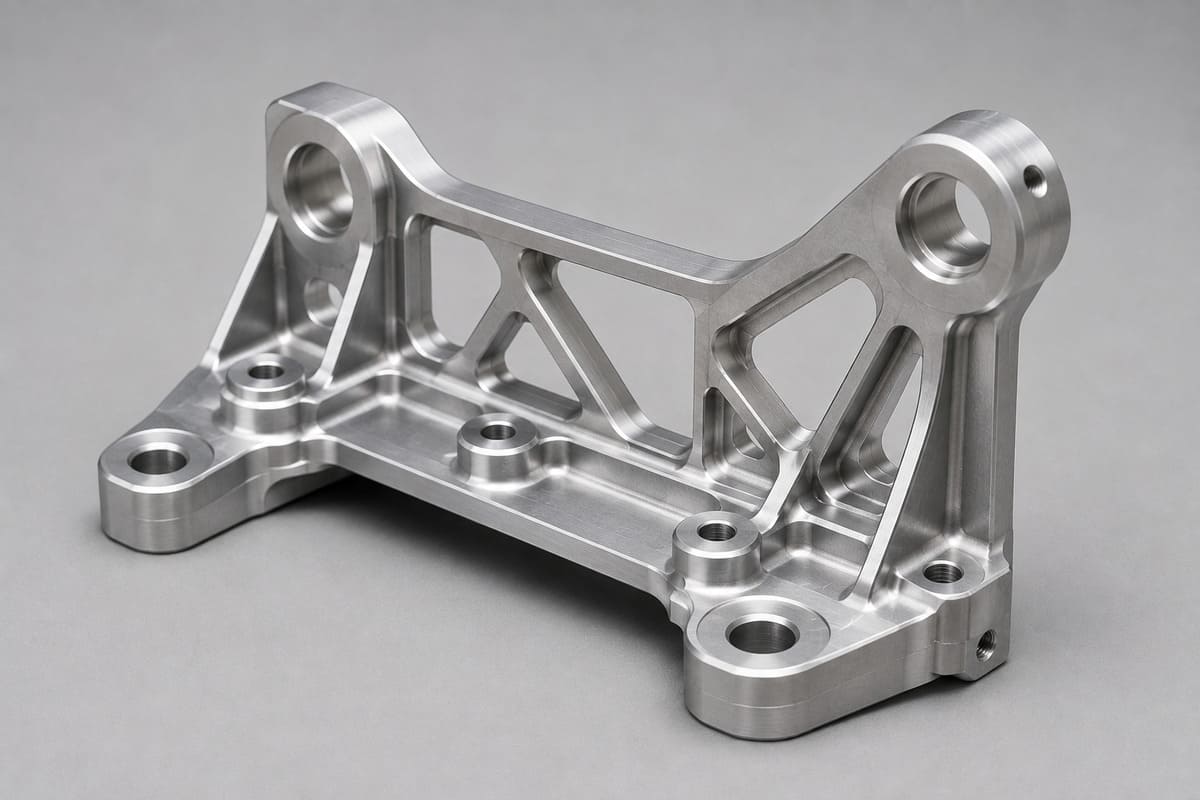
6061 vs 7075 Aluminum: Strength, Machinability, Cost & Applications
Views: 0 Author: NAITE TECH Engineering Team Publish Time: 2026-09-21 Origin: Site
6061 and 7075 are two of the most frequently specified aluminum alloys for CNC machined parts. Both offer a high strength-to-weight ratio, good machinability and broad availability, but they solve different engineering problems.
6061 is generally the more balanced alloy. It combines moderate-to-high strength with good corrosion resistance, weldability, finishing flexibility and relatively economical material cost. 7075 is selected primarily when significantly higher mechanical strength is worth the additional material cost and the trade-offs in welding and corrosion behavior.
For CNC machined parts, however, the decision should not be reduced to “6061 is cheaper” or “7075 is stronger.”
The correct choice depends on the load case, geometry, temper, product form, machining strategy, environmental exposure, surface treatment, inspection requirements and production quantity.
At NAITE TECH, we commonly machine both alloys for custom aluminum components. This guide compares 6061-T6/T651 and 7075-T6/T651 from a practical engineering and manufacturing perspective.
For most general-purpose CNC machined aluminum components, 6061 is the practical starting point because it provides a useful combination of strength, machinability, corrosion resistance, weldability, anodizing response, availability and cost.
Choose 7075 when the design genuinely benefits from its much higher yield and tensile strength, particularly where section size or part weight is constrained.
There is one important distinction that is often missed:
7075 is much stronger than 6061, but it is only slightly stiffer.
Typical reference values put the elastic modulus of 6061-T6/T651 at about 68.9 GPa and 7075-T6/T651 at about 71.7 GPa. That is only a small difference in elastic stiffness even though 7075 has roughly 80% higher typical yield strength.
If a 6061 bracket is bending too much while remaining below yield, changing the alloy to 7075 may therefore produce only a modest reduction in elastic deflection. Increasing section thickness, adding ribs or changing the load path can have a much larger effect.
6061 vs 7075 Aluminum at a Glance
Property
6061-T6 / T651
7075-T6 / T651
Practical Significance
Density
~2.70 g/cm³
~2.81 g/cm³
7075 is slightly heavier at equal volume
Ultimate tensile strength
~310 MPa
~572 MPa
7075 has substantially higher tensile strength
Yield strength
~276 MPa
~503 MPa
Major advantage for 7075 in compact, highly loaded parts
Elastic modulus
~68.9 GPa
~71.7 GPa
Only a small stiffness difference
Brinell hardness
~95 HB
~150 HB
7075 is considerably harder
Fatigue-strength reference*
~96.5 MPa
~159 MPa
Test-specific reference, not a universal design allowable
Corrosion resistance
Generally better
Generally lower in T6
Environment and finish matter
Conventional fusion weldability
Good, with HAZ strength loss
Generally poor
Important for fabricated assemblies
Anodizing
Common and generally predictable
Possible, but appearance/process control can be more demanding
Important for cosmetic parts
Material cost
Usually lower
Usually higher
Market price varies by form, size and region
Typical selection
General engineering
High-strength structures
Use 7075 when strength creates real value
*Mechanical-property values above are typical reference values, not design allowables. Actual requirements vary with specification, product form, thickness, orientation, temper and supplier certification.
Typical reference data for 6061-T6/T651 and 7075-T6/T651 support the large strength difference shown above, while their elastic moduli remain close.
That distinction is fundamental to good material selection.
What Is 6061 Aluminum?
6061 is a heat-treatable 6xxx-series aluminum alloy whose principal alloying system is magnesium and silicon, with smaller amounts of copper and chromium.
It is one of the most widely used engineering aluminum grades because no single property dominates at the expense of all the others. Instead, 6061 provides a useful balance of mechanical strength, corrosion resistance, joining capability, machinability and finishing performance.
The Aluminum Association describes 6xxx-series alloys as heat treatable, formable and weldable, with moderately high strength and excellent corrosion resistance. 6061 is one of the best-known alloys in that family.
The alloy number alone does not completely specify the material. Temper matters.
6061-T6 has been solution heat treated and artificially aged to develop its mechanical properties.
6061-T651 adds stress relief by controlled stretching. This condition is commonly encountered in plate and is useful for machined components where removing a large percentage of the original stock could otherwise expose residual stresses.
For heavily machined plates, large pockets or components with significant material removal on one side, the stress condition of the raw material can be as important as its nominal tensile strength.
It is therefore better to specify the required alloy and temper on the drawing rather than simply writing “6061 aluminum.”
Typical Applications of 6061
6061 is commonly used for CNC machined housings, mounting brackets, machine components, robotic structures, fixtures, frames, heat-transfer components, automotive parts, electronics hardware and general structural components.
Its weldability also makes it more practical than 7075 when machined parts must later become part of a welded assembly.
Hydro notes that 6061 responds well to anodizing and is readily welded by common commercial methods, although welding a T6 component reduces strength in the heat-affected zone unless an appropriate post-weld treatment is used.
What Is 7075 Aluminum?
7075 is a heat-treatable 7xxx-series aluminum alloy built around a zinc-magnesium-copper alloying system.
Its main reason for use is mechanical strength.
In the T6/T651 condition, 7075 reaches strength levels far above those of 6061 while maintaining the low density associated with aluminum. This makes it useful for compact structures where weight and section size are tightly constrained.
Common applications include aerospace structures, highly loaded brackets, performance automotive parts, tooling, shafts, precision mechanical components and other parts where higher strength-to-weight performance justifies the material.
7075-T6 is solution heat treated and artificially aged to obtain high strength.
7075-T651 includes stress relief by stretching and is widely encountered in plate used for CNC machining.
For machined structural parts, the product form and temper should be considered together.
A 7075 plate, extrusion and forging are not interchangeable simply because all three carry the same alloy number. Mechanical minimums, grain flow, available thicknesses, residual stress and applicable material specifications may differ.
For high-load or aerospace-related projects, the drawing should identify the required material specification rather than relying only on a generic alloy designation.
What About 7075-T73 or T7351?
Maximum strength is not always the only requirement.
7075 in the T6 family has known stress-corrosion considerations, particularly in demanding environments and certain material orientations. Overaged tempers such as T73/T7351 are used where improved stress-corrosion-cracking resistance is more important than maintaining maximum T6 strength. MatWeb notes this trade-off directly for 7075.
That is another reason a drawing that says only “7075” is incomplete for a critical application.
6061 vs 7075 Chemical Composition
The different behavior of these alloys begins with their chemistry.
Element
6061, wt.%
7075, wt.%
Silicon
0.40–0.80
≤0.40
Iron
≤0.70
≤0.50
Copper
0.15–0.40
1.20–2.00
Manganese
≤0.15
≤0.30
Magnesium
0.80–1.20
2.10–2.90
Chromium
0.04–0.35
0.18–0.28
Zinc
≤0.25
5.10–6.10
Titanium
≤0.15
≤0.20
Aluminum
Balance
Balance
The much higher zinc, magnesium and copper content in 7075 is central to its high precipitation-hardened strength. 6061 relies primarily on its magnesium-silicon system and has a more moderate strength level with better general fabrication flexibility.
The composition limits above are consistent with Aluminum Association-derived alloy tables.
6061 vs 7075 Mechanical Properties
Mechanical-property tables are useful, but they are also easy to misuse.
The values normally quoted online are typical reference numbers for a particular temper. Actual minimum properties depend on the governing specification, material form, thickness and test orientation.
They should be used for material comparison, not substituted blindly for certified design values.
Tensile Strength
Typical ultimate tensile strength is approximately:
6061-T6/T651: 310 MPa
7075-T6/T651: 572 MPa
That puts 7075 at roughly 84% higher typical ultimate tensile strength than 6061.
For a compact structural component where section size cannot be increased, this difference can be highly significant.
Yield Strength
Yield strength is often more useful than ultimate strength when evaluating whether a part will take a permanent set under static loading.
Typical reference values are approximately:
6061-T6/T651: 276 MPa
7075-T6/T651: 503 MPa
Again, 7075 provides roughly an 82% increase in typical yield strength.
This is the property difference that often justifies 7075 in a highly loaded, weight-sensitive bracket or structural component.
Hardness
Typical Brinell hardness values are around 95 HB for 6061-T6/T651 and 150 HB for 7075-T6/T651.
The higher hardness of 7075 influences cutting forces, edge loading and wear behavior, although hardness alone does not determine overall CNC machinability.
Fatigue Performance
Reference data also show higher fatigue-strength values for 7075-T6/T651 under specific laboratory test conditions.
This should not be converted into a universal “7075 lasts X% longer” rule.
Fatigue performance is highly dependent on stress concentration, surface condition, notch geometry, mean stress, load spectrum, material orientation, finish, corrosion environment and manufacturing defects.
For fatigue-critical components, use appropriate fatigue data for the actual material specification and perform a proper structural assessment.
Density and Strength-to-Weight Ratio
6061 has a typical density of about 2.70 g/cm³. 7075 is approximately 2.81 g/cm³.
At identical geometry, a 7075 component is therefore slightly heavier.
The reason 7075 is described as having a high strength-to-weight ratio is not that it is lighter than 6061. It is because its strength increases much more than its density does.
This distinction matters.
Replacing 6061 with 7075 without changing the geometry will not make the part lighter. Weight is reduced only if the higher allowable strength enables the design to use less material while still meeting structural requirements.
Stiffness: Why 7075 Is Stronger but Not Much Stiffer
This is one of the most important differences between strength and structural behavior.
Typical elastic modulus:
6061-T6/T651: approximately 68.9 GPa
7075-T6/T651: approximately 71.7 GPa
The difference is only about 4%.
Elastic modulus controls how much a material stretches or bends under load before permanent deformation occurs.
Yield strength controls when permanent deformation begins.
Those are different design problems.
Suppose a 6061 machine bracket stays well below its yield strength but deflects 0.20 mm under operating load. Replacing the same geometry with 7075 does not provide anything close to an 80% reduction in deflection because elastic modulus barely changes.
A geometry change may be more effective.
Increasing section height, adding a rib, shortening an unsupported span or changing the load path can improve stiffness much more than changing from one conventional aluminum alloy to another.
This is a common case where specifying 7075 can add cost without solving the actual engineering problem.
6061 vs 7075 Machinability
Both 6061-T6 and 7075-T6 are widely CNC machined.
A simple statement such as “6061 is machinable and 7075 is difficult to machine” is too crude to be useful.
Published machinability ratings themselves illustrate the problem: commonly cited Aluminum Association/MatWeb-derived reference data give 6061-T6/T651 a machinability rating around 50 on their aluminum scale and 7075-T6/T651 around 70.
That does not mean every 7075 part will be cheaper or easier to manufacture.
Machinability in a real CNC job depends on chip formation, hardness, tool material, cutter geometry, lubrication, tool engagement, wall thickness, toolpath strategy, part rigidity, tolerance and production quantity.
How 6061 Behaves During CNC Machining
6061 is an established material for milling and turning and supports high material-removal rates when the tooling and cutting conditions are appropriate.
Because it is softer than 7075, cutting-edge condition and chip evacuation deserve attention. Aluminum can adhere to the cutting edge under unfavorable conditions, causing built-up edge and degrading surface finish.
Sharp aluminum-specific cutting tools, appropriate rake geometry, effective chip evacuation and suitable coolant or lubrication help maintain a stable cut.
6061 is particularly attractive for prototypes and general production because raw material is widely available in bar, plate and extrusion forms.
How 7075 Behaves During CNC Machining
7075 is harder and stronger, which increases cutting-edge load compared with softer aluminum grades.
At the same time, its cutting behavior can be very good with appropriate tooling. The material should not automatically be classified as “poorly machinable.”
For precision parts, the greater concern is often not whether the cutter can remove material, but how the complete process controls:
When we quote a 7075 component, we therefore do not add cost simply because the drawing says “7075.” Geometry and process requirements are usually more important to machining time than the alloy name alone.
Thin-Wall and High-Material-Removal Parts
Thin-wall components require process planning regardless of whether they are 6061 or 7075.
The initial stock condition matters because machining can redistribute residual stresses as material is removed.
For plates with large pockets, thin floors or asymmetric material removal, using a stress-relieved temper such as T651 and planning roughing and finishing operations appropriately can improve dimensional stability.
Good practice may include balanced material removal, leaving finishing stock, controlling clamping force, allowing the workpiece to relax between operations, and measuring critical features after the part reaches a stable condition.
For general manufacturability recommendations on walls, pockets, radii and tolerances, see our CNC machining design guide.
6061 vs 7075 Corrosion Resistance
6061 generally provides better corrosion resistance than 7075-T6 in typical atmospheric environments.
This is one of the most important trade-offs for designers who select 7075 only because of its strength.
Protolabs likewise identifies lower general corrosion resistance and stress-corrosion susceptibility among the trade-offs of 7075 relative to 6061.
That does not mean 7075 cannot be used outdoors or in demanding environments.
It means the designer should evaluate:
environmental exposure, sustained tensile stress, material temper, galvanic couples, protective finish and maintenance conditions.
If the component is exposed to moisture, salt or contact with dissimilar metals, the surface-protection strategy should be considered at the design stage rather than after machining is complete.
For severe applications, the correct solution may also involve a different 7075 temper rather than automatically using T6.
6061 vs 7075 Anodizing and Surface Finishing
Both 6061 and 7075 can be anodized.
However, the final anodized appearance is influenced by alloy chemistry, raw-material condition, machining surface, pretreatment, anodizing process and dye.
6061 is widely used for anodized machined components and generally gives predictable results for industrial parts. Hydro specifically identifies good finishing and anodizing characteristics for 6061.
7075 can also be anodized, including protective and hard-anodized applications, but its higher copper and zinc content can influence coating appearance and process response.
For cosmetic parts, it is therefore better to approve the finish on representative production material than to assume that two different aluminum alloys will produce an identical color.
Cosmetic Anodizing
For a customer-facing housing where visual consistency is more important than maximum material strength, 6061 is often the more practical starting point.
The design team should also remember that alloy is only one source of variation. Different material lots, surface preparation, bead blasting, machining direction and anodizing batches can all affect appearance.
Color-critical production should be controlled through an agreed finish specification and, where appropriate, an approved sample.
Hard Anodizing
Type III hard anodizing is used when higher surface hardness and wear resistance are required.
The anodic coating also changes dimensions because oxide growth occurs at the surface. Tight-fitting bores, threads and precision mating features should therefore be reviewed before coating.
The machining drawing should identify whether dimensions apply before or after finishing.
NAITE TECH supports anodizing, hard anodizing, bead blasting, polishing and other secondary operations through our surface finishing services.
6061 vs 7075 Weldability and Fabrication
If the part must be welded using conventional fusion-welding methods, 6061 is usually much easier to incorporate into the design.
6061 is considered readily weldable by common commercial methods, although the heat-affected zone of a T6 component loses strength during welding.
That reduction must be included in structural design.
7075, by contrast, is generally considered a poor candidate for conventional fusion welding. Hydro likewise describes 7075 as a poor welding choice, while noting that resistance welding can be possible in appropriate applications.
If the design consists of several welded structural members, selecting 7075 purely for its high parent-material strength can create a manufacturing route that is unsuitable from the beginning.
Material selection should follow the complete assembly process, not only the strength of an isolated machined component.
6061 vs 7075 Cost
7075 generally costs more than 6061 as raw material, but quoting the difference as a fixed percentage is misleading.
Metal prices change with market conditions, stock form, thickness, supplier, order volume, certification and availability.
More importantly, raw stock is only one part of a finished CNC component.
A useful cost model is:
Finished part cost = material + programming + setup + machining + tooling + finishing + inspection + handling + process risk
The contribution of each term varies from part to part.
Raw Material Cost
For a simple component with very little machining, the price difference between 6061 and 7075 stock may have a strong influence on final cost.
For a complex 5-axis part with hours of machine time, extensive inspection and several finishing operations, material may represent a much smaller percentage of the total price.
In that case, even a substantial difference in raw-material price does not translate directly into the same percentage difference in finished-part cost.
Machining Cost
Machining cost is driven by the manufacturing process.
Important factors include stock size, material-removal volume, tool access, setup count, cutter engagement, tolerance, feature size and inspection.
The alloy affects the process, but it is only one variable.
A simple 7075 plate with two setups may cost less to machine than a highly pocketed 6061 housing requiring five-axis positioning and long-reach tools.
Quantity Also Changes the Cost
Prototype pricing and production pricing should not be compared directly.
Programming, setup and first-part verification are distributed over the number of components in the batch.
NAITE TECH has a real 6061-T6 mounting-bracket example in which the unit price decreases substantially as order quantity rises because fixed preparation costs are distributed across more pieces. The example also shows that the cost curve eventually flattens once material, machine time, tooling and finishing dominate.
The extra material cost is easier to justify when higher strength provides a measurable design benefit.
A compact structural bracket is a good example.
If a 6061 design cannot meet the required factor of safety without becoming larger or heavier, 7075 may allow the designer to maintain the required envelope while raising the load capacity.
Conversely, if the 6061 part already has an adequate safety margin and the design is controlled by stiffness, corrosion resistance or welding, paying for 7075 may provide little practical value.
6061 vs 7075 for CNC Machining: Which Should You Choose?
Material selection should start with the function of the part.
Choose 6061 When the Design Needs Balance
6061 is a strong starting choice for general-purpose machined parts where moderate-to-high strength is sufficient and the design also values corrosion resistance, welding, finishing flexibility, availability and material cost.
Typical examples include machine brackets, electronics housings, robotics structures, fixture components, general industrial hardware and anodized enclosures.
For many CNC components, this is why 6061 is the default engineering aluminum rather than the “inferior” alternative to 7075.
Choose 7075 When Higher Strength Solves a Real Constraint
7075 becomes attractive when the design is strength-limited and the available section size or weight is restricted.
Examples include compact aerospace brackets, high-load mechanical links, lightweight structural joints, highly loaded tooling components and performance mechanical parts.
The design should still account for corrosion environment, temper, finishing, joining method and cost.
When 7075 Is Overengineering
7075 may be unnecessary when the existing 6061 design already has adequate strength and there is no opportunity to reduce section size or weight.
It may also be a poor trade when the assembly requires fusion welding, the part is used in a corrosion-sensitive environment without a suitable protection strategy, or consistent cosmetic finishing is a higher priority than maximum strength.
Another common case is stiffness-controlled design.
If the problem is elastic deflection rather than yielding, the approximately 4% difference in elastic modulus means a change to 7075 may accomplish far less than expected.
When 6061 May Not Be Strong Enough
6061 becomes difficult to justify when meeting the load requirement would require excessive material, unacceptable weight or a section size that does not fit the available envelope.
In those cases, the higher yield strength of 7075 can become a meaningful engineering advantage.
The decision should ideally be made from calculated loading and safety requirements rather than a generic preference for one alloy.
6061 vs 7075 by Application
Aerospace Components
The word “aerospace” does not automatically mean 7075.
A highly loaded structural aircraft component may justify 7075 or another aerospace alloy and temper.
A fixture, test adapter, equipment housing or noncritical bracket may not.
The correct material depends on the structural requirement, environment, specification and certification level.
For flight hardware, use the governing engineering drawing and applicable material specification rather than a general web comparison.
Robotics and Automation
6061 works well for housings, mounting plates, frames and general robot structures.
A compact arm joint or highly loaded lightweight link may justify evaluation of 7075 if higher yield strength allows a smaller cross-section.
For high-accuracy systems, stiffness may be more important than yield strength, so geometry remains critical.
Automotive and Motorsport
6061 is widely useful for brackets, housings, adapters and general machined components.
7075 may be considered for high-load lightweight components where welding is not required and the operating environment is understood.
Thermal exposure, fatigue loading and surface protection should be evaluated separately from room-temperature tensile strength.
Electronics and Enclosures
6061 is normally the more practical alloy for machined electronic housings.
Its strength is adequate for many enclosures, it machines well, and it works effectively with common anodized finishes.
7075 usually provides little benefit unless the housing itself is carrying unusually high structural loads.
Jigs, Fixtures and Tooling
6061 is common for fixtures, nests, plates and assembly tooling because it combines adequate mechanical performance with economical machining.
7075 can be appropriate where threaded features, clamping zones or highly loaded sections benefit from greater strength or hardness.
The fixture's expected service load and wear mechanism should drive the decision.
Outdoor and Corrosive Environments
6061 usually deserves consideration first where general corrosion resistance is important.
7075 can still be used with a suitable temper and protection strategy, but the engineer should not assume that a high-strength alloy is automatically a better environmental material.
6061 vs 7075 Part Selection Examples
CNC Part
Likely Starting Choice
Engineering Reason
Electronics housing
6061
Cost, corrosion resistance and finishing
General mounting bracket
6061
Balanced strength and manufacturability
Welded machine frame component
6061
Better compatibility with welding
Anodized control enclosure
6061
Practical cosmetic-finishing route
Fixture plate
6061
Good balance of performance and cost
High-load compact bracket
Evaluate 7075
Higher yield strength may reduce required section
Lightweight structural joint
Evaluate 7075
Strength-to-weight may be valuable
High-load tooling component
Evaluate 7075
Greater strength and hardness
Outdoor equipment housing
6061
Better general corrosion behavior
Thin-wall aerospace component
Application-specific
Material spec, temper, loading and certification govern
This table is deliberately not written as an absolute rule.
A part name does not determine the alloy.
A bracket can be lightly loaded or highly loaded. A housing can be structural or purely protective. A fixture can operate for ten cycles or several million.
The drawing and load case matter more than the category name.
What Actually Changes on the CNC Machine?
From a machining supplier's perspective, the alloy selection changes more than a line item on the purchase order.
It influences stock selection, cutting parameters, tool loading, workholding, deformation risk, surface-finishing strategy and inspection planning.
For 6061, we pay close attention to sharp tooling, chip evacuation and prevention of built-up edge when surface appearance matters.
For 7075, the greater hardness and strength raise cutting-edge loads, while high-strength thin-wall parts often require careful workholding and a controlled roughing-to-finishing sequence.
For either alloy, heavily pocketed parts may move after substantial material removal if residual stress is released.
That is why a drawing should not be reviewed only from the final CAD geometry. Process planning has to consider where the part starts, how it will be held and what material will remain after each operation.
Before specifying either alloy, answer five questions.
1. What is limiting the design? If the limiting condition is yielding or ultimate strength, 7075 may offer a significant advantage. If the limiting condition is elastic deflection, changing geometry may be more effective.
2. Does the part need to be welded? If conventional fusion welding is part of the assembly process, 6061 is generally the more practical material.
3. What environment will the part see? Outdoor moisture, salt exposure, galvanic contact and sustained stress should be considered before choosing 7075-T6.
4. What finish is required? Functional anodizing, hard anodizing and cosmetic color control may influence alloy choice and dimensional planning.
5. Does the strength advantage justify the finished-part cost? Compare the whole manufacturing route, not only the raw-material price.
If these questions are answered clearly, material selection usually becomes much easier.
Common Material Selection Mistakes
Choosing 7075 Simply Because It Is Stronger
Higher strength is useful only when the design takes advantage of it.
If the 6061 component already meets load requirements, switching to 7075 can increase material cost without improving function.
Confusing Strength With Stiffness
This is probably the most important mistake in 6061 vs 7075 comparisons.
7075's yield strength is dramatically higher, but its elastic modulus is only slightly higher.
A deflection problem and a yield-strength problem should not be solved in the same way.
Ignoring the Temper
“6061” and “7075” are incomplete specifications for many engineering parts.
T6, T651, T73, T7351 and other tempers have different manufacturing histories and properties.
Specify the condition required by the design.
Comparing Values From Different Product Forms
A generic internet table may mix values from sheet, plate, bar, extrusion and forging.
For a critical component, use the property requirements that apply to the actual purchased product and specification.
Ignoring Surface Treatment Until After Machining
Anodizing and other coatings can affect dimensions, masking requirements, thread fit, conductivity and appearance.
Finish requirements should be known during process planning.
Applying Tight Tolerances Without Considering Geometry
Neither 6061 nor 7075 automatically guarantees dimensional accuracy.
Thin walls, deep pockets, weak sections and excessive clamping can make a nominal tolerance difficult regardless of material strength.
Tolerance should follow functional need and realistic manufacturing conditions.
How NAITE TECH Machines 6061 and 7075 Aluminum Parts
NAITE TECH manufactures custom 6061 and 7075 aluminum components from prototype quantities through repeat production.
Our process begins with review of the CAD model and engineering drawing.
Material grade and temper are checked against the application, followed by an evaluation of stock form, workholding, tool access, tolerance, surface finish and inspection requirements.
For heavily machined or thin-wall components, process planning may include staged roughing, controlled clamping and dedicated finishing operations to manage dimensional movement.
Surface finishing is integrated into the manufacturing plan where anodizing, hard anodizing, bead blasting, polishing or other treatments are required.
Inspection strategy is then matched to the drawing. Depending on the project, this can include in-process measurement, calibrated dimensional inspection, CMM verification and material documentation.
Frequently Asked Questions About 6061 vs 7075 Aluminum
Engineering answers to common questions about 6061 and 7075 aluminum, including strength, stiffness, CNC machinability, corrosion resistance, anodizing, welding, cost, and material selection.
Yes. In comparable T6/T651 conditions, 7075 aluminum has substantially higher tensile and yield strength than 6061.
6061-T6 yield: ~276 MPa 7075-T6 yield: ~503 MPa
This makes 7075 particularly useful for compact, highly loaded components where increasing section size or weight is difficult. Actual properties vary with temper, product form, thickness, orientation, and material specification.
Only slightly. This is an important distinction between strength and stiffness.
Although 7075 has much higher yield strength, its elastic modulus is only about 4% higher based on typical values. If a component is deflecting too much but remains below yield, changing geometry, section thickness, ribbing, or load path may be more effective than simply changing from 6061 to 7075.
Both 6061-T6 and 7075-T6 machine well, and describing one alloy as universally easier to machine can be misleading.
6061 is softer and supports high material-removal rates, but poor cutting conditions can promote built-up edge. 7075 is harder and increases cutting-edge load, yet it can produce clean cutting behavior with suitable tooling and parameters.
For an actual CNC component, machinability depends on geometry, tool engagement, wall thickness, workholding, tolerance, surface finish, and production quantity rather than alloy designation alone.
6061 is generally less expensive as raw material than 7075.
However, raw stock is only one component of the finished CNC part cost. Programming, setup, machine time, workholding, tooling, finishing, inspection, scrap risk, and production quantity can have an equal or greater impact.
A complex 6061 part can therefore cost considerably more to manufacture than a simple 7075 part. Material price should be evaluated as part of the complete manufacturing route.
Both alloys can be anodized, but 6061 is generally the more straightforward choice for cosmetic anodized components.
7075 can also be anodized, including hard anodizing, but its higher zinc and copper content can influence coating appearance and color response.
For color-critical production, the finish should be approved on representative production material rather than assuming that 6061 and 7075 will produce an identical anodized appearance.
7075 is generally considered a poor choice for conventional fusion welding because of cracking and metallurgical concerns.
If the component will become part of a welded aluminum assembly, 6061 is usually the more practical choice.
Welding 6061-T6 still reduces strength in the heat-affected zone, so the joint and surrounding structure must be designed for the post-weld material condition.
6061 generally provides better general corrosion resistance than 7075-T6.
When 7075 is used in demanding environments, the design should account for moisture, salt exposure, sustained tensile stress, galvanic contact, temper, and protective surface treatments.
In stress-corrosion-sensitive applications, other 7075 tempers such as T73 or T7351 may be considered depending on the governing engineering requirements.
No. Aerospace is an application sector, not a single material requirement.
A highly loaded structural component may justify 7075 or another high-strength aerospace alloy. Fixtures, test equipment, housings, adapters, and lower-load components may use 6061 or other aluminum grades.
The decision should follow the engineering drawing, load case, certification requirement, corrosion environment, and applicable material specification.
Not automatically.
Although 7075 provides substantially higher strength, it also differs from 6061 in corrosion behavior, weldability, density, finishing response, temper options, and material cost.
A substitution should therefore be reviewed against the complete functional and manufacturing requirements rather than approved solely because 7075 has a higher tensile-strength value.
Start with the structural requirement rather than the alloy name.
If 6061 already meets the required load, fatigue conditions, safety margin, environmental requirements, and available geometry, changing to 7075 may provide little practical benefit.
7075 becomes a stronger candidate when the design is strength-limited and cannot increase section size or weight.
If material choice is uncertain, review the CAD model, technical drawing, alloy temper, load conditions, surface finish, quantity, and end-use environment together before releasing the part for production.
Conclusion: 6061 or 7075?
There is no universal winner between 6061 and 7075.
6061 is usually the more balanced material for general CNC machining. It combines useful strength with good corrosion resistance, weldability, finishing performance, wide availability and lower material cost.
7075 becomes valuable when substantially higher yield and tensile strength solve a genuine structural constraint.
The most important distinction is that strength and stiffness are not the same thing.
7075 can carry much higher stress before yielding, but its elastic modulus is only slightly greater than that of 6061. If the component is deflecting rather than yielding, redesigning the geometry may produce a larger improvement than changing alloys.
A sound material decision should therefore consider:
load case, stiffness, geometry, temper, corrosion exposure, joining, surface finish, manufacturing route and total finished-part cost.
For a CNC project, the best time to resolve these questions is before production begins.