
- Home
- Capabilities
- Solution
- Material
- Industry
- Resources
- Request a Quote
Views: 0 Author: Site Editor Publish Time: 2026-06-16 Origin: Site
Designing holes for CNC machined parts involves much more than simply defining a diameter in a CAD model. Hole size, depth, location, tolerance requirements, and threading specifications can all influence machining efficiency, production cost, and final part quality.
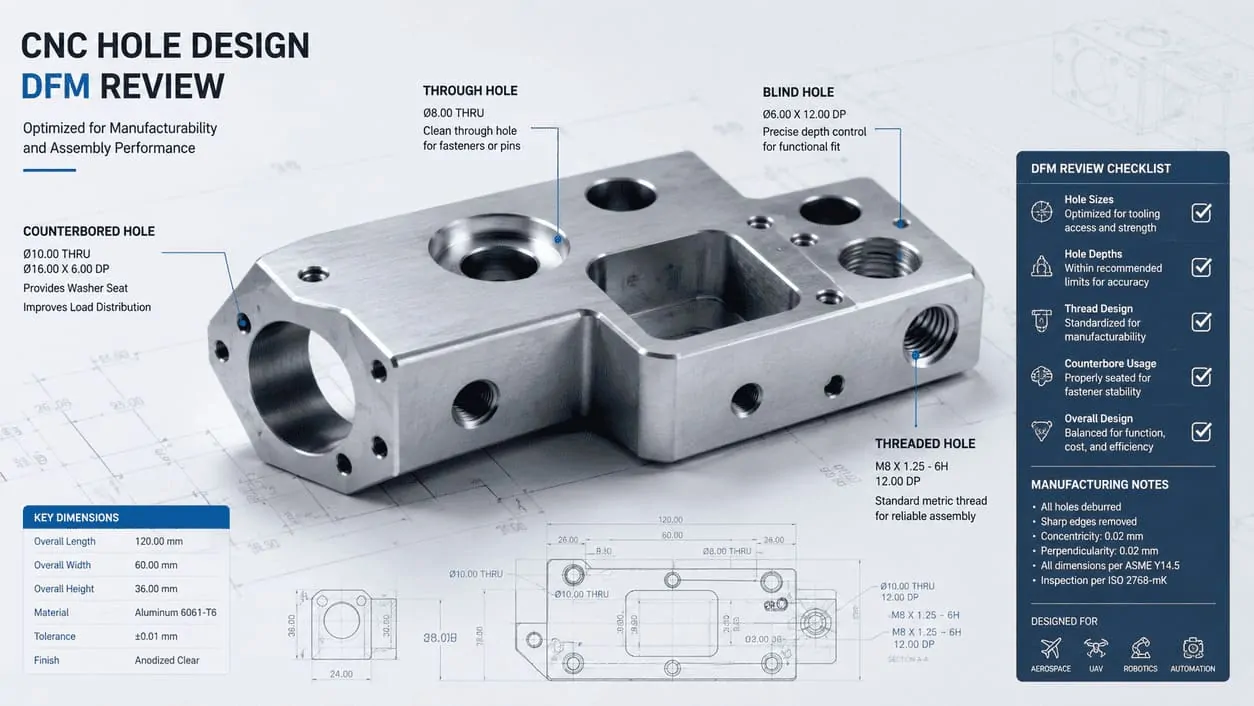
Whether creating simple through holes, blind holes, threaded features, or precision locating holes, proper hole design helps ensure reliable manufacturing results and reduces the risk of machining complications during production.
Many common CNC machining challenges—including excessive hole depth, difficult tool access, tight tolerance requirements, and poor feature placement—can often be avoided through effective machining design best practices and early manufacturability analysis.
Hole geometry should also be evaluated alongside corner radius optimization, thin-wall machining considerations, material selection, and overall part complexity. When these features are designed together, manufacturers can often achieve better machining performance, shorter lead times, and more consistent quality.
For complex components requiring deep holes, precision positioning, or threaded features, an early engineering review can help identify potential production risks before machining begins.
This guide covers the most important hole design considerations for CNC machined parts, helping engineers improve manufacturability, reduce machining costs, and avoid common design mistakes.
Understand the differences between through holes, blind holes, threaded holes, counterbores, and countersinks.
Learn recommended hole sizes and how diameter selection impacts tooling and machining efficiency.
Discover practical depth-to-diameter ratios and design recommendations for deep-hole machining.
Explore best practices for tapped holes, thread engagement, and manufacturable thread specifications.
Understand how hole tolerances influence drilling, reaming, boring, and inspection requirements.
Identify frequent hole design errors that increase machining complexity and production cost.
Learn how engineering reviews help optimize hole geometry for manufacturing success.
See how hole size, depth, location, and tolerance requirements affect machining performance.
Hole design is one of the most common and important aspects of CNC part design. Nearly every machined component contains one or more holes that serve functional, assembly, fastening, alignment, fluid flow, or weight-reduction purposes.
While holes may appear simple in a CAD model, their geometry can significantly influence tooling requirements, machining efficiency, achievable tolerances, and overall manufacturing cost.
Factors such as hole diameter, depth, location, spacing, threading requirements, and accessibility should all be considered during the design phase. Optimizing these features early through proper CNC engineering guidelines and a thorough manufacturing feasibility assessment can help reduce production risks and improve overall part quality.
Hole design should also be evaluated together with inside corner machining, material selection, tolerance requirements, and structural wall design to ensure the entire component is optimized for manufacturing.
Different hole types serve different engineering and assembly functions. Understanding the purpose of each hole style helps engineers select the most practical and manufacturable solution.
A through hole passes completely through the workpiece from one side to the other.
Through holes are among the easiest hole types to manufacture because chips can evacuate freely during drilling and machining operations.
Common applications include:
Fastener clearance holes
Alignment holes
Fluid passages
Weight-reduction features
Mechanical assemblies
Because tooling access is generally unrestricted, through holes often provide the most cost-effective manufacturing solution.
A blind hole has a defined depth and does not extend completely through the material.
Blind holes are frequently used when:
The opposite surface must remain intact
Threaded features are required
Assembly requirements limit through-hole usage
Internal cavities must be controlled
Compared with through holes, blind holes typically require more careful depth control and chip evacuation management.
As hole depth increases, machining complexity may also increase.
A counterbored hole contains a larger cylindrical recess at the top of the hole.
This design allows fastener heads to sit flush or below the surface of the component.
Counterbores are commonly used for:
Socket head cap screws
Precision assemblies
Machine components
Fixture designs
Counterbored features often improve assembly appearance while protecting fasteners from external contact.
A countersunk hole contains a conical opening designed to accommodate flat-head screws.
The angled surface allows the fastener head to sit flush with the surrounding material.
Typical applications include:
Aerospace panels
Sheet metal assemblies
Electronic enclosures
Cosmetic surfaces
Common countersink angles include 82°, 90°, and 100°, depending on regional standards and fastener specifications.
Threaded holes allow screws, bolts, and fasteners to be directly installed into the machined component.
These holes are often created through:
Tapping
Thread milling
Form tapping
Proper thread design requires consideration of:
Hole diameter
Thread engagement depth
Material properties
Tool accessibility
For critical assemblies, threaded features are often reviewed during an engineering manufacturability review to ensure reliable production and assembly performance.
Many designers select hole styles based solely on assembly requirements without considering manufacturing implications.
From a machining perspective, through holes are generally the simplest and most economical to produce, while deep blind holes, precision threaded holes, and tightly toleranced features often require additional machining operations.
Selecting the simplest hole type that satisfies the functional requirement can often reduce cycle time, tooling requirements, and production cost.
Experienced suppliers providing custom machining solutions frequently evaluate hole geometry during design reviews to identify opportunities for manufacturing optimization.
Before finalizing hole features, consider the following questions:
✔ Does the hole need to be blind, or can it be a through hole?
✔ Is a counterbore or countersink truly required?
✔ Can hole depth be reduced?
✔ Are threaded features necessary for every fastener location?
✔ Has the hole design been reviewed through a production readiness review?
Answering these questions early can help simplify machining operations and improve manufacturability.
Hole diameter has a direct impact on tooling selection, machining stability, achievable tolerances, and overall manufacturing efficiency.
While CNC machines are capable of producing very small holes, smaller diameters often require specialized tooling, reduced cutting parameters, and additional machining time. As a result, hole size should be selected based not only on functional requirements but also on manufacturability considerations.
In general, designing holes around commonly available drill sizes helps simplify production, improve machining consistency, and reduce manufacturing costs.
For components requiring multiple hole features, diameter selection should be evaluated alongside machining design standards, feature spacing, and overall part geometry.
Modern CNC machining can produce holes smaller than 1 mm, but extremely small holes introduce several manufacturing challenges.
As hole diameter decreases, the risk of:
Tool breakage
Tool deflection
Chip evacuation issues
Increased cycle time
Reduced positional accuracy
also increases.
For most CNC machined parts, holes below 1 mm should only be used when functionally necessary.
The following guidelines are commonly used for CNC machined components:
Hole Diameter | Recommendation |
|---|---|
< 1 mm | Avoid when possible |
1–3 mm | Use with caution |
3–10 mm | Preferred range |
10–20 mm | Excellent manufacturability |
> 20 mm | Generally straightforward |
Holes within the 3–10 mm range typically offer the best balance between manufacturability, tooling availability, and machining efficiency.
Whenever practical, hole diameters should align with standard drill sizes.
Using standard tooling can provide several advantages:
Reduced setup complexity
Faster machining
Better tool availability
Lower tooling costs
Improved production consistency
Designs requiring numerous custom diameter values may increase programming and tooling requirements without providing significant functional benefits.
For production-oriented designs, many suppliers performing a manufacturability review recommend standardizing hole diameters wherever possible.
Hole size should always be considered together with tolerance requirements.
A simple drilled hole may be sufficient for many applications, while tighter tolerances may require:
Reaming
Boring
Precision finishing operations
As tolerance requirements become more demanding, manufacturing complexity and inspection requirements typically increase.
For critical locating features and precision assemblies, diameter specifications should be evaluated during a design optimization assessment to determine the most efficient production method.
A common design mistake is specifying too many different hole diameters within the same component.
For example:
Ø3.2 mm
Ø3.5 mm
Ø3.8 mm
Ø4.1 mm
Ø4.5 mm
Each additional hole size may require:
Additional tool changes
More programming effort
Longer setup times
Increased manufacturing cost
Where possible, standardizing hole sizes across the design can simplify production and improve machining efficiency.
Many engineers focus on achieving exact nominal dimensions without considering available tooling.
In practice, selecting hole diameters that match common drill sizes often reduces setup complexity and improves machining efficiency without affecting part performance.
Engineering teams providing precision manufacturing solutions frequently recommend consolidating multiple hole sizes into a smaller number of standardized diameters during design reviews.
This simple adjustment can improve productivity while reducing overall production costs.
✔ Use the largest practical diameter for the application
✔ Prefer standard drill sizes whenever possible
✔ Minimize the number of unique hole diameters
✔ Avoid extremely small holes unless functionally required
✔ Review tolerance requirements before specifying precision hole dimensions
✔ Include hole geometry in your production-focused design review
Following these practices can improve manufacturability, reduce machining complexity, and help ensure consistent production quality.
Hole depth is one of the most important factors affecting CNC machining performance, tool life, chip evacuation, and overall manufacturing efficiency.
While modern CNC machines can produce relatively deep holes, increasing hole depth generally increases machining complexity. Deeper holes often require longer cutting tools, reduced feed rates, additional chip-clearing cycles, and tighter process control.
As a result, hole depth should be carefully evaluated during the design phase rather than simply maximizing depth based on available space within the part.
For optimal manufacturability, engineers should consider hole depth together with diameter, material type, tolerance requirements, and overall manufacturing-oriented design principles.
As hole depth increases, several machining challenges become more significant.
These include:
Reduced tool rigidity
Poor chip evacuation
Increased tool deflection
Higher heat generation
Longer cycle times
Greater risk of tool breakage
For blind holes, chip evacuation becomes particularly important because chips cannot exit through the opposite side of the workpiece.
As depth increases, maintaining hole straightness and dimensional accuracy also becomes more difficult.
A commonly used engineering guideline is to evaluate hole depth relative to hole diameter.
The following recommendations are widely accepted across CNC machining applications:
Hole Depth Ratio | Recommendation |
|---|---|
≤ 3× Diameter | Preferred |
3×–5× Diameter | Common |
5×–8× Diameter | More Challenging |
> 8× Diameter | Deep Hole Machining |
> 12× Diameter | Specialized Process May Be Required |
For example:
Hole Diameter | Preferred Maximum Depth |
|---|---|
Ø3 mm | 9 mm |
Ø5 mm | 15 mm |
Ø8 mm | 24 mm |
Ø10 mm | 30 mm |
Designs within the 3× diameter guideline typically provide the best balance between manufacturability and production efficiency.
Hole type has a significant influence on achievable depth.
Through holes generally allow:
Better chip evacuation
Higher drilling efficiency
Lower machining risk
Greater achievable depth
Because chips can exit through the opposite side of the part, through holes are often easier to machine than blind holes of the same diameter.
Blind holes require:
Controlled depth measurement
Additional chip management
Greater process monitoring
Increased machining time
For deep blind holes, manufacturing complexity can increase rapidly.
Whenever possible, engineers should evaluate whether a through hole can satisfy the same functional requirement.
Threaded holes introduce additional depth considerations.
In many applications, excessive thread depth provides little functional benefit while increasing machining time.
General recommendations include:
Material Type | Recommended Thread Engagement |
|---|---|
Aluminum | 1.0–1.5 × Diameter |
Steel | 1.0 × Diameter |
Stainless Steel | 1.0–1.5 × Diameter |
For example:
M6 thread in aluminum → 6–9 mm engagement
M8 thread in steel → 8 mm engagement
Beyond these values, additional thread depth often contributes little additional holding strength.
This is why many engineering manufacturability assessments focus on optimizing thread depth rather than simply maximizing it.
When deep holes cannot be avoided, the following practices can improve manufacturability:
Increase hole diameter whenever possible
Reduce depth where functionally acceptable
Prefer through holes over blind holes
Avoid unnecessarily tight tolerances
Allow adequate clearance for tooling access
Standardize hole dimensions across the design
These practices often reduce machining complexity while improving production reliability.
One of the most common issues identified during design reviews is excessive hole depth.
Engineers frequently specify deeper holes than required because additional depth appears to provide greater strength or assembly flexibility.
In reality, unnecessary depth often increases machining time, tooling requirements, and production cost without improving functionality.
Suppliers providing high-accuracy machining solutions routinely evaluate hole depth during project reviews and often recommend reducing depth where possible to improve manufacturing efficiency.
Small design changes in hole depth can sometimes produce substantial cost savings in both prototype and production environments.
Before finalizing hole depth specifications, ask the following:
✔ Can the hole be made shallower?
✔ Can a blind hole become a through hole?
✔ Does the thread require full depth engagement?
✔ Is the depth-to-diameter ratio practical?
✔ Has chip evacuation been considered?
✔ Has the feature been reviewed during a manufacturing readiness evaluation?
Answering these questions early can help reduce machining complexity and improve overall production performance.
Hole tolerance requirements have a direct impact on machining methods, inspection procedures, production cost, and achievable manufacturing accuracy.
While many holes can be produced using standard drilling operations, tighter tolerance requirements often require additional machining processes such as reaming, boring, or precision finishing.
For this reason, tolerance specifications should be driven by functional requirements rather than applying unnecessarily tight values across an entire design.
Proper tolerance selection is an important part of machining design optimization and can significantly improve both manufacturability and cost efficiency.
A hole tolerance defines the allowable variation between the specified diameter and the final manufactured feature.
For example:
Specified Hole Size | Acceptable Range |
|---|---|
Ø10.00 mm ±0.10 mm | 9.90–10.10 mm |
Ø10.00 mm ±0.05 mm | 9.95–10.05 mm |
Ø10.00 mm ±0.01 mm | 9.99–10.01 mm |
As tolerances become tighter, manufacturing complexity generally increases.
Tighter tolerances may require:
Additional machining operations
Slower cutting parameters
Specialized tooling
Increased inspection requirements
More quality control procedures
Different machining methods provide different levels of accuracy.
Process | Typical Accuracy |
|---|---|
Drilling | ±0.10–0.20 mm |
Reaming | ±0.01–0.05 mm |
Boring | ±0.01–0.03 mm |
Precision Grinding | < ±0.01 mm |
For many mechanical components, standard drilling provides sufficient accuracy.
However, locating features, bearing seats, dowel pin holes, and precision assemblies often require secondary finishing operations.
Selecting the appropriate process early during a production feasibility review can help avoid unnecessary manufacturing costs.
Not every hole requires high precision.
Tighter tolerances are typically justified when holes are used for:
Precision alignment
Bearing installation
Dowel pin locations
Press-fit assemblies
Aerospace components
High-performance mechanical systems
In these applications, dimensional variation can directly affect assembly performance and operational reliability.
Many holes only serve as clearance features for fasteners.
Examples include:
Bolt clearance holes
Cover mounting holes
Bracket attachment points
General assembly features
For these applications, extremely tight tolerances often provide little practical benefit.
Applying unnecessarily tight tolerances to non-critical holes may increase machining costs without improving functionality.
This is why many engineering review processes focus on identifying which features truly require precision control.
Hole diameter is only one aspect of accuracy.
Hole location can be equally important.
In many assemblies, positional accuracy affects:
Component alignment
Fastener fit
Bearing performance
Assembly repeatability
A perfectly sized hole located incorrectly can still cause assembly failure.
For precision applications, engineers should evaluate both size tolerance and positional tolerance during the design phase.
Components containing multiple holes can experience cumulative dimensional variation.
This phenomenon is known as tolerance stack-up.
Common examples include:
Bolt patterns
Mounting plates
Fixture components
Aerospace assemblies
As the number of critical holes increases, controlling positional relationships becomes increasingly important.
Effective manufacturing-focused engineering analysis can help identify tolerance stack-up risks before production begins.
Many CNC suppliers receive drawings where nearly every hole carries a tight tolerance requirement.
In practice, only a small percentage of these features usually influence assembly performance.
By identifying critical-to-function holes and relaxing tolerances on non-critical features, manufacturers can often reduce machining time, inspection effort, and production cost without affecting product quality.
Engineering teams providing precision component manufacturing services frequently review tolerance specifications during DFM evaluations to identify these opportunities.
Before applying a tight hole tolerance, ask:
✔ Does this hole affect assembly alignment?
✔ Does it locate another component?
✔ Does it support a bearing or dowel pin?
✔ Would a larger tolerance still satisfy the design intent?
✔ Has the tolerance been validated through a design-for-production assessment?
Only specifying tight tolerances where functionally required can significantly improve manufacturability and reduce overall production costs.
Threaded holes are among the most frequently used features in CNC machined parts. They eliminate the need for separate nuts, simplify assembly, and provide secure fastening directly within the component.
However, poorly designed threaded holes can increase machining time, reduce thread quality, and create unnecessary manufacturing challenges.
Factors such as thread size, engagement depth, material properties, hole location, and tool accessibility should all be considered during the design phase.
Applying proven CNC part design recommendations can help improve thread performance while reducing production costs.
Using standard thread specifications simplifies manufacturing and improves tooling availability.
Common metric thread sizes include:
Metric Threads | Common Applications |
|---|---|
M3 | Electronics & Small Components |
M4 | General Assemblies |
M5 | Fixtures & Equipment |
M6 | Industrial Components |
M8 | Mechanical Assemblies |
M10+ | Heavy-Duty Applications |
Similarly, Unified thread standards (UNC/UNF) are commonly used in North American markets.
Selecting standard thread sizes helps reduce setup complexity and allows manufacturers to use readily available tooling.
A common misconception is that deeper threads always create stronger assemblies.
In reality, once sufficient thread engagement is achieved, additional thread depth often provides little improvement in holding strength.
General recommendations:
Material | Recommended Thread Engagement |
|---|---|
Aluminum | 1.0–1.5 × Diameter |
Brass | 1.0 × Diameter |
Steel | 1.0 × Diameter |
Stainless Steel | 1.0–1.5 × Diameter |
Examples:
Thread Size | Recommended Engagement |
|---|---|
M4 | 4–6 mm |
M6 | 6–9 mm |
M8 | 8–12 mm |
M10 | 10–15 mm |
Beyond these values, machining time increases while functional benefits often remain limited.
Blind threaded holes require additional space beneath the threaded section.
This clearance allows:
Tap runout
Chip accumulation
Threading tool exit
Improved thread quality
A good practice is to include additional depth below the required thread engagement.
Without sufficient clearance, threads may be incomplete or difficult to manufacture consistently.
Different materials behave differently during threading operations.
Easy to machine
Excellent thread formation
Suitable for most standard thread sizes
Higher cutting forces
Increased tool wear
Greater risk of tap breakage
Challenging machining characteristics
Requires careful process control
Often benefits from thread milling
Material selection should always be evaluated together with custom manufacturing engineering solutions and assembly requirements.
Threads positioned too close to part edges can weaken the surrounding material.
Insufficient edge distance may lead to:
Material cracking
Reduced thread strength
Distortion during machining
Assembly failures
As a general guideline:
Minimum Edge Distance

≥ 1.5 × Thread Diameter
For highly loaded applications, larger margins may be recommended.
Two common methods are used to create internal threads:
Advantages:
Fast
Cost-effective
Widely used
Limitations:
Higher risk of tool breakage
Less flexible for large threads
Advantages:
Better thread quality
Greater flexibility
Improved performance in difficult materials
Limitations:
Longer machining time
More programming requirements
Many suppliers offering advanced machining capabilities use thread milling for critical applications requiring superior thread accuracy.
Using multiple thread sizes within the same component can increase:
Tool changes
Programming time
Setup complexity
Inspection requirements
For example:
Avoid:
M4
M5
M6
M7
M8
Prefer:
M5
M6
when functionally acceptable.
Standardization often improves manufacturing efficiency while simplifying assembly operations.
One of the most common findings during a DFM review is excessive thread usage.
Designers sometimes specify threaded holes in locations where clearance holes, inserts, or alternative fastening methods could achieve the same result.
Reducing unnecessary threaded features often leads to: √ Faster machining √ Lower tooling costs √ Improved reliability √ Simplified assembly
Engineering teams providing precision CNC manufacturing services frequently evaluate fastening strategies during design reviews to identify these opportunities.
Before finalizing threaded hole specifications, consider the following:
✔ Is the selected thread size standardized?
✔ Is the engagement depth greater than necessary?
✔ Is sufficient bottom clearance provided?
✔ Is the thread too close to an edge?
✔ Would thread milling improve quality?
✔ Has the feature been reviewed through a manufacturing optimization review?
Following these guidelines can improve thread quality, reduce machining risk, and enhance overall manufacturability.
Even experienced engineers occasionally create hole features that are difficult, expensive, or inefficient to manufacture.
Many machining issues can be traced back to hole designs that overlook tooling limitations, manufacturability considerations, or assembly requirements.
Understanding these common mistakes can help reduce production costs, improve machining efficiency, and avoid unnecessary delays during manufacturing.
Small holes often appear simple in CAD models, but they can be surprisingly difficult to machine.
As hole diameter decreases:
Tool rigidity decreases
Tool breakage risk increases
Chip evacuation becomes more difficult
Machining time increases
Although modern CNC machines can produce very small holes, designers should avoid miniature hole sizes unless they are functionally required.
Whenever possible, selecting larger diameters can improve manufacturing reliability and reduce cost.
Deep holes are one of the most common manufacturability issues identified during engineering reviews.
Designers often specify more depth than necessary without realizing the manufacturing implications.
Excessive depth may result in:
Longer cycle times
Increased tool wear
Poor chip evacuation
Reduced accuracy
Higher production costs
Following recommended depth-to-diameter ratios typically results in more efficient machining.
Not every hole requires high precision.
A common design error is assigning unnecessarily tight tolerances to non-critical features.
This frequently leads to:
Additional machining operations
Increased inspection requirements
Longer lead times
Higher manufacturing costs
Critical tolerances should be reserved for features that directly affect assembly, alignment, or functional performance.
Many suppliers performing a design-for-manufacturing evaluation identify tolerance reduction opportunities during the quotation process.
Every additional hole diameter may require:
Additional tooling
Extra tool changes
More programming
Increased setup time
For example:
Poor Practice:
Ø3.2 mm
Ø3.8 mm
Ø4.3 mm
Ø4.7 mm
Ø5.1 mm
Improved Practice:
Ø3 mm
Ø4 mm
Ø5 mm
Standardizing hole dimensions often improves manufacturing efficiency without affecting functionality.
Holes positioned too close to part edges can weaken surrounding material and increase the risk of failure.
Potential problems include:
Material deformation
Cracking
Reduced thread strength
Assembly issues
A commonly used guideline is:
Minimum Edge Distance

≥ 1.5 × Hole Diameter
For highly loaded components, larger safety margins may be required.
Hole placement should always be considered together with structural component design and expected loading conditions.
A hole may be technically manufacturable but still difficult to machine efficiently.
Problems often occur when holes are located:
Inside deep cavities
Near vertical walls
Close to internal corners
Within restricted machining areas
Limited tool access can increase setup complexity and machining cost.
This is why many engineers evaluate hole placement alongside internal feature optimization during the design phase.
Threaded holes are useful, but not every fastener location requires internal threads.
Excessive use of threaded features can result in:
Longer machining time
More tool wear
Additional inspection requirements
Higher production cost
In some situations, clearance holes, inserts, or alternative fastening methods may provide a more efficient solution.
The majority of costly hole-related manufacturing issues are discovered during design reviews rather than on the machine shop floor.
Features such as excessive depth, unnecessary tolerances, poor accessibility, and redundant threaded holes are often easy to correct before production starts.
Engineering teams providing custom CNC production services regularly perform design reviews to identify these opportunities and help customers improve manufacturability before releasing parts for production.
Small design adjustments at this stage often prevent significantly larger manufacturing costs later.
Before releasing a part for production, review the following checklist:
✔ Are hole diameters standardized?
✔ Are hole depths practical?
✔ Are tolerances only applied where necessary?
✔ Is edge distance sufficient?
✔ Can tooling easily access every hole?
✔ Are threaded holes truly required?
✔ Has the design undergone a manufacturing efficiency assessment?
Addressing these questions early can improve production efficiency, reduce machining costs, and increase overall manufacturing reliability.
Successful hole design involves more than selecting the correct diameter or depth. Every hole feature must be evaluated within the context of the entire part design, manufacturing process, material selection, and assembly requirements.
A hole that appears acceptable in isolation may create machining challenges when combined with tight tolerances, restricted tool access, thin walls, deep cavities, or complex geometries.
This is why experienced manufacturers evaluate hole features as part of a broader CNC design engineering review rather than assessing each feature independently.
The most cost-effective design changes are usually made before machining begins.
Early design evaluation can help identify:
Excessive hole depth
Unnecessary tolerances
Overly small hole diameters
Difficult-to-machine threaded features
Poor tool accessibility
Potential assembly challenges
Addressing these issues during the design phase is typically far less expensive than making changes after production starts.
Hole geometry should never be reviewed independently.
Instead, engineers should evaluate hole features alongside:
Material selection
Wall thickness
Internal corner geometry
Fastening strategy
Surface finish requirements
Assembly interfaces
For example, a deep threaded hole located within a thin wall section may introduce significantly different manufacturing challenges than the same hole placed in a thicker structural region.
This integrated approach is a fundamental part of effective manufacturing-focused product design.
The most successful CNC designs achieve the required functional performance while remaining practical to manufacture.
In many cases, small adjustments can dramatically improve manufacturability:
Design Change | Potential Benefit |
|---|---|
Increase hole diameter | Better tool rigidity |
Reduce hole depth | Faster machining |
Relax tolerance | Lower production cost |
Standardize hole sizes | Fewer tool changes |
Simplify threaded features | Improved efficiency |
Improve tool access | Shorter cycle time |
These optimizations often improve production efficiency without affecting the intended function of the part.
A structured design review can identify manufacturability concerns before production begins.
Typical review topics include:
Hole diameter suitability
Hole depth limitations
Thread engagement requirements
Tool accessibility
Tolerance strategy
Material-specific machining considerations
Many engineering teams use a formal design validation process to evaluate these factors before releasing parts for manufacturing.
This approach helps reduce production risk while improving quality and consistency.
Prototype machining often reveals opportunities for improvement.
During prototype builds, manufacturers frequently identify:
Hole features that are unnecessarily complex
Tolerances that can be relaxed
Thread depths that exceed requirements
Opportunities for feature standardization
Applying these lessons before production can improve efficiency and reduce long-term manufacturing costs.
For companies producing parts at scale, this iterative optimization process often delivers substantial cost savings over time.
Many designers assume that more detailed specifications automatically produce better parts.
In reality, the most manufacturable designs often share several characteristics: ✔ Standard hole diameters ✔ Practical depth requirements ✔ Appropriate tolerances ✔ Consistent thread specifications ✔ Good tool accessibility
By simplifying hole features wherever possible, engineers can often improve manufacturability while maintaining the same functional performance.
Manufacturers providing precision machining support services frequently identify these simplification opportunities during project reviews.
When designing holes for CNC machined parts:
✔ Use standard hole diameters whenever possible
✔ Keep hole depths practical
✔ Avoid unnecessarily tight tolerances
✔ Standardize hole sizes across the design
✔ Provide sufficient edge distance
✔ Ensure adequate tool access
✔ Use threaded features only when necessary
✔ Evaluate hole geometry as part of the entire component design
✔ Perform a comprehensive manufacturing readiness review before production
Following these principles can help reduce machining complexity, improve production efficiency, and achieve more consistent manufacturing results.
In many CNC projects, improving manufacturability does not require a complete redesign.
Simple adjustments such as:
Increasing a hole diameter by 1 mm
Reducing thread depth
Standardizing hole sizes
Converting a blind hole to a through hole
can often reduce machining time, lower production costs, and improve manufacturing reliability.
For this reason, many customers choose to request a production engineering assessment before finalizing part designs.
The ideal hole diameter depends on the application, material, and machining requirements. In general, hole diameters between 3 mm and 10 mm provide an excellent balance between manufacturability, tooling availability, and machining efficiency. Smaller holes can be machined but may require specialized tooling and longer cycle times.
A common guideline is to keep hole depth within 3 to 5 times the hole diameter whenever possible. Holes deeper than 8 times the diameter are generally considered deep-hole features and may require specialized machining strategies to maintain accuracy and effective chip evacuation.
Yes. Through holes are typically easier and more cost-effective to machine because chips can evacuate freely through the opposite side of the part. Blind holes often require additional depth control and chip management, particularly when the hole is deep.
Modern CNC machines can produce holes smaller than 1 mm depending on the material and tooling. However, very small holes increase the risk of tool breakage, reduced accuracy, and longer machining times. Designers should avoid extremely small holes unless they are functionally necessary.
For most applications, thread engagement equal to 1.0–1.5 times the thread diameter is sufficient. For example, an M6 thread in aluminum typically requires 6–9 mm of engagement. Additional thread depth often provides little increase in holding strength while increasing machining time.
Yes. Tighter tolerances frequently require secondary operations such as reaming, boring, or precision finishing. They may also increase inspection requirements and machining time. Tolerances should only be tightened when necessary for functional or assembly requirements.
Several factors can affect hole accuracy, including tool deflection, excessive hole depth, material properties, machine rigidity, and improper cutting parameters. Hole size, depth, and tolerance requirements should all be considered during the design phase to improve machining consistency and accuracy.
Standardizing hole sizes reduces the number of tools required during machining, minimizes tool changes, simplifies programming, and improves production efficiency. It can also help reduce manufacturing costs without affecting part functionality.
A common engineering guideline is to maintain an edge distance of at least 1.5 times the hole diameter. Additional clearance may be required for heavily loaded parts, threaded holes, or components made from weaker materials.
Absolutely. A design review can identify issues such as excessive depth, unnecessary tolerances, poor tool accessibility, and inefficient thread specifications before machining begins. Early design optimization often improves manufacturability, reduces production costs, and shortens lead times.
Designing manufacturable holes involves more than selecting a diameter or depth. Thread engagement, tolerance requirements, tool accessibility, material properties, and assembly considerations can all affect production cost and machining performance.
At NAITE TECH, our engineering team reviews hole geometry during every project to identify opportunities for improved manufacturability, reduced machining time, and lower production costs.


