
- Home
- Capabilities
- Solution
- Material
- Industry
- Resources
- Request a Quote
Views: 0 Author: Site Editor Publish Time: 2026-05-18 Origin: Site
CNC machining costs can vary significantly depending on where your parts are manufactured.
For procurement teams, engineers, and product developers, supplier region can directly impact not only machining price, but also lead time, engineering communication, shipping cost, and overall project efficiency.
The United States, China, and Europe are among the most common sourcing regions for CNC machining, but each offers very different cost structures and manufacturing advantages.
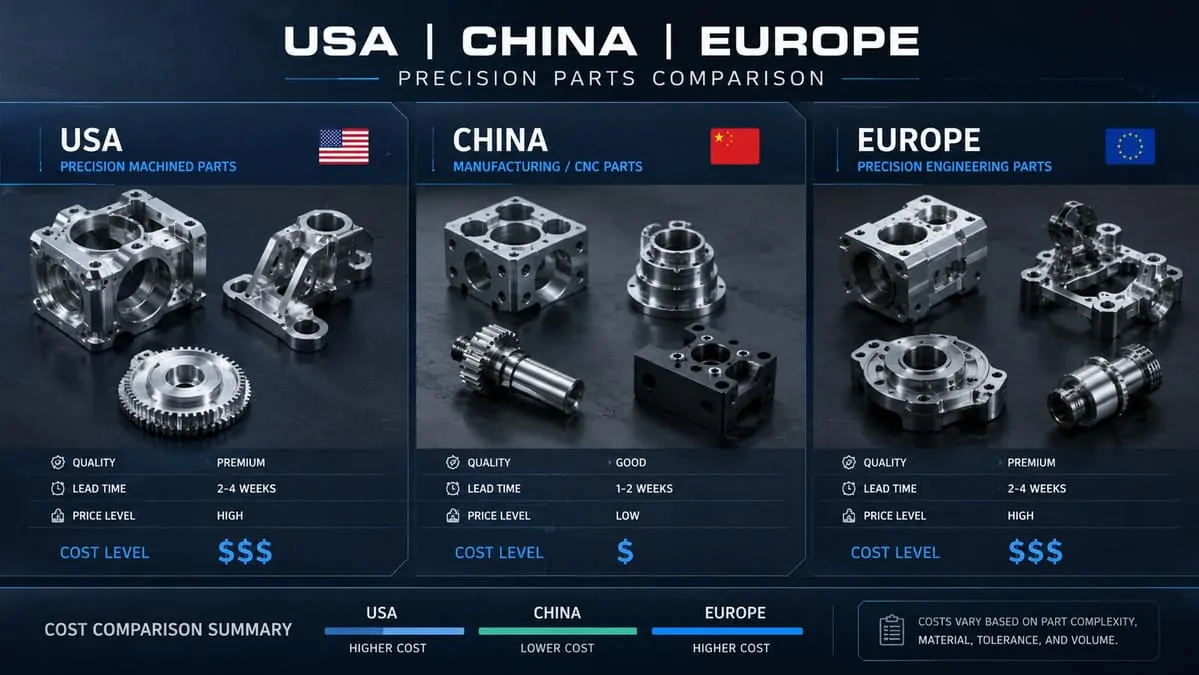
For example:
U.S. suppliers are often selected for faster domestic turnaround and stronger local collaboration
China is typically preferred for cost-efficient production and scalable manufacturing
Europe is commonly chosen for precision engineering, regulated industries, and strong technical documentation
Because labor costs, manufacturing ecosystems, certifications, and logistics differ across regions, the lowest quoted machining price does not always represent the lowest total project cost.
Buyers evaluating American machining suppliers, leading CNC suppliers in China, and European CNC manufacturers should consider both direct machining cost and hidden operational costs before selecting a supplier.
This guide compares CNC machining costs across the USA, China, and Europe to help sourcing teams better understand pricing differences, trade-offs, and regional manufacturing advantages.
Whether you are sourcing prototypes, low-volume production, or repeat manufacturing orders, choosing the right CNC manufacturing partner can significantly improve both project cost control and supply chain efficiency.
Upload your drawings or CAD files to receive engineering feedback, lead time estimates, and competitive pricing recommendations.
CNC machining pricing is influenced by multiple factors beyond simple machine time.
Even when producing the same part, total cost can vary significantly depending on design complexity, material choice, supplier capabilities, and production location.
Understanding these cost drivers can help buyers better evaluate supplier quotations and avoid unexpected manufacturing expenses.
Material is one of the most significant cost factors in CNC machining.
Different materials vary greatly in:
raw material cost
machinability
tool wear
cycle time
Common examples include:
aluminum (cost-effective and easy to machine)
stainless steel (higher machining time and tooling wear)
titanium (premium material with difficult machinability)
brass and copper (good machinability but material cost dependent)
Projects requiring exotic alloys or high-performance materials will typically carry higher machining costs.
More complex parts require more machine time, programming effort, and setup work.
Cost increases are commonly associated with:
deep pockets
thin walls
tight tolerances
multiple setups
complex geometries
5-axis machining requirements
Complex parts often require stronger precision machining services capabilities and more experienced suppliers.
Tighter tolerances generally increase manufacturing cost.
This is because tighter tolerances may require:
slower machining speeds
additional inspection
more process control
higher scrap risk
For many parts, unnecessary tolerance requirements can significantly increase quote pricing.
Buyers should only specify critical tolerances where functionally required.
Post-processing can contribute a meaningful percentage of total project cost.
Common secondary processes include:
anodizing
plating
powder coating
polishing
heat treatment
assembly
Projects requiring multiple finishing steps often benefit from suppliers offering custom CNC manufacturing plus integrated secondary operations.
Quantity has a major impact on unit cost.
General cost behavior:
prototypes → higher unit cost
low-volume production → moderate unit cost
repeat production → lower unit cost through setup amortization
Larger orders often improve cost efficiency by spreading setup, programming, and tooling costs across more units.
Machining price alone does not represent total sourcing cost.
Additional logistics factors include:
international shipping
customs duties
tariffs
packaging
lead time risk
This is particularly relevant when comparing local suppliers with overseas Chinese CNC manufacturers.
A lower machining quote may still result in higher total landed cost depending on logistics requirements.
CNC machining cost is influenced by far more than hourly machine rate.
Buyers should evaluate total project cost across material, complexity, tolerance, finishing, and logistics before selecting a supplier or comparing regional quotations.
Understanding these cost drivers makes it easier to compare suppliers more accurately and avoid focusing solely on quoted unit price.
For buyers evaluating global sourcing options, a structured machining supplier comparison guide can improve purchasing decisions and reduce hidden manufacturing risk.
CNC machining costs vary substantially across different sourcing regions.
The United States, China, and Europe each have distinct pricing structures driven by labor cost, manufacturing infrastructure, supplier specialization, and logistics considerations.
While machining price is an important factor, total sourcing cost should always be evaluated alongside quality expectations, lead time requirements, and project complexity.
Factor | USA | China | Europe |
|---|---|---|---|
Hourly Machining Rate | High | Low to Moderate | Moderate to High |
Labor Cost | High | Lower | Higher |
Prototype Cost | High | Competitive | Moderate to High |
Production Cost | High | Cost-effective | Moderate |
Lead Time | Fast (domestic) | Competitive | Moderate |
Shipping Cost | Low for U.S. buyers | International shipping required | Regional dependent |
Certifications | Strong | Supplier dependent | Strong |
Best For | Domestic speed & collaboration | Cost efficiency & scale | Precision & regulated industries |
In broad terms:
The United States typically has the highest machining cost due to:
labor rates
facility overhead
regulatory expenses
domestic operational costs
However, U.S. suppliers can offer advantages in:
fast communication
local logistics
engineering collaboration
This makes American machining suppliers attractive for urgent projects or local production needs.
China is generally the most cost-competitive region for CNC machining.
Cost advantages often come from:
lower labor cost
mature supplier ecosystems
high manufacturing density
scalable production capacity
This is why many buyers source through leading CNC suppliers in China for projects prioritizing cost efficiency and production scalability.
However, buyers should also account for shipping, customs, and supplier qualification.
Europe typically sits between the USA and China in overall machining cost.
European suppliers are often selected for:
strong engineering standards
technical precision
certifications
regulated manufacturing environments
Projects requiring technical documentation, advanced materials, or precision manufacturing frequently evaluate European CNC manufacturers despite higher costs than some overseas alternatives.
A lower quote may not always produce the lowest overall project cost.
Additional expenses can include:
shipping fees
customs duties
quality issues
engineering delays
scrap risk
communication inefficiencies
Buyers focused only on unit price may overlook operational costs that significantly impact project economics.
For this reason, many sourcing teams compare total landed cost rather than machining price alone.
The cheapest machining quote is not always the most cost-effective sourcing decision.
Buyers should evaluate total manufacturing cost across machining, shipping, quality risk, and project management efficiency.
A well-structured sourcing strategy should balance:
machining price
supplier capability
lead time
logistics
manufacturing risk
For broader regional sourcing decisions, many teams use a structured manufacturing cost comparison approach before selecting a final supplier.
The United States is generally one of the highest-cost regions for CNC machining.
Higher pricing is primarily driven by labor expenses, facility overhead, compliance requirements, and broader operating costs associated with domestic manufacturing.
However, despite higher machining rates, U.S. suppliers remain a preferred option for many buyers requiring fast local turnaround, simplified logistics, and closer engineering collaboration.
Several factors contribute to higher machining costs in the U.S., including:
higher labor wages
facility and utility costs
regulatory compliance expenses
insurance and liability costs
quality management overhead
These factors typically result in higher hourly machining rates compared with overseas suppliers.
As a result, prototype and production pricing from top CNC companies in the USA is often higher than equivalent quotes from Asia or some European suppliers.
Although pricing is higher, U.S. suppliers offer several operational advantages.
Common benefits include:
faster domestic shipping
easier supplier communication
local engineering collaboration
simplified project management
reduced import complexity
For North American teams, working with American machining suppliers can significantly reduce lead time risk and improve responsiveness during product development.
This is particularly useful for:
urgent prototypes
design revisions
iterative engineering workflows
U.S.-based suppliers are often selected for projects involving:
early-stage prototypes
low-volume engineering builds
urgent production requirements
defense-related manufacturing
projects requiring local supply chain control
For projects where time-to-market is critical, higher machining cost may be justified by faster execution and operational simplicity.
While domestic sourcing can reduce shipping and logistics complexity, buyers should still assess total project economics.
U.S. machining may be less cost-effective for:
budget-sensitive projects
larger production volumes
mature product designs
In these cases, buyers often compare domestic suppliers with Chinese CNC manufacturers or regional alternatives depending on project goals.
CNC machining in the USA typically carries the highest direct manufacturing cost, but can provide meaningful advantages in logistics speed, engineering collaboration, and domestic project control.
For urgent or locally managed projects, U.S. suppliers may still represent the most efficient sourcing option despite higher pricing.
The value of U.S. machining is often strongest when speed, communication, and operational simplicity are prioritized over lowest manufacturing cost.
For cost-sensitive production programs, buyers often evaluate global sourcing strategies or compare domestic options with precision manufacturers in China.
China is widely recognized as one of the most cost-competitive regions for CNC machining.
For global buyers, Chinese suppliers are often selected for their ability to combine competitive pricing, scalable production capacity, and broad manufacturing capability across multiple processes.
Compared with the USA and many European markets, CNC machining costs in China are typically lower, particularly for low-volume production, repeat manufacturing, and multi-process projects.
Several factors contribute to China's pricing competitiveness.
Common cost advantages include:
lower labor costs
dense manufacturing ecosystems
large supplier networks
high machine availability
mature industrial supply chains
These factors allow many Chinese CNC manufacturers to offer competitive pricing across a wide range of part types and production volumes.
China is particularly competitive for:
CNC milling
CNC turning
prototype machining
low-volume production
production-scale manufacturing
Beyond machining price, China also offers several operational advantages.
Common benefits include:
strong production scalability
multi-process manufacturing support
integrated finishing capability
flexible production capacity
extensive material availability
Many buyers sourcing through leading CNC suppliers in China value the ability to consolidate machining, finishing, assembly, and secondary operations within one supplier workflow.
This can reduce supplier fragmentation and simplify project coordination.
China is frequently selected for projects involving:
cost-sensitive production
bridge production
low-volume manufacturing
repeat production orders
projects requiring multiple manufacturing processes
For buyers seeking stronger cost control, China often becomes particularly attractive after prototype validation or early product development stages.
Companies transitioning from prototypes to production frequently evaluate custom CNC manufacturing suppliers in China to improve overall production economics.
Although machining costs are generally lower, buyers should evaluate total landed cost rather than focusing only on quoted pricing.
Additional considerations may include:
international shipping
customs duties
tariffs
communication workflows
supplier qualification
inspection requirements
Selecting experienced suppliers can significantly reduce sourcing risk and improve project outcomes.
For buyers prioritizing quality consistency, supplier selection remains just as important as regional cost advantage.
China often provides the strongest pricing advantage for CNC machining, particularly for production-focused projects, scalable manufacturing, and integrated sourcing workflows.
However, buyers should evaluate total project cost across logistics, supplier capability, quality management, and communication — not machining price alone.
For many companies, China represents a practical balance between cost efficiency, manufacturing capability, and production scalability.
Buyers comparing global sourcing options often evaluate precision manufacturers in China, European machining suppliers, and domestic suppliers based on project complexity, budget priorities, and operational requirements.
Europe occupies a middle position in global CNC machining cost comparison.
Compared with China, European machining is generally more expensive. Compared with the United States, Europe can sometimes offer a more balanced combination of engineering capability, quality systems, and manufacturing cost depending on supplier region and project type.
For buyers prioritizing precision, technical support, and regulated manufacturing environments, European suppliers remain an important sourcing option.
Several factors influence machining pricing across European markets.
Common contributors include:
higher labor expenses
regulatory compliance requirements
energy and operating costs
quality system implementation
advanced manufacturing standards
Because of these factors, machining quotes from European CNC manufacturers are often higher than comparable pricing from China.
However, pricing can still vary substantially between countries, supplier specialization, and production requirements.
Despite higher production costs, Europe offers several strengths valued by engineering teams and procurement departments.
Common advantages include:
strong technical expertise
mature quality systems
advanced machining capability
regulated manufacturing experience
robust engineering documentation
Many buyers choose European machining suppliers for projects requiring tighter process control, technical precision, or stronger regulatory alignment.
Europe is particularly competitive in sectors such as:
aerospace
medical devices
robotics
industrial automation
high-performance engineering
European suppliers are frequently selected for projects involving:
precision engineering components
complex geometries
regulated industry requirements
advanced materials
documentation-heavy production environments
For technically demanding applications, buyers may prioritize supplier capability and quality consistency over lowest manufacturing cost.
Projects involving certification requirements or stringent inspection standards often evaluate precision machining services providers within Europe.
When evaluating Europe as a sourcing region, buyers should look beyond direct machining cost.
Additional considerations may include:
shipping distance
regional logistics
certification requirements
engineering collaboration needs
supply chain flexibility
For some projects, a higher machining quote may still result in lower operational risk and stronger production predictability.
As a result, many procurement teams evaluate total project value rather than direct part price alone.
Europe is often positioned between China and the USA in CNC machining cost, combining strong engineering capability with mature manufacturing standards.
For regulated industries, technical precision, and documentation-intensive projects, European suppliers can provide strong long-term manufacturing value despite higher pricing.
European machining is often best suited for projects where manufacturing reliability, engineering rigor, and quality assurance carry greater importance than minimizing upfront production cost.
For broader sourcing evaluations, buyers frequently compare European CNC manufacturers, American machining suppliers, and leading CNC suppliers in China before selecting a regional manufacturing strategy.
Quoted machining price is only one part of the total sourcing equation.
In practice, hidden operational costs can significantly affect project profitability, production timelines, and long-term supplier performance.
When comparing suppliers across the USA, China, and Europe, buyers should evaluate total landed cost rather than focusing solely on unit price.
International sourcing often introduces costs beyond machining itself.
Additional expenses may include:
international freight
customs clearance
import duties
tariffs
export packaging
shipping insurance
These factors can materially change total project economics.
A lower machining quote from overseas Chinese CNC manufacturers may still require a full landed cost evaluation before making purchasing decisions.
For time-sensitive projects, logistics delays can also introduce indirect operational costs.
Quality problems can quickly outweigh initial cost savings.
Potential hidden costs include:
rejected parts
rework expenses
production downtime
inspection failures
delayed customer delivery
Supplier qualification is therefore critical.
Selecting experienced precision machining services providers can reduce manufacturing risk and improve production consistency.
For regulated industries, quality failures can create substantial downstream costs.
Communication quality can directly impact manufacturing efficiency.
Common hidden issues include:
unclear technical feedback
delayed engineering responses
specification misunderstandings
revision management problems
Even competitively priced suppliers may become costly if communication inefficiencies slow project execution.
Many sourcing teams prioritize CNC manufacturing partners with stronger engineering communication and more structured project workflows.
Product designs frequently evolve during development and early production.
Hidden costs may arise from:
drawing revisions
tooling adjustments
setup changes
tolerance modifications
material substitutions
Suppliers with stronger technical collaboration capabilities can often handle engineering changes more efficiently.
This is particularly important for prototype development and low-volume manufacturing programs.
Managing multiple vendors can also increase indirect cost.
Operational overhead may include:
supplier coordination
separate quality control workflows
logistics management
purchasing administration
documentation tracking
For projects involving machining plus secondary operations, working with suppliers offering custom CNC manufacturing and integrated services can help reduce administrative complexity.
The lowest machining quote does not automatically produce the lowest total manufacturing cost.
Shipping, communication, quality performance, engineering changes, and supplier management can significantly influence real project economics.
Effective sourcing decisions require evaluating both direct machining cost and operational cost drivers.
For this reason, many procurement teams use a structured machining supplier comparison guide when assessing suppliers across different manufacturing regions.
There is no universal “best” sourcing region for CNC machining.
The most suitable option depends on your project requirements, production stage, technical expectations, and budget priorities.
Rather than choosing based on machining price alone, buyers should evaluate which sourcing region best aligns with their operational goals.
The United States is often the preferred option for projects prioritizing:
fast domestic turnaround
local supplier communication
engineering collaboration
simplified logistics
supply chain proximity
Working with American machining suppliers can be particularly valuable for:
urgent prototypes
rapid engineering iterations
early-stage development
projects requiring frequent design revisions
For North American teams, domestic sourcing can reduce operational friction and improve project responsiveness.
China is commonly selected for projects focused on:
production cost optimization
scalable manufacturing
repeat production
multi-process manufacturing
flexible production capacity
Many buyers choose leading CNC suppliers in China when cost control and manufacturing scalability are primary objectives.
China is especially competitive for:
prototype-to-production transitions
low-volume manufacturing
machining plus finishing workflows
production-oriented sourcing strategies
Companies seeking stronger production economics frequently evaluate precision manufacturers in China as part of their sourcing strategy.
Europe is often preferred for projects requiring:
advanced engineering support
precision manufacturing
technical documentation
certification-driven workflows
regulated production environments
Projects in aerospace, medical devices, robotics, and industrial automation commonly source through European CNC manufacturers for their strong quality systems and technical expertise.
For technically demanding applications, Europe may offer stronger long-term manufacturing alignment despite higher pricing.
Supplier region can also vary depending on where a project sits within its lifecycle.
A common sourcing approach may include:
local prototypes or engineering validation
overseas production optimization
mixed-region manufacturing strategies
Some companies work with domestic suppliers during early development and transition to custom CNC manufacturing partners for cost-focused production phases.
This approach can balance speed, engineering collaboration, and long-term production economics.
USA, China, and Europe each offer different sourcing strengths.
The best option depends on whether your project prioritizes speed, cost efficiency, engineering precision, production scalability, or regulatory compliance.
Rather than asking which region is universally better, buyers should determine which sourcing model best fits their project objectives.
For complex purchasing decisions, comparing suppliers through a structured manufacturing cost comparison framework can help improve sourcing outcomes and reduce long-term operational risk.
For many companies, the most effective CNC sourcing strategy is not limited to a single region.
Instead of choosing exclusively between the USA, China, or Europe, buyers often combine suppliers across multiple regions based on project stage, cost targets, and operational priorities.
This hybrid sourcing approach can help balance engineering agility, production efficiency, and long-term cost control.
Many companies use a staged sourcing model.
Typical workflows may include:
Early development stages often prioritize:
fast feedback cycles
engineering communication
rapid design revisions
local collaboration
During this phase, buyers frequently work with American machining suppliers or regional suppliers to accelerate validation and reduce development friction.
After designs stabilize, sourcing priorities often shift toward:
production cost reduction
scalable manufacturing
repeat production efficiency
integrated workflows
At this stage, many companies begin evaluating leading CNC suppliers in China or broader global manufacturing options.
For mature programs, supplier decisions may involve balancing:
cost stability
quality consistency
logistics resilience
multi-region manufacturing flexibility
Some organizations combine domestic and overseas sourcing to improve operational redundancy and reduce supply chain risk.
Rather than treating manufacturing regions as mutually exclusive choices, many companies strategically combine local and global suppliers across different project phases.
This hybrid approach can improve manufacturing flexibility, reduce operational cost, and strengthen long-term sourcing resilience.
A hybrid model is often suitable for projects involving:
rapid product development
evolving engineering requirements
low-volume to production transitions
multi-site manufacturing operations
long-term supply chain planning
Companies requiring both agility and cost efficiency frequently work with CNC manufacturing partners capable of supporting multiple production stages.
Potential advantages include:
reduced sourcing risk
improved production flexibility
better regional cost optimization
stronger business continuity
diversified supplier networks
Rather than optimizing only for unit price, hybrid sourcing allows procurement teams to optimize across speed, cost, quality, and operational resilience.
Reducing CNC machining cost is not only about finding the lowest quote.
For many projects, long-term manufacturing success depends on balancing cost efficiency, quality consistency, engineering support, and supply chain flexibility.
NAITE TECH supports international customers with integrated manufacturing solutions designed to improve sourcing efficiency across prototypes, low-volume production, and repeat manufacturing programs.
Managing multiple suppliers can increase cost, communication overhead, and project complexity.
NAITE TECH provides integrated manufacturing capabilities including:
CNC milling
CNC turning
sheet metal fabrication
3D printing
surface finishing
This consolidated workflow can help customers reduce supplier fragmentation and simplify project coordination.
For projects requiring machining plus secondary processes, working with a supplier offering custom CNC manufacturing can improve efficiency and lower administrative burden.
Cost reduction often begins before machining starts.
Our engineering team reviews project files to identify:
manufacturability risks
tolerance optimization opportunities
material alternatives
cost reduction possibilities
process improvements
Early engineering feedback can help minimize unnecessary machining cost and reduce production risk.
Support may include:
DFM review
material recommendations
process selection guidance
tolerance analysis
Companies seeking stronger technical collaboration often value suppliers with more structured engineering workflows.
Different production stages typically require different sourcing priorities.
NAITE TECH supports:
rapid prototypes
bridge production
low-volume manufacturing
repeat production orders
This allows customers to move from development to production without repeatedly changing suppliers.
Companies requiring both machining and rapid prototyping services often benefit from more streamlined product development workflows.
Consistent quality is essential for controlling manufacturing cost over time.
Inspection capabilities include:
dimensional inspection
CMM verification
first article inspection
visual inspection
inspection reporting upon request
Reliable process control can help reduce scrap risk, rework cost, and production disruption.
For customers sourcing precision components, quality management remains a critical part of total project economics.
International sourcing requires clear communication and dependable execution.
NAITE TECH supports global projects with:
English engineering communication
quotation responsiveness
export packaging
worldwide shipping coordination
This helps customers manage sourcing more efficiently across different project stages and geographic regions.
Whether you are comparing European CNC manufacturers, American machining suppliers, or leading CNC suppliers in China, selecting an experienced manufacturing partner can significantly improve sourcing outcomes.
Cost-effective manufacturing is not simply about lower machining price.
Integrated capabilities, engineering support, quality management, and reliable execution can all play a major role in improving total manufacturing efficiency.
For companies evaluating regional sourcing strategies, working with an experienced CNC manufacturing partner can help balance cost control, engineering support, and long-term production flexibility.
CNC machining cost is influenced by material selection, machining time, part complexity, tolerances, finishing requirements, and labor cost. Additional operational factors such as inspection, shipping, and engineering communication can also affect total manufacturing cost.
In many cases, China offers lower machining cost compared with the USA and Europe due to labor cost advantages, dense supplier ecosystems, and scalable production capacity. However, buyers should still evaluate logistics, quality systems, and supplier capability when comparing leading CNC suppliers in China.
The best region depends on project priorities. Domestic suppliers may be preferable for rapid communication and engineering iterations, while overseas suppliers can sometimes provide stronger production economics. Many companies use hybrid sourcing strategies across different development stages.
CNC machining pricing varies significantly based on material, complexity, tolerance requirements, order quantity, and supplier region. Prototype parts often cost more per unit than repeat production orders due to setup, programming, and engineering preparation.
USA suppliers are often selected for local speed and engineering collaboration. China is frequently preferred for cost efficiency and scalable production. Europe is commonly chosen for regulated industries, technical precision, and documentation-focused manufacturing environments.
Beyond machining price, buyers should evaluate freight cost, customs duties, tariffs, quality risk, engineering revisions, communication delays, inspection requirements, and supplier management overhead.
Yes. Suppliers offering machining, finishing, prototyping, and secondary operations within one workflow can often reduce coordination burden, supplier fragmentation, and operational complexity through stronger custom CNC manufacturing capabilities.
Common cost reduction methods include optimizing part design, simplifying tolerances, selecting appropriate materials, reducing unnecessary finishing steps, and working with experienced CNC manufacturing partners capable of providing engineering support before production.


