
- Home
- Capabilities
- Solution
- Material
- Industry
- Resources
- Request a Quote
Views: 0 Author: Site Editor Publish Time: 2026-05-23 Origin: Site
CNC machining lead time can vary from a few days to several weeks depending on the part design, production requirements, manufacturing process, and supplier capacity.
For engineers, procurement teams, and product developers, delivery schedule is often just as important as machining cost. A competitive quote loses value quickly if production delays impact testing, launch timelines, or customer delivery commitments.
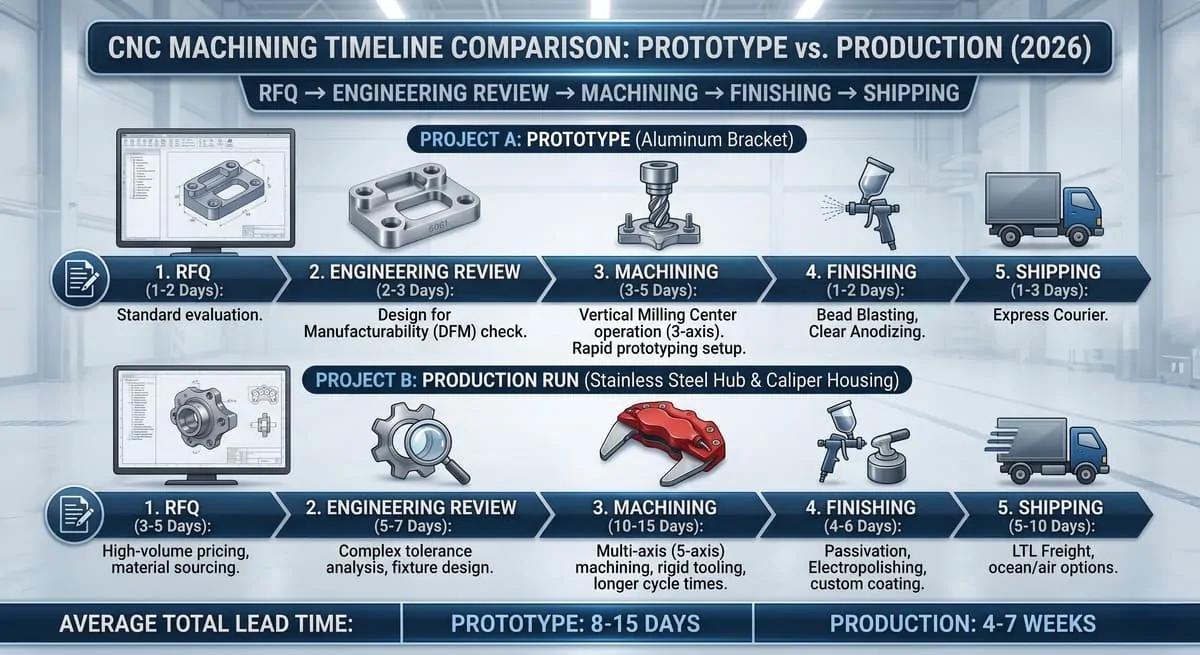
One of the most common questions buyers ask is simple:
How long does CNC machining actually take?
The answer depends on far more than machine time alone.
Part geometry, material availability, finishing requirements, production volume, engineering review, and logistics planning can all influence the final delivery schedule.
Prototype parts, for example, are often produced faster than repeat production orders, while complex components requiring tight tolerances or secondary processing may require additional manufacturing time.
Supplier location can also influence delivery expectations. Buyers comparing American machining suppliers, leading CNC suppliers in China, and European CNC manufacturers may encounter very different timelines depending on production workflow, communication speed, and shipping requirements.
This guide explains typical CNC machining timelines for prototypes and production parts, the factors that affect turnaround time, and practical ways to reduce manufacturing delays without sacrificing quality.
Whether you are sourcing a single prototype or planning repeat production, understanding machining lead time can help improve project scheduling, supplier selection, and overall manufacturing efficiency.
Upload your drawings or CAD files for lead time evaluation, engineering feedback, and manufacturing recommendations.
CNC machining lead time is influenced by more than machining hours alone.
Two suppliers producing the same component may provide very different delivery estimates depending on production capacity, manufacturing workflow, engineering review requirements, and order scheduling.
Understanding the main drivers behind machining turnaround time can help buyers evaluate quotations more accurately and reduce unexpected project delays.
Part geometry is one of the biggest variables affecting CNC machining timelines.
Simple components with standard features can often move through programming, setup, and machining relatively quickly.
More complex parts typically require additional time for:
CAM programming
fixture preparation
multi-axis setup
toolpath optimization
in-process inspection
Lead time usually increases when projects involve:
deep cavities
thin walls
complex contours
tight tolerances
5-axis machining requirements
Projects requiring advanced geometries often depend on suppliers with stronger precision machining services capability and broader machine resources.
Lead time does not begin when machining starts.
In many projects, material sourcing affects the production schedule before manufacturing even begins.
Commonly stocked materials such as:
aluminum
stainless steel
brass
engineering plastics
are generally easier to source quickly.
Lead times may increase when projects require:
titanium alloys
specialty stainless grades
aerospace materials
customer-specified stock
uncommon engineering plastics
Material procurement delays can become particularly important for low-volume projects or highly specialized applications.
Supplier workload directly affects delivery timelines.
Even relatively simple parts can experience longer lead times when machine capacity is fully booked.
Scheduling factors may include:
machine availability
operator allocation
production queue length
fixture availability
maintenance schedules
This is one reason why quoted delivery dates can differ significantly between suppliers offering similar pricing.
Experienced CNC manufacturing partners typically manage capacity planning more efficiently, especially during high-volume periods.
Machining is often only one stage of the production process.
Many projects require additional operations before shipment.
Common secondary processes include:
anodizing
heat treatment
plating
powder coating
polishing
laser marking
assembly
Each added process introduces additional handling, scheduling, inspection, and processing time.
Working with suppliers offering integrated custom CNC manufacturing support can sometimes reduce delays caused by multi-vendor coordination.
Production volume can significantly influence manufacturing timelines.
Prototype projects may move quickly through machining because of smaller batch sizes and simplified scheduling.
Larger production orders typically require additional planning for:
raw material preparation
machine allocation
process validation
quality control
batch scheduling
Lead time expectations should therefore be evaluated differently for prototypes, low-volume manufacturing, and repeat production programs.
For international sourcing, delivery time extends beyond factory completion.
Buyers should account for logistics planning and transportation time, particularly when working with overseas Chinese CNC manufacturers.
Final delivery schedules may be influenced by:
export processing
packaging preparation
customs clearance
freight method
regional holidays
destination logistics
In some cases, shipping time may equal or exceed the machining timeline itself.
CNC delivery schedules are shaped by the entire manufacturing workflow — not simply by machine runtime.
Part complexity, material sourcing, supplier capacity, finishing operations, and logistics planning can all affect how quickly machined parts reach the customer.
Understanding these lead time drivers makes supplier quotations easier to interpret and helps buyers build more realistic production schedules.
For projects involving cost, speed, and sourcing trade-offs, many teams evaluate both delivery expectations and broader manufacturing cost comparison factors before selecting a supplier.
There is no single standard CNC machining lead time.
Delivery schedules vary depending on part complexity, quantity, manufacturing process, supplier workload, and post-processing requirements.
However, buyers can generally expect different timelines for prototypes, low-volume production, and repeat manufacturing orders.
The table below provides a practical reference range for common CNC machining scenarios.
Project Type | Typical Lead Time |
|---|---|
Simple Prototype Parts | 3–7 business days |
Complex Prototype Parts | 5–15 business days |
Low-Volume Production | 1–4 weeks |
Repeat Production Orders | 2–6 weeks |
Parts Requiring Extensive Finishing | Additional processing time may apply |
These timelines represent typical industry expectations and can vary depending on supplier capability, machine availability, inspection requirements, and logistics planning.
Prototype projects are usually completed faster than production orders.
Because quantities are lower and production planning is simpler, suppliers can often move prototype work through programming, setup, machining, and inspection more quickly.
Typical prototype turnaround depends on factors such as:
CAD readiness
part geometry
material selection
machining complexity
finishing requirements
Simple aluminum prototype parts may be completed within several business days.
Projects involving tight tolerances, specialty materials, or multi-process workflows generally require longer schedules.
Companies sourcing rapid prototyping services often prioritize delivery speed alongside engineering responsiveness and technical feedback.
Low-volume manufacturing occupies the space between prototypes and full production.
This production stage usually requires more planning than one-off prototype work but remains more flexible than large production programs.
Lead time can be influenced by:
order quantity
fixture preparation
process validation
inspection planning
material allocation
Many suppliers supporting low-volume manufacturing maintain flexible workflows designed to shorten transition time between development and production.
Production schedules typically involve more coordination than prototype work.
Larger orders may require:
production queue scheduling
machine allocation
batch planning
quality documentation
inventory management
Repeat manufacturing programs can benefit from previously established tooling, machining parameters, and validated workflows.
However, production delivery time may still vary depending on supplier capacity and project complexity.
Buyers evaluating production CNC machining programs should consider both machining speed and long-term scheduling reliability.
Machining completion does not always mean shipment readiness.
Projects requiring finishing, heat treatment, coating, or assembly frequently involve additional processing stages.
Common lead time extensions may come from:
anodizing turnaround
plating queues
outsourced heat treatment
inspection reporting
packaging preparation
Suppliers providing integrated custom CNC manufacturing support may be able to reduce delays by managing these processes within a more coordinated production workflow.
Prototype CNC machining can often be completed within days, while production programs typically require longer planning, scheduling, and process coordination.
Delivery expectations should always be evaluated based on project complexity, production stage, and secondary processing requirements.
Understanding the difference between prototype timelines and production schedules helps buyers set more realistic delivery expectations and select suppliers aligned with project priorities.
For projects involving global sourcing decisions, delivery planning is often evaluated alongside manufacturing cost comparison and supplier capability assessment.
CNC machining lead time can vary significantly between sourcing regions.
Delivery schedules are shaped not only by machining speed, but also by production workflow, communication practices, logistics requirements, and manufacturing capacity.
When comparing suppliers across the USA, China, and Europe, buyers should consider total delivery timeline rather than factory production time alone.
Factor | USA | China | Europe |
|---|---|---|---|
Prototype Turnaround | Fast | Competitive | Moderate |
Production Scheduling | Fast–Moderate | Scalable | Moderate |
Engineering Communication | Fast | Supplier dependent | Strong |
Shipping Impact | Low (domestic buyers) | Higher | Regional dependent |
Capacity Flexibility | Moderate | High | Moderate |
Typical Advantage | Local speed | Production scalability | Engineering precision |
These comparisons represent general industry patterns. Actual delivery performance depends on supplier capability, project complexity, and production planning.
For buyers located in North America, U.S. suppliers often provide shorter overall delivery cycles.
Advantages commonly include:
reduced shipping distance
faster engineering communication
local scheduling alignment
simplified logistics
Projects involving urgent prototypes, engineering changes, or rapid product development frequently benefit from working with American machining suppliers.
Domestic sourcing can also reduce delays associated with customs processing and international freight coordination.
However, delivery speed still depends heavily on supplier workload and machine availability.
China is widely used for both prototype and production CNC machining.
Many buyers choose leading CNC suppliers in China because of their ability to support:
flexible production scaling
broad machine capacity
multi-process manufacturing
high-volume scheduling
Factory production speed can often be highly competitive.
However, total delivery schedules should also account for:
export preparation
customs processing
international shipping
destination logistics
For overseas customers, transportation planning may become a meaningful part of overall project lead time.
European suppliers are frequently selected for technically demanding projects requiring strong engineering communication and manufacturing control.
Projects involving:
regulated industries
advanced materials
technical documentation
precision components
often evaluate European CNC manufacturers for their manufacturing reliability and process discipline.
Lead times can vary depending on country, supplier specialization, and project requirements.
Compared with domestic sourcing, logistics planning may still influence final delivery schedules for international buyers.
Supplier region alone does not determine delivery performance.
Two suppliers operating within the same country can still produce dramatically different timelines depending on:
machine capacity
scheduling discipline
engineering responsiveness
process integration
production planning maturity
Experienced CNC manufacturing partners often shorten delivery timelines through stronger workflow management and more efficient project coordination.
USA, China, and Europe each offer different delivery strengths.
Local speed, production scalability, engineering coordination, and logistics planning all play a role in determining actual machining lead time.
Rather than asking which region is universally faster, buyers should evaluate which sourcing model best matches their project priorities, delivery requirements, and operational constraints.
Many procurement teams compare American machining suppliers, leading CNC suppliers in China, and European CNC manufacturers based on both delivery expectations and broader manufacturing strategy.
When sourcing CNC machined parts internationally, factory completion is only part of the delivery timeline.
For many overseas buyers, shipping can become one of the largest variables affecting total lead time.
Even when machining is completed quickly, transportation, customs procedures, and logistics coordination can add several days or weeks before parts reach the final destination.
Understanding shipping expectations is therefore essential when working with overseas Chinese CNC manufacturers.
Shipping Method | Estimated Transit Time | Typical Use Case |
|---|---|---|
Express Shipping | 3–7 business days | Urgent prototypes |
Air Freight | 5–12 business days | Faster production delivery |
Sea Freight | 20–45+ days | Cost-sensitive production orders |
Rail Freight* | Varies by destination | Selected regional routes |
*Availability depends on destination market and logistics conditions.
These timelines are general references and may vary by carrier, customs processing, destination region, seasonal demand, and geopolitical conditions.
Express delivery is commonly used for prototype machining and urgent engineering programs.
Typical advantages include:
faster transit time
simplified tracking
reduced handling stages
quicker customs workflows
Express shipping is frequently selected for:
prototype parts
engineering validation
emergency replacement components
small production quantities
Although logistics cost is generally higher, the faster timeline can help protect project schedules.
Air freight is often used when buyers need faster delivery without the premium cost associated with express couriers.
Many production projects choose air freight for:
medium-volume shipments
accelerated production schedules
lower inventory buffer strategies
Air transportation can substantially reduce international delivery time compared with sea freight.
However, shipment size, packaging requirements, and customs procedures still influence final delivery schedules.
Sea freight remains a common option for larger or cost-sensitive production programs.
Typical advantages include:
lower shipping cost
higher cargo capacity
better suitability for larger production volumes
However, buyers should account for longer transportation timelines.
Sea freight schedules can be affected by:
port congestion
container availability
customs inspections
seasonal shipping fluctuations
regional logistics disruptions
For production planning, shipping strategy should be evaluated together with broader manufacturing cost comparison considerations.
Shipping lead time involves more than transit duration.
Unexpected delays may also come from:
export documentation
packaging preparation
customs clearance
destination inspections
local delivery coordination
holiday-related logistics slowdowns
In some projects, these operational factors can extend delivery schedules beyond the original machining estimate.
Working with experienced CNC manufacturing partners can often improve shipment planning and reduce avoidable logistics delays.
Fast machining does not automatically mean fast delivery.
When sourcing internationally, freight method, customs processing, and logistics coordination can significantly influence total project lead time.
For global sourcing programs, buyers should evaluate complete delivery timelines — including machining, post-processing, and transportation — rather than focusing on factory production time alone.
Many companies comparing leading CNC suppliers in China also assess logistics planning as part of a broader supplier evaluation process.
CNC machining delays are not always caused by machine availability or production speed.
In many projects, unexpected delivery issues originate from engineering coordination, documentation gaps, material sourcing problems, or workflow bottlenecks outside the machining process itself.
Understanding these hidden delay factors can help buyers build more reliable production schedules and reduce sourcing risk.
One of the most common causes of lead time extension appears before production even begins.
Incomplete technical documentation may create delays related to:
missing tolerances
unclear dimensions
material specification gaps
unfinished CAD files
drawing inconsistencies
When engineering clarification is required, suppliers may need additional communication rounds before programming or machining can proceed.
Design revisions during production can also extend timelines through:
program updates
setup adjustments
inspection changes
manufacturing revalidation
Projects supported by stronger engineering review services often move into production more smoothly.
Material availability can significantly influence machining schedules.
Although standard materials are often readily available, specialized stock may require additional sourcing time.
Common delay sources include:
aerospace alloys
specialty stainless steel grades
customer-specified materials
uncommon plastics
certified raw material requirements
Material shortages or supplier procurement bottlenecks can quickly shift originally planned delivery dates.
This becomes particularly important in regulated industries or projects involving tight material traceability requirements.
Quality verification is essential to precision manufacturing, but it can also influence production timelines.
Additional lead time may be required for:
CMM inspection
first article inspection
dimensional reporting
customer documentation
certification verification
Complex quality requirements can extend final shipment readiness, especially for precision projects.
Buyers working with experienced precision machining services providers often benefit from more structured inspection workflows.
Supplier scheduling pressure is another frequently underestimated factor.
Even technically capable suppliers may experience timeline extension during periods of high production demand.
Capacity-related delays can stem from:
machine bottlenecks
operator availability
overloaded production queues
maintenance downtime
fixture scheduling conflicts
This is one reason why two suppliers quoting similar prices can offer very different delivery commitments.
Evaluating supplier workload and operational maturity is often just as important as comparing cost.
Production timelines can slow considerably when communication processes are inefficient.
Typical issues may include:
delayed technical responses
quotation clarification cycles
approval bottlenecks
slow revision feedback
cross-timezone coordination challenges
For international sourcing programs, communication quality can directly influence manufacturing responsiveness.
Many companies therefore prioritize CNC manufacturing partners with stronger project management and engineering communication capability.
Even after production is completed, delivery timelines may still be affected by external logistics factors.
Potential issues include:
customs inspections
export documentation delays
freight congestion
holiday shipping slowdowns
regional transportation disruptions
International sourcing strategies should account for these variables during delivery planning rather than relying only on factory completion dates.
Many CNC delivery delays originate outside the machine shop itself.
Engineering revisions, material sourcing, inspection requirements, communication workflows, and logistics coordination can all affect final delivery performance.
Reducing machining lead time often requires improving workflow quality across the entire production process — from engineering preparation through shipment execution.
For this reason, many buyers evaluate supplier responsiveness, technical communication, and operational structure alongside broader manufacturing cost comparison considerations.
Reducing CNC machining lead time is not only the supplier’s responsibility.
Project preparation, design decisions, documentation quality, and sourcing strategy can all influence how quickly parts move from quotation to delivery.
The following practices can help shorten manufacturing timelines while maintaining production quality.
Production delays often begin with incomplete technical information.
Well-prepared project files allow suppliers to move more quickly through quotation, engineering review, programming, and production planning.
Documentation should ideally include:
complete dimensions
tolerance requirements
material specification
surface finish requirements
quantity information
inspection expectations
Clear documentation reduces clarification cycles and helps suppliers provide more reliable delivery commitments.
Part design directly affects machining efficiency.
Overly complex geometries, unnecessarily tight tolerances, and difficult-to-machine features can extend setup time, programming effort, and inspection workload.
Simple design adjustments may help reduce lead time, including:
simplifying internal features
minimizing unnecessary tight tolerances
selecting standard material sizes
reducing avoidable secondary operations
Early engineering review services can often identify manufacturability improvements before production begins.
Frequent design revisions can disrupt production schedules.
When drawings continue changing during quotation, programming, or machining stages, suppliers may need to restart portions of the workflow.
Timeline impact may include:
revised CAM programming
setup modification
updated inspection planning
scheduling adjustments
Finalizing technical requirements as early as possible helps reduce avoidable production interruptions.
Multi-vendor workflows can introduce coordination delays.
Projects involving machining, finishing, inspection, and secondary processing may benefit from suppliers offering broader custom CNC manufacturing capability.
Integrated workflows can help reduce:
supplier handoffs
logistics coordination
communication gaps
scheduling conflicts
This is especially valuable for low-volume production and complex project management environments.
Lead time expectations should be discussed early — not after production begins.
Suppliers can often recommend:
alternative materials
process adjustments
expedited production options
shipping recommendations
Open communication helps align delivery expectations with manufacturing reality.
Experienced CNC manufacturing manufacturer frequently provide practical scheduling guidance based on machine availability, workflow planning, and project complexity.
For international sourcing, delivery planning should include logistics decisions from the beginning.
Choosing the right freight method can significantly influence total project timeline.
Buyers should evaluate:
express delivery vs air freight
production urgency
shipment size
customs considerations
inventory planning
In some projects, logistics optimization may reduce total delivery time more effectively than attempting to accelerate machining alone.
Faster CNC delivery is usually achieved through stronger project preparation, better engineering communication, and more efficient production planning — not simply by requesting shorter deadlines.
Design quality, supplier selection, integrated workflows, and logistics planning all play an important role in improving manufacturing speed.
Lead time reduction is most effective when buyers and suppliers work collaboratively to improve workflow efficiency across engineering, manufacturing, and logistics stages.
Many sourcing teams evaluate delivery planning together with supplier capability, cost structure, and broader manufacturing strategy considerations.
Fast CNC machining is not simply about running machines harder or promising unrealistic delivery dates.
Reliable lead time performance depends on engineering preparation, workflow coordination, production planning, and execution consistency across the entire manufacturing process.
NAITE TECH supports global customers with manufacturing workflows designed to improve responsiveness across prototype development, low-volume production, and repeat machining programs.
Reducing delivery risk often starts before machining begins.
Our engineering team reviews project files to identify potential issues that may affect manufacturability, production efficiency, or delivery schedule.
Review support may include:
manufacturability assessment
tolerance review
material recommendations
process selection guidance
machining feasibility analysis
Early engineering review services can help reduce clarification cycles, avoid preventable revisions, and support more predictable production planning.
Managing multiple vendors can introduce unnecessary coordination time.
NAITE TECH provides integrated manufacturing support including:
CNC milling
CNC turning
Swiss machining solutions
sheet metal fabrication
3D printing
surface finishing
Combining multiple manufacturing processes within one workflow can help reduce scheduling complexity and improve delivery coordination.
For projects involving machining plus secondary operations, integrated custom CNC manufacturing support may improve overall turnaround efficiency.
Lead time requirements often change as projects evolve.
Prototype development typically prioritizes engineering responsiveness and quick iteration, while production programs focus more on scheduling stability and manufacturing scalability.
NAITE TECH supports:
rapid prototypes
low-volume manufacturing
bridge production
repeat production orders
This allows customers to transition between development stages without repeatedly changing suppliers or rebuilding production workflows.
Companies requiring both machining and rapid prototyping services often benefit from more streamlined supplier collaboration.
Communication speed can directly influence manufacturing timelines.
NAITE TECH supports international projects with:
English engineering communication
quotation responsiveness
project coordination
export packaging
worldwide shipping support
Clear communication and structured workflow management help reduce avoidable delays during quotation, production, and delivery stages.
Many buyers evaluating top CNC suppliers in China prioritize communication quality alongside manufacturing capability and pricing.
Fast delivery should not come at the expense of manufacturing quality.
Inspection support may include:
dimensional inspection
CMM verification
first article inspection
inspection reporting upon request
Consistent process control helps reduce:
rework risk
production interruptions
delivery uncertainty
Reliable execution is an important part of sustainable lead time performance, particularly for precision manufacturing projects.
Shorter lead times are often achieved through stronger engineering preparation, integrated workflows, responsive communication, and disciplined production planning.
Manufacturing speed and manufacturing reliability work best together — not as competing priorities.
For companies balancing delivery speed, technical requirements, and sourcing efficiency, selecting an experienced CNC manufacturing partner can help improve both project responsiveness and long-term manufacturing performance.
CNC machining lead time varies depending on part complexity, material availability, production quantity, finishing requirements, and supplier scheduling. Simple prototype parts may be completed within several business days, while production orders can require multiple weeks depending on workflow and capacity planning.
Prototype projects can experience delays due to incomplete drawings, engineering revisions, material sourcing, complex geometries, or secondary processing requirements. Early technical preparation and stronger engineering review services can often help improve timeline predictability.
Delivery speed depends on project complexity, supplier workload, production process, and shipping method. Many buyers work with leading CNC suppliers in China for competitive prototype and production turnaround, but total delivery schedules should also account for export processing and international logistics.
Key variables typically include part complexity, material availability, machine capacity, order quantity, finishing operations, engineering revisions, inspection requirements, and shipping logistics.
Yes. Processes such as anodizing, plating, polishing, heat treatment, and coating may extend overall production schedules because they introduce additional processing, handling, inspection, and scheduling stages.
Lead time can often be reduced by submitting complete drawings, optimizing part design, finalizing engineering changes early, planning logistics in advance, and working with experienced CNC manufacturing partners capable of supporting efficient project workflows.
In many cases, yes. Suppliers offering machining, finishing, inspection, and secondary operations within a unified workflow can often reduce coordination delays through stronger custom CNC manufacturing capability.
Prototype machining typically prioritizes rapid setup, engineering responsiveness, and smaller quantities. Production programs usually involve additional scheduling, batch planning, quality control, and supply chain coordination, resulting in longer delivery timelines.


