
- Home
- Capabilities
- Solution
- Material
- Industry
- Resources
- Request a Quote
Views: 0 Author: Site Editor Publish Time: 2026-05-25 Origin: Site
Choosing a CNC machining supplier is rarely just a pricing decision.
The right manufacturing partner can influence product quality, development speed, supply chain reliability, and long-term production performance. The wrong choice may introduce avoidable delays, inconsistent quality, engineering friction, or unexpected operational cost.
For procurement teams, engineers, and product developers, supplier evaluation has become increasingly complex.
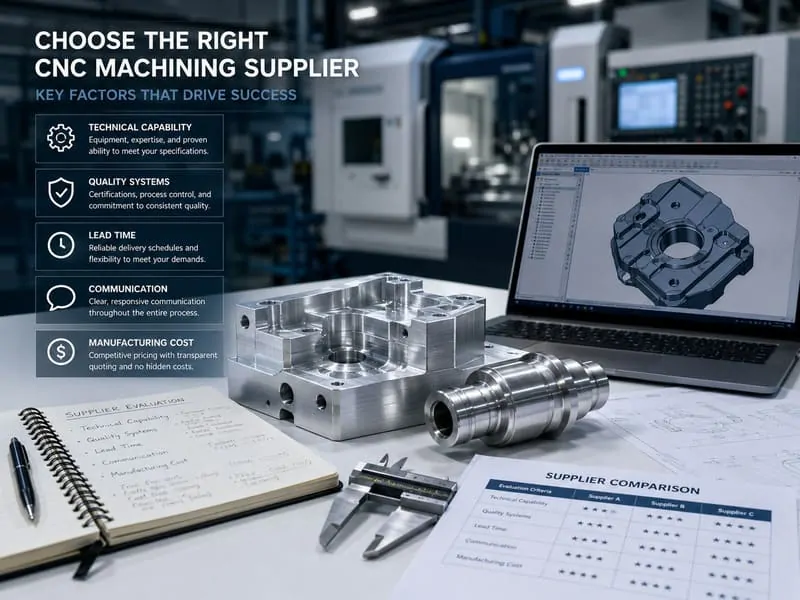
Modern projects often require more than basic machining capability. Buyers may need support for:
tight tolerances
complex geometries
multiple material options
engineering collaboration
low-volume production
scalable manufacturing workflows
As a result, selecting a supplier typically involves evaluating technical capability, communication quality, production capacity, inspection standards, and overall delivery reliability — not simply comparing quotations.
Whether you are sourcing prototypes, precision components, or repeat production parts, understanding how to assess precision machining services, custom CNC manufacturing capability, and potential CNC manufacturing partners can significantly improve sourcing outcomes.
This guide outlines the key criteria buyers should consider when choosing a CNC machining supplier, along with practical evaluation methods used across engineering and manufacturing environments.
Supplier selection can directly affect project cost, delivery performance, and manufacturing risk.
Even technically simple components can become problematic when production capability, communication quality, or workflow discipline do not align with project requirements.
The impact of supplier choice often becomes visible across several areas of a project lifecycle.
Machined parts must consistently meet technical requirements.
Supplier capability can influence:
dimensional accuracy
surface finish quality
material conformity
process consistency
inspection reliability
For projects involving precision assemblies, regulated industries, or demanding engineering requirements, manufacturing quality may directly affect downstream product performance.
Working with experienced precision machining services providers can help reduce quality-related risk and improve repeatability across production cycles.
The lowest quotation does not always represent the best sourcing decision.
Unexpected cost often appears through:
rework
scrap parts
delayed production
engineering clarification cycles
logistics disruption
supplier management overhead
Many buyers therefore evaluate suppliers using a broader manufacturing cost comparison approach rather than focusing exclusively on quoted machining price.
Total manufacturing value frequently extends beyond unit cost alone.
Fast quoting and competitive pricing are valuable — but reliable delivery performance is equally important.
Production schedules may be affected by:
machine capacity
workflow planning
material availability
finishing coordination
communication responsiveness
Projects with strict launch schedules or customer commitments often prioritize suppliers with stronger delivery discipline and predictable scheduling practices.
Many sourcing teams therefore assess delivery performance together with broader CNC lead time guide considerations during supplier evaluation.
Communication quality is often underestimated during supplier selection.
However, effective engineering collaboration can substantially influence project efficiency.
Areas where communication matters include:
DFM feedback
tolerance clarification
drawing revisions
process recommendations
issue resolution
Suppliers with stronger technical communication capability frequently help reduce approval cycles, engineering delays, and preventable production issues.
This becomes particularly important for prototype development, low-volume manufacturing, and technically demanding projects.
Technical capability should be one of the first areas evaluated when selecting a CNC machining supplier.
A supplier may offer competitive pricing and fast quoting, but if technical capability does not match project requirements, manufacturing issues can quickly appear during production.
Buyers should assess machining capability based on actual project fit rather than general marketing claims.
The following checklist highlights several areas commonly reviewed during supplier evaluation.
Different suppliers support different manufacturing scopes.
Before requesting production, buyers should verify whether the supplier’s equipment and process capability align with project requirements.
Areas worth evaluating include:
CNC milling capability
CNC turning capability
multi-axis machining support
complex geometry handling
prototype machining capability
production machining capacity
Projects involving intricate features, tight tolerances, or difficult geometries may require suppliers with stronger custom CNC manufacturing capability and broader machine resources.
When evaluating suppliers, asking about similar completed projects can often provide more useful insight than reviewing equipment lists alone.
Material capability is another important qualification factor.
Not every CNC supplier maintains equal experience across metals, plastics, and specialty engineering materials.
Buyers should confirm whether suppliers can support required materials such as:
aluminum alloys
stainless steel
brass
copper
titanium
engineering plastics
For specialized applications, additional considerations may include:
aerospace alloys
medical-grade materials
traceability requirements
certified raw material sourcing
Material familiarity can influence machining quality, delivery reliability, and manufacturing efficiency.
Suppliers with broader precision machining services experience often demonstrate stronger process understanding across multiple material categories.
Tolerance capability should always be evaluated against actual product requirements.
Rather than accepting generic claims of “high precision,” buyers should verify measurable manufacturing capability.
Typical evaluation points include:
standard machining tolerance range
tight tolerance capability
repeatability performance
geometric tolerance experience
surface finish control
Projects involving precision assemblies, aerospace components, medical parts, or technical interfaces frequently require stronger process discipline and inspection capability.
Requesting tolerance examples from previous production work can help buyers assess practical manufacturing competence more accurately.
Companies comparing precision machining services providers often place significant emphasis on consistency — not simply theoretical tolerance claims.
Inspection capability is a critical part of technical evaluation.
Manufacturing quality depends not only on machining accuracy but also on the ability to verify and document results.
Supplier assessment may include reviewing:
CMM capability
dimensional inspection workflow
first article inspection support
measurement equipment
inspection reporting availability
For technical or regulated projects, buyers may also evaluate:
calibration procedures
documentation practices
traceability systems
quality record management
Suppliers with stronger inspection infrastructure typically provide more reliable manufacturing verification throughout prototype and production workflows.
Modern projects frequently require more than standalone machining.
Many buyers prefer suppliers capable of supporting broader manufacturing workflows through integrated services.
Additional process capability may include:
surface finishing
heat treatment
laser marking
assembly support
sheet metal fabrication
additive manufacturing
Working with suppliers offering wider custom CNC manufacturing scope can sometimes reduce coordination complexity across multi-process projects.
This becomes especially valuable when managing compressed schedules or multi-stage product development programs.
Technical capability should be assessed against real project requirements — not simply supplier marketing language.
Machine resources, material experience, tolerance performance, inspection capability, and process range all influence manufacturing suitability.
Strong technical alignment often reduces manufacturing risk before production even begins.
For complex projects, buyers frequently combine technical evaluation with broader delivery, communication, and CNC lead time guide considerations when selecting qualified suppliers.
Technical capability alone does not guarantee manufacturing suitability.
A supplier may be fully capable of producing a prototype part but struggle when project volume increases, delivery schedules tighten, or production complexity expands.
For this reason, buyers should evaluate whether a supplier can support the full manufacturing lifecycle — from prototype development to repeat production.
Capacity and scalability often become increasingly important as projects move beyond early engineering validation.
Prototype manufacturing and production manufacturing are not identical environments.
Prototype work typically emphasizes:
engineering flexibility
rapid setup
fast iteration cycles
technical collaboration
Production programs usually require stronger focus on:
workflow stability
scheduling discipline
repeatability
capacity management
quality consistency
Some suppliers perform extremely well during prototype development but encounter operational challenges during larger production runs.
Companies sourcing rapid prototyping services should therefore evaluate whether suppliers can also support future production requirements.
Many projects operate between one-off prototyping and high-volume production.
This stage often requires suppliers capable of balancing flexibility with controlled production workflow.
Key evaluation points may include:
flexible batch sizing
mixed-order scheduling
shorter setup cycles
engineering responsiveness
repeatable process control
Strong low-volume manufacturing capability can be particularly valuable for:
pilot production
bridge manufacturing
product validation
early commercial launch programs
Suppliers comfortable with low-volume environments often provide smoother transitions between development and scaled production.
Delivery performance depends not only on machine capability but also on available production capacity.
Even technically qualified suppliers may experience scheduling challenges when machine utilization is high.
Buyers may wish to assess:
machine count
production queue management
shift capacity
scheduling flexibility
equipment redundancy
Projects with aggressive timelines often benefit from suppliers capable of managing production allocation efficiently.
This becomes increasingly important when evaluating delivery reliability alongside broader CNC lead time guide considerations.
Supplier suitability should be evaluated not only for today’s requirements but also for potential future growth.
Production demand can evolve rapidly as products move through development, validation, and commercialization stages.
Buyers may consider whether suppliers can accommodate:
increasing order volumes
repeat production schedules
multi-part programs
evolving technical requirements
expanded manufacturing scope
Selecting suppliers with scalable custom CNC manufacturing capability can help reduce disruption caused by supplier changes later in a project lifecycle.
Scalability is not only about machine quantity.
Workflow integration also affects how efficiently projects scale.
Projects involving multiple processes may require coordination across:
machining
finishing
inspection
secondary operations
packaging
logistics
Suppliers offering integrated production workflows can sometimes reduce management complexity, communication gaps, and scheduling friction.
This may improve operational efficiency for both prototype and production environments.
A supplier that can successfully produce a prototype is not automatically equipped to support long-term production growth.
Manufacturing capacity, scheduling discipline, low-volume flexibility, and scalability should all be evaluated during supplier selection.
Strong supplier evaluations typically consider both current project requirements and future manufacturing scenarios.
For many buyers, long-term sourcing success depends on finding CNC manufacturing partners capable of supporting development, production growth, and operational continuity across changing project stages.
Quality capability is often evaluated through more than machining accuracy alone.
For many buyers, especially those working in regulated or technically demanding industries, supplier quality systems play an important role in manufacturing qualification and long-term production confidence.
A capable supplier should not only be able to produce accurate parts — but also demonstrate how manufacturing quality is managed, verified, and maintained.
Inspection is important, but quality control begins much earlier in the manufacturing workflow.
Supplier evaluation may include reviewing how quality is managed across:
quotation review
engineering preparation
production planning
machining execution
final verification
Strong quality systems typically rely on structured processes rather than end-of-line inspection alone.
This can help reduce rework, production variability, and preventable manufacturing issues.
Certification expectations vary significantly across industries and project types.
For many CNC projects, buyers commonly review whether suppliers maintain recognized quality management systems such as:
ISO-based workflows
documented process control
inspection procedures
calibration practices
Projects involving aerospace, medical, automotive, or industrial applications may require additional qualification criteria depending on regulatory and customer requirements.
However, certifications should be evaluated together with actual operational capability.
A certificate alone does not automatically guarantee manufacturing performance.
Documentation capability is often an important part of supplier qualification.
Buyers may assess whether suppliers can support:
first article inspection
dimensional reports
CMM reporting
material certificates
inspection records
Documentation becomes increasingly important for projects involving:
precision assemblies
regulated industries
customer audits
traceability requirements
repeat production programs
Suppliers with stronger precision machining services workflows often demonstrate more mature inspection and reporting practices.
For some applications, quality evaluation extends beyond finished dimensions.
Traceability and process discipline can also influence supplier suitability.
Typical assessment areas may include:
material traceability
lot tracking
process documentation
revision management
calibration control
These practices help improve manufacturing consistency and support long-term production reliability.
Traceability expectations often increase as projects become more technically complex or compliance-driven.
A supplier producing one acceptable sample part does not necessarily demonstrate sustainable manufacturing capability.
Long-term supplier evaluation should consider:
repeatability
process stability
production consistency
quality responsiveness
corrective action discipline
Reliable quality performance becomes particularly important during low-volume manufacturing transitions and repeat production programs.
Many buyers therefore evaluate quality systems as part of broader supplier capability assessment — not as an isolated checklist item.
Strong manufacturing quality depends on structured systems, process discipline, and consistent execution — not inspection alone.
Quality systems, documentation capability, traceability practices, and repeatability all contribute to long-term supplier reliability.
Technical capability is important, but communication quality often determines how efficiently projects actually move through manufacturing.
Even highly capable suppliers can create friction when technical questions remain unresolved, revision handling is slow, or engineering coordination lacks structure.
For many procurement teams and engineers, supplier responsiveness becomes increasingly important during prototype development, complex projects, and fast-moving production environments.
Quick quotations can be helpful, but quoting speed alone does not fully reflect supplier communication quality.
Buyers should also evaluate how suppliers handle technical interaction during the quotation stage.
Useful indicators may include:
clarification quality
engineering questions
manufacturability feedback
material recommendations
tolerance discussion
A supplier asking thoughtful technical questions often demonstrates stronger project engagement than one providing immediate pricing with minimal engineering review.
Early communication quality can provide valuable insight into future production collaboration.
Strong suppliers frequently contribute more than machining execution.
Technical collaboration may help improve:
manufacturability
production efficiency
tolerance strategy
material selection
cost optimization
Early engineering review services can sometimes identify design risks or process improvements before production begins.
This collaborative approach can help reduce downstream revisions, manufacturing delays, and avoidable project cost.
Engineering changes are common during product development and production refinement.
How suppliers handle revisions can significantly affect workflow efficiency.
Buyers may evaluate whether suppliers maintain structured approaches to:
drawing revision control
CAD updates
process changes
documentation alignment
approval tracking
Poor revision handling can lead to communication gaps, manufacturing confusion, and production errors.
Responsive engineering coordination often becomes particularly valuable during rapid prototyping services workflows and iterative product development programs.
Manufacturing timelines are closely linked to communication quality.
Slow technical responses, delayed approvals, or unclear issue escalation can quickly influence production schedules.
Supplier responsiveness may affect:
quotation turnaround
engineering clarification
production coordination
inspection communication
shipment readiness
For international sourcing, communication practices become even more important because timezone differences and remote collaboration naturally increase operational complexity.
Many buyers therefore evaluate communication quality alongside broader CNC lead time guide considerations.
As projects become more complex, communication often extends beyond individual technical discussions.
Large or multi-stage programs may require coordination across:
engineering
production
quality
finishing
logistics
Suppliers with stronger project management capability can help reduce communication bottlenecks and improve workflow transparency across manufacturing stages.
This may be especially valuable for buyers managing multi-part programs, accelerated schedules, or international supply chains.
Strong CNC suppliers do more than provide machining capability.
Clear engineering communication, structured revision handling, responsive collaboration, and disciplined project coordination can significantly improve manufacturing efficiency.
Communication capability often becomes increasingly important as projects grow in complexity, production scale, and technical requirements.
For many buyers, long-term sourcing success depends on selecting CNC manufacturing partners capable of supporting both manufacturing execution and effective engineering collaboration.
Lead time is one of the most closely watched factors during supplier selection.
However, evaluating delivery performance involves more than comparing advertised turnaround speed.
A supplier promising extremely short lead times may still struggle with schedule consistency, communication discipline, or production coordination.
For many buyers, reliable delivery performance matters just as much as fast machining capability.
Quoted lead time and real-world delivery performance are not always identical.
Production schedules can be influenced by multiple operational variables, including:
machine availability
material sourcing
engineering revisions
finishing coordination
inspection workload
logistics planning
Because of these variables, buyers should evaluate how suppliers manage delivery commitments — not simply what lead time is listed on a quotation.
Companies reviewing CNC lead time guide benchmarks often compare supplier promises against demonstrated operational practices.
Fast prototype turnaround does not automatically translate into strong production delivery performance.
Prototype environments usually emphasize:
quick setup
engineering responsiveness
rapid iteration
Production programs typically require additional strengths in:
scheduling discipline
workflow control
repeatability
capacity management
Supplier evaluations should therefore consider whether delivery capability aligns with the actual stage of the project.
This becomes particularly important when moving from rapid prototyping services into low-volume or repeat manufacturing programs.
Delivery reliability is closely connected to operational planning.
Buyers can often gain useful insight by asking how suppliers manage:
production scheduling
machine allocation
workload balancing
expedited orders
peak demand periods
Strong scheduling practices may help reduce delivery uncertainty, especially during periods of high manufacturing demand.
Operational transparency in this area often reflects broader manufacturing maturity.
For overseas projects, total lead time extends beyond factory production.
Delivery planning may also involve:
export preparation
packaging coordination
customs processing
freight scheduling
destination logistics
When evaluating international suppliers, buyers should consider the complete delivery chain rather than focusing only on machining turnaround.
Many teams comparing leading CNC suppliers in China incorporate logistics planning directly into supplier assessment.
Consistent delivery performance can become increasingly important as production relationships mature.
Reliable suppliers often contribute to:
more stable inventory planning
reduced operational disruption
improved production forecasting
lower schedule risk
For repeat manufacturing programs, dependable delivery capability may ultimately provide more operational value than occasionally faster turnaround promises.
Many companies therefore prioritize delivery consistency when selecting long-term CNC manufacturing partners.
Fast lead times can be valuable, but predictable delivery performance often matters more over the life of a manufacturing program.
Scheduling discipline, operational planning, communication responsiveness, and logistics coordination all influence real-world delivery reliability.
Effective supplier evaluation should consider how delivery performance is achieved — not simply how quickly it is advertised.
For many sourcing teams, lead time assessment becomes a broader review of workflow maturity, operational discipline, and manufacturing reliability.
Price is often one of the first factors reviewed during supplier selection.
However, focusing exclusively on the lowest quotation can create hidden manufacturing risk.
The most competitive quote does not always deliver the strongest overall sourcing outcome.
For many projects, supplier value should be evaluated through a broader manufacturing perspective that includes quality, delivery performance, engineering support, and operational reliability.
Unit price alone rarely represents total manufacturing cost.
Additional cost may appear through:
production delays
quality issues
rework
engineering clarification cycles
communication inefficiencies
logistics complications
A lower initial quote can become significantly more expensive if manufacturing performance creates operational disruption later in the project.
Many procurement teams therefore evaluate suppliers using broader manufacturing cost comparison principles rather than relying solely on quoted machining price.
Technical collaboration may influence project economics more than buyers initially expect.
Strong supplier support can contribute to:
improved manufacturability
optimized tolerances
smarter material selection
reduced machining complexity
shorter production timelines
Early engineering review services sometimes help identify opportunities to improve manufacturing efficiency before production begins.
These improvements can influence both cost structure and production performance.
Manufacturing quality directly affects sourcing economics.
Quality-related issues can introduce additional expense through:
scrap components
corrective production
assembly disruption
shipment delays
supplier management overhead
Reliable precision machining services workflows often help reduce these risks by improving consistency and verification discipline.
For technically demanding projects, stable quality performance may generate meaningful operational value over time.
Lead time reliability can also affect total manufacturing value.
Delivery instability may influence:
inventory planning
production scheduling
customer commitments
product launch timing
operational workload
Suppliers with stronger delivery performance often help reduce indirect business cost associated with manufacturing uncertainty.
Many sourcing teams therefore evaluate pricing together with broader CNC lead time guide considerations during supplier qualification.
Supplier evaluation should consider more than immediate project pricing.
Long-term sourcing relationships may depend on broader factors such as:
technical compatibility
communication quality
scalability
workflow maturity
manufacturing flexibility
A supplier aligned with long-term operational requirements can sometimes create greater value than one selected purely on short-term pricing advantage.
This becomes increasingly relevant for repeat production programs and growing manufacturing partnerships.
Competitive pricing is important, but total manufacturing value extends beyond quoted unit cost.
Engineering capability, quality consistency, delivery reliability, communication effectiveness, and operational fit all influence sourcing outcomes.
Many successful sourcing decisions balance pricing with broader manufacturing performance criteria.
For companies selecting long-term CNC manufacturing partners, total value evaluation often provides a more accurate picture of supplier suitability than price comparison alone.
Selecting a CNC machining supplier involves evaluating not only strengths, but also potential warning signs.
Some supplier issues become visible only after production begins — when delivery delays, quality problems, or communication breakdowns are already affecting the project.
Recognizing common red flags early can help buyers reduce sourcing risk and improve supplier qualification decisions.
Extremely low pricing is not always a competitive advantage.
When suppliers provide quotations with little or no engineering clarification, buyers should evaluate the situation carefully.
Potential concerns may include:
incomplete requirement review
misunderstood specifications
unrealistic cost assumptions
hidden scope gaps
future change orders
Strong suppliers often ask technical questions before finalizing quotations, particularly for complex or precision projects.
Meaningful engineering review services during the quoting phase frequently indicate stronger manufacturing engagement.
Supplier capability should be measurable.
Buyers should be cautious when technical questions receive vague, inconsistent, or overly generic responses.
Areas worth probing include:
machining tolerance capability
material experience
inspection process
production capacity
quality verification
Reliable precision machining services providers are typically able to discuss manufacturing capability with clear technical context rather than broad marketing language.
Aggressive delivery commitments can be attractive, but they should be evaluated against operational credibility.
Questions buyers may ask include:
How is production scheduled?
What is current machine availability?
How are urgent orders managed?
What happens during peak workload periods?
Promised timelines unsupported by workflow explanation may introduce delivery risk later in the project.
Many procurement teams compare supplier commitments against broader CNC lead time guide expectations when evaluating feasibility.
Early communication often predicts future collaboration quality.
Potential warning indicators may include:
slow response cycles
unclear technical answers
inconsistent information
poor revision handling
limited engineering engagement
Communication issues during quotation and project preparation can become more significant during production, especially for technically complex or time-sensitive programs.
Strong supplier responsiveness frequently contributes to smoother engineering coordination and operational stability.
Modern manufacturing programs often extend beyond standalone machining.
Projects may require support for:
finishing
inspection
assembly
packaging
logistics coordination
Suppliers with very narrow process capability may increase project complexity through additional vendor management and coordination requirements.
For multi-stage projects, broader custom CNC manufacturing capability can sometimes improve workflow efficiency.
Quality capability should be visible and explainable.
Buyers may wish to evaluate how suppliers address:
inspection workflow
quality documentation
measurement capability
traceability practices
corrective action handling
Limited transparency in these areas can create uncertainty regarding manufacturing control and long-term production reliability.
Many sourcing problems show early warning signs before production begins.
Pricing behavior, technical clarity, communication quality, delivery credibility, and operational transparency can all provide useful indicators during supplier evaluation.
Supplier qualification is often strongest when buyers evaluate both positive capability indicators and potential operational risks.
For long-term sourcing success, many companies assess technical strength, workflow maturity, and communication quality together when selecting CNC manufacturing partners.
Choosing a CNC machining supplier often becomes easier when evaluation criteria are structured into a practical review framework.
Rather than relying on pricing or marketing claims alone, buyers can assess suppliers across technical, operational, quality, and communication dimensions.
The checklist below provides a simplified evaluation approach commonly used during supplier screening and qualification.
Evaluation Area | Key Questions to Ask |
|---|---|
Technical Capability | Can the supplier support required geometries, tolerances, materials, and processes? |
Material Support | Do they have experience with your required materials and sourcing requirements? |
Quality Systems | What inspection workflows, documentation, and traceability practices are available? |
Manufacturing Capacity | Can they support prototypes, low-volume production, and scaling requirements? |
Communication | Are technical questions answered clearly and responsively? |
Lead Time Reliability | How are delivery schedules managed and communicated? |
Engineering Support | Do they provide manufacturability feedback or technical recommendations? |
Process Range | Can they support finishing, inspection, assembly, or secondary operations? |
Cost Structure | Does the quotation reflect total manufacturing value rather than price alone? |
Long-Term Fit | Can the supplier support future production growth and evolving requirements? |
This checklist can be adapted based on project complexity, industry requirements, and sourcing priorities.
Not every project requires the same supplier profile.
Different applications may prioritize different qualification criteria.
For example:
Prototype projects may emphasize:
engineering responsiveness
quick setup capability
rapid iteration
flexible scheduling
Production programs may place greater focus on:
delivery reliability
repeatability
capacity management
long-term operational stability
Supplier evaluation becomes more effective when criteria align with actual project needs rather than using a single universal scoring model.
Supplier evaluation does not need to rely exclusively on documents or capability lists.
Technical interaction itself can provide useful qualification insight.
Areas worth observing include:
question quality
engineering engagement
manufacturability discussion
revision handling
technical clarity
Strong engineering review services behavior during early discussions often reflects broader manufacturing maturity.
Supplier suitability is rarely determined by one factor alone.
A supplier offering strong pricing but weak communication may create operational risk.
A technically capable supplier with unstable delivery performance may struggle to support production schedules.
Effective sourcing decisions typically balance:
technical capability
quality discipline
communication responsiveness
delivery reliability
manufacturing value
Many procurement teams therefore evaluate suppliers through a broader manufacturing cost comparison and operational performance perspective.
Supplier qualification is not only about approving a current order.
It can also influence future manufacturing flexibility, supply chain stability, and operational efficiency.
Selecting the right CNC manufacturing partners may help support:
smoother production transitions
reduced sourcing disruption
stronger technical collaboration
more scalable manufacturing workflows
Long-term supplier compatibility often becomes increasingly valuable as projects grow in complexity and production scale.
Strong supplier selection typically combines technical assessment, operational review, communication evaluation, and long-term manufacturing fit.
Structured evaluation frameworks often help buyers make more reliable sourcing decisions than pricing comparison alone.
The most effective supplier qualification processes are usually systematic rather than reactive.
By evaluating capability, workflow maturity, communication quality, and delivery performance together, buyers can build more reliable and scalable manufacturing partnerships.
Choosing the right supplier typically involves evaluating technical capability, material support, quality systems, communication responsiveness, delivery reliability, and long-term manufacturing fit. Buyers often compare suppliers across multiple criteria rather than relying solely on pricing.
Common evaluation questions may include machining capability, tolerance performance, material experience, inspection process, production capacity, delivery scheduling, and engineering support availability. Early technical discussions can provide useful insight into supplier suitability.
Engineering communication can strongly influence project efficiency. Clear technical discussion, revision handling, manufacturability feedback, and responsive collaboration often help reduce delays and manufacturing friction. Many buyers evaluate engineering review services capability as part of supplier qualification.
Not necessarily. Lower pricing may sometimes be offset by hidden costs related to quality issues, delivery instability, rework, communication challenges, or operational inefficiency. Many sourcing teams use broader manufacturing cost comparison evaluation methods when reviewing suppliers.
Technical capability can often be assessed through machining scope, tolerance performance, material experience, inspection capability, completed project examples, engineering communication quality, and production workflow maturity.
Quality expectations vary by project and industry. Buyers commonly review inspection workflow, documentation capability, traceability practices, calibration procedures, and quality management processes when evaluating suppliers.
Some suppliers support both environments, while others specialize in only one area. Buyers sourcing rapid prototyping services may wish to confirm whether suppliers can also manage low-volume manufacturing, repeat production, and long-term scalability requirements.
Potential warning indicators may include vague technical responses, unrealistic delivery promises, limited engineering discussion, unclear quality processes, poor communication responsiveness, or unusually low quotations without sufficient project review.


