
- Home
- Capabilities
- Solution
- Material
- Industry
- Resources
- Request a Quote
Views: 0 Author: Site Editor Publish Time: 2025-11-11 Origin: Site
Surface roughness plays a crucial role in determining the quality, performance, and longevity of machined components. In modern CNC machining, where precision and consistency are the cornerstones of manufacturing, understanding and controlling surface roughness is not just about aesthetics—it’s about functionality, reliability, and cost efficiency.
At NAITE TECH, our machining philosophy combines deep engineering insight with state-of-the-art technology to achieve the ideal surface finish for every component. In this technical guide, we’ll explore what surface roughness truly means, how it’s measured, and how manufacturers can optimize machining processes to meet demanding surface quality requirements.
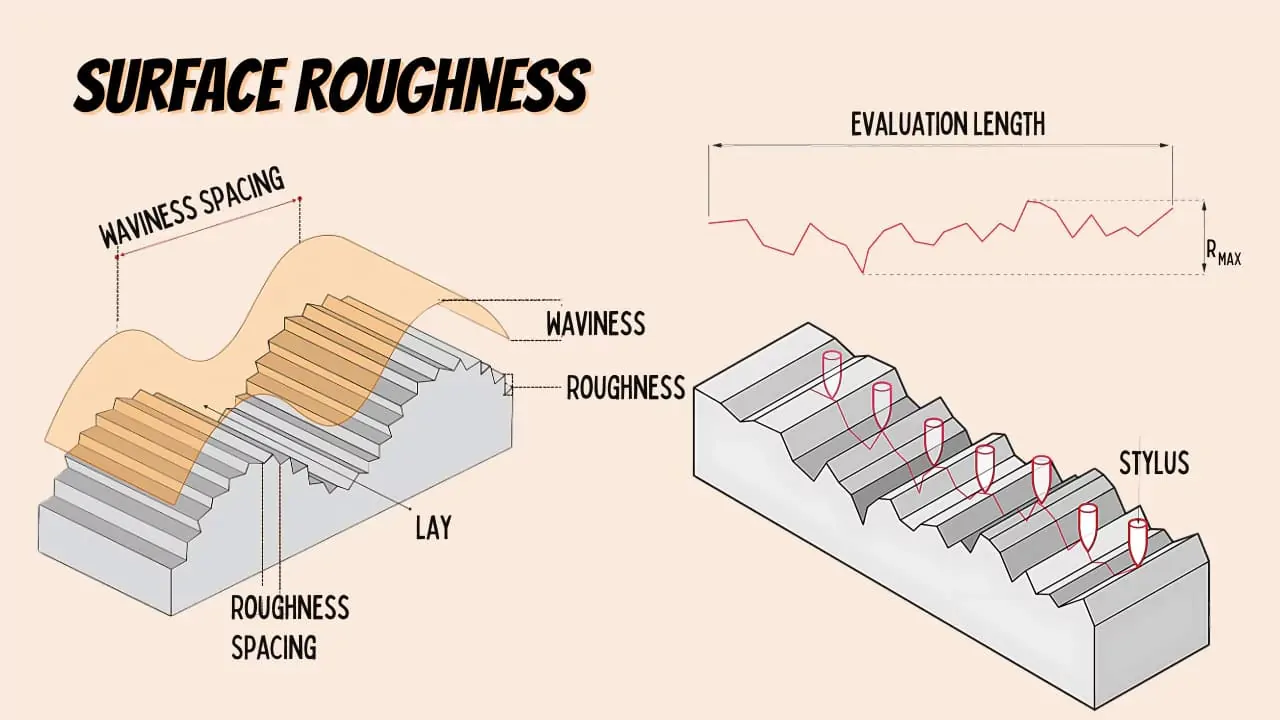
Surface roughness refers to the fine irregularities or microscopic deviations on the surface of a machined part. These irregularities result from the interaction of the cutting tool and the workpiece during the machining process.
In engineering terms, surface roughness is a measure of the texture of a surface—it quantifies the vertical deviations of a real surface from its ideal form. A perfectly smooth surface would have a surface roughness of zero, but in practice, every machined surface has peaks and valleys at a certain scale.
Although often used interchangeably, surface roughness and surface finish are not identical.
Surface roughness refers specifically to small-scale surface irregularities caused by the machining process itself.
Surface finish is a broader term that includes roughness, waviness, and lay (the direction of the surface pattern).
In CNC machining, engineers typically control surface roughness (Ra, Rz, Rmax) as a measurable specification, while surface finish describes the overall surface quality.
The microscopic texture of a CNC-machined surface depends on several process parameters:
Tool geometry and sharpness: Dull tools create irregular peaks and burrs.
Feed rate and spindle speed: Higher feed rates increase the distance between tool marks, raising roughness values.
Cutting depth and material hardness: Deeper cuts or harder materials can induce chatter and tool deflection.
Vibration and machine stability: Even minor vibrations in the spindle or fixture can degrade surface quality.
Lubrication and cooling: Proper coolant flow reduces friction and thermal effects, resulting in smoother surfaces.
Understanding these factors is the foundation of surface quality optimization in precision CNC machining.
The importance of surface roughness extends beyond visual appearance—it directly impacts the mechanical, functional, and economic performance of a component.
Friction and wear: A smoother surface reduces friction and abrasion between mating parts, extending service life.
Sealing and fit: Components like hydraulic pistons or valves require controlled roughness to ensure tight seals.
Fatigue resistance: Surface peaks can act as stress concentrators. Minimizing roughness enhances fatigue life.
In industries such as automotive, aerospace, and robotics, tight assembly tolerances require consistent surface roughness values to guarantee interchangeability and precision alignment.
In consumer products and high-end devices, surface finish influences visual appeal and perceived quality. A polished aluminum housing, for example, conveys craftsmanship and precision.
Achieving ultra-smooth finishes (e.g., Ra < 0.4 μm) often requires additional machining passes or secondary polishing operations. Balancing surface quality and machining efficiency is therefore critical.
At NAITE TECH, we optimize machining parameters using data-driven simulation and in-process inspection to reach the target Ra at the lowest possible cost.
Surface roughness is not defined by a single value but by several standardized parameters. Each represents different aspects of the surface’s micro-profile. The most common are Ra, Rz, and Rmax, as defined by international standards like ISO 4287 and ASME B46.1.
Ra represents the arithmetic mean of the absolute deviations of the surface profile from the mean line over a specified length.
It is the most commonly used parameter because it provides a general indication of the surface’s smoothness.

Units: Micrometers (μm) or microinches (μin)
Typical ranges:
Grinding: 0.1–0.8 μm
Milling: 0.8–3.2 μm
Turning: 1.6–6.3 μm
Casting: 6.3–25 μm

Rz measures the average height difference between the highest peak and the deepest valley in five sampling lengths.
It is more sensitive to large irregularities and gives a better representation of the extreme surface features than Ra.
Rmax indicates the maximum peak-to-valley height within the sampling length. It’s particularly useful for identifying isolated surface defects that may not significantly affect Ra but could impact performance.
Rt: Total height of the profile (maximum peak to minimum valley across the full length).
Rp / Rv: Highest peak and lowest valley relative to the mean line.
Rq: Root mean square roughness, emphasizing larger deviations.
Engineers often specify multiple parameters together—for instance, Ra ≤ 0.8 μm and Rz ≤ 4 μm—to ensure both average and extreme surface conditions are within tolerance.
Accurate measurement of surface roughness is essential to verify compliance with design specifications and ensure product reliability. In CNC machining, three main methods are used: contact, optical, and 3D surface analysis.
Contact profilometers use a diamond-tipped stylus that traverses the surface. As the stylus moves, vertical displacements are recorded to generate a surface profile.
Advantages: High accuracy, standardized method (ISO 4288).
Limitations: Slow measurement speed, potential surface damage on soft materials.
Common use: Metal components, flat or cylindrical surfaces.
Non-contact optical profilers use light interference or laser scanning to map surface topography.
Advantages: No contact damage, rapid data acquisition, suitable for reflective or delicate surfaces.
Limitations: Limited for very rough or highly absorptive materials.
Technologies: White-light interferometry, confocal microscopy, laser triangulation.
For advanced applications such as aerospace and medical devices, 3D surface mapping provides a complete visualization of texture, directionality, and microstructure.
Combined with CAD data, it helps engineers analyze tool marks, burrs, and form errors in three dimensions.
When evaluating surface roughness:
Always measure in the direction perpendicular to the lay (tool marks).
Use consistent cutoff lengths (Lc) as defined by ISO 4288.
Ensure the part is free from oil or contamination before measurement.
NAITE TECH employs a hybrid approach, combining tactile and optical inspection to validate surface integrity on every production batch.
In engineering and CNC manufacturing, surface roughness is commonly expressed using different scales or units depending on regional standards or industry practices. To ensure proper communication between design engineers, machinists, and quality inspectors, conversion charts are indispensable.
Ra, Rz, and N Grade Conversion Table
| N Grade | Ra (μm) | Ra (μin) | Typical Process |
|---|---|---|---|
| N1 | 0.025 | 1 | Super finishing / Lapping |
| N2 | 0.05 | 2 | Mirror polishing |
| N3 | 0.1 | 4 | Fine grinding |
| N4 | 0.2 | 8 | Precision grinding |
| N5 | 0.4 | 16 | Fine turning / Fine milling |
| N6 | 0.8 | 32 | General turning / Milling |
| N7 | 1.6 | 63 | Rough turning / Drilling |
| N8 | 3.2 | 125 | Rough machining / Casting |
| N9 | 6.3 | 250 | Forging surfaces |
| N10 | 12.5 | 500 | Flame cutting / Sand casting |
| N11 | 25 | 1000 | Coarse casting |
| N12 | 50 | 2000 | Very rough surfaces |
This chart bridges the most common engineering roughness representations.
For instance:
Ra 0.4 μm (N5) typically results from precision grinding.
Ra 3.2 μm (N8) corresponds to general machining.
Ra 12.5 μm (N10) indicates a rougher, unmachined surface such as cast or plasma-cut parts.
Although Ra and Rz measure different aspects of the surface, engineers often need to approximate one from the other. As a general rule of thumb:
Rz ≈ 4–10 × Ra
For example, a Ra value of 0.8 μm roughly corresponds to Rz = 3.2–8 μm, depending on process conditions.
Pro Tip from NAITE TECH:
Always verify surface finish requirements with your client’s drawing standard (ISO or ASME). Conversion approximations can vary significantly between standards or materials.
Controlling surface roughness is not just about inspection—it starts with process design. Every CNC parameter, from tooling geometry to coolant delivery, plays a part in defining the final surface profile.
The cutting tool is the first determinant of surface texture.
Tool Material and Coating: Carbide and PCD tools produce smoother finishes on aluminum and non-ferrous alloys. TiAlN-coated tools resist wear at high speeds.
Tool Nose Radius: Larger nose radii yield smoother surfaces but can induce chatter if the setup is unstable.
Tool Sharpness: A worn or chipped edge will dramatically increase Ra values.
At NAITE TECH, we monitor tool wear digitally using spindle load feedback and automatically trigger tool replacement to maintain consistent surface quality.
Surface roughness responds directly to cutting speed, feed rate, and depth of cut.
| Parameter | Influence on Roughness | Optimization Strategy |
|---|---|---|
| Feed rate (f) | Higher feed → deeper tool marks → higher Ra | Reduce feed during finishing |
| Cutting speed (V) | Higher speed → smoother surface (to a limit) | Increase within tool stability limits |
| Depth of cut (ap) | Large ap → high cutting force → vibration | Use smaller depths for finish passes |
| Coolant/Lubrication | Reduces friction & temperature | Use mist or flood cooling depending on material |
In practice, surface quality improvement often involves a multi-pass approach:
Roughing – high feed/depth for material removal.
Semi-finishing – moderate feed for shape refinement.
Finishing – low feed, high spindle speed, and light depth for the desired Ra.
Toolpath programming also influences the surface texture:
Circular interpolation produces smoother transitions than linear toolpaths.
5-axis machining reduces tool repositioning marks, ideal for complex surfaces.
Constant tool engagement strategies maintain cutting pressure consistency, minimizing vibration-induced roughness.
At NAITE TECH, we employ CAM-based surface simulation to predict the theoretical Ra value before production—allowing our engineers to tune paths for the best achievable finish.
Thermal stability and vibration control are crucial to maintaining consistent microtexture:
Use balanced tool holders and dynamic vibration damping systems.
Maintain consistent coolant pressure and flow to avoid micro-burns or built-up edges.
Isolate machine foundations to reduce external vibration transfer.
When ultra-low roughness (mirror-level) is required, secondary processes complement CNC machining:
Polishing & Lapping: Mechanical removal of microscopic peaks.
Electropolishing: Electrochemical smoothing of stainless or titanium surfaces.
Grinding & Superfinishing: Abrasive micro-cutting for tight Ra control.
Coating or Plating: Enhances both surface hardness and appearance.
Case Example:
For an automotive precision shaft, NAITE TECH achieved a reduction in Ra from 3.2 μm to 0.8 μm by combining fine turning, diamond polishing, and controlled coolant delivery.
CNC surface roughness specifications are defined under international standards that unify communication between designers, machinists, and inspectors.
ISO 4287 / ISO 4288 – Defines profile parameters such as Ra, Rz, and Rmax.
ASME B46.1 – U.S. standard focusing on measurement methods and interpretation.
JIS B0601 – Japanese equivalent for surface texture evaluation.
Surface finish requirements are often shown as symbols on technical drawings. For example:
Basic symbol (∧) – surface finish required.
With numbers (e.g., Ra 1.6) – specifies roughness value.
Bar added below – material removal required.
Circle added – no material removal permitted (e.g., cast or molded surface).
Tip: Always check whether Ra or Rz is specified. Misinterpreting the unit can lead to costly rework or part rejection.
Every material behaves differently under machining. The achievable roughness depends on mechanical properties, thermal conductivity, and work-hardening behavior.
Excellent machinability and thermal conductivity.
Easily achieves Ra < 0.8 μm with proper tool control.
Best suited for visual parts (aerospace covers, electronic housings).
Tends to work-harden and generate built-up edges.
Requires sharp tools, slow feed, and high coolant flow.
Typical achievable Ra: 0.8–1.6 μm after fine turning or grinding.
Soft, ductile, and thermally conductive materials.
Can achieve mirror finishes (Ra < 0.2 μm) with diamond tooling.
Used in precision optical and decorative parts.
Surface roughness is affected by heat and chip adhesion.
Requires sharp uncoated tools, high spindle speed, and minimal pressure.
Typical Ra: 1.6–3.2 μm depending on type (e.g., PEEK, ABS, Nylon).
| Material | Common Process | Typical Ra (μm) | Application |
|---|---|---|---|
| Aluminum 6061 | CNC Milling | 0.8–1.6 | Aerospace, Electronics |
| Stainless Steel 304 | Turning / Grinding | 0.8–3.2 | Medical, Food Equipment |
| Copper | Diamond Turning | 0.2–0.8 | Optics, Electrical |
| ABS / Nylon | Milling | 1.6–3.2 | Prototypes, Plastic Parts |
Surface roughness requirements vary widely by industry, depending on performance and safety factors.
Tight fatigue limits require Ra < 0.8 μm for turbine blades, landing gears, and fasteners.
Controlled surface texture ensures aerodynamic stability and fatigue life.
Titanium and stainless implants need Ra 0.2–0.8 μm for optimal biocompatibility and osseointegration.
NAITE TECH performs electropolishing and micro-grinding to meet medical surface specs.
Engine and transmission parts typically require Ra 0.8–1.6 μm for friction reduction and sealing.
For EV motors and gears, finer finishes improve energy efficiency.
Mirror surfaces (Ra < 0.1 μm) required for injection mold cavities.
NAITE TECH integrates CNC milling + EDM + polishing for optical-grade surface finish.
Delivering high-precision CNC components is not only about geometry — surface quality defines both performance and aesthetics.
At NAITE TECH, our commitment to perfection lies in a systematized surface control workflow that integrates metrology, digital process optimization, and continuous improvement.
Every project begins and ends with data.
NAITE TECH utilizes multi-level roughness measurement systems to ensure that every Ra or Rz value meets customer specifications.
Our inspection arsenal includes:
Contact Profilometers — for direct Ra, Rz, and Rt measurements on machined surfaces.
3D Optical Interferometers — capture high-resolution topography of precision and reflective parts (e.g., mirror-polished molds).
Confocal Microscopes — for non-contact scanning of micro-textures on soft materials like polymers or copper.
Coordinate Measuring Machines (CMM) — verify geometric accuracy alongside surface profiles for holistic quality control.
Each measurement is automatically logged into our digital manufacturing execution system (MES), enabling traceability from raw material to final inspection.
NAITE TECH Quality Note:
All surface inspections comply with ISO 4287 / ISO 13565 / ASME B46.1 standards, ensuring global consistency for international clients.
Surface finish optimization begins at the CAM and CNC programming stage.
Our engineers simulate tool paths, cutting parameters, and machine dynamics before actual machining.
Key control features at NAITE TECH include:
Digital Twin Simulation: Predicts theoretical Ra values and material removal patterns before production.
Real-Time Vibration Monitoring: Sensors detect chatter frequencies, automatically adjusting spindle speed and feed rate.
Closed-Loop Tool Compensation: Ensures tool wear or thermal drift doesn’t affect final surface texture.
High-Speed Machining Centers: Equipped with linear motors, thermal compensation, and dynamic balancing for ultra-smooth surface motion.
These systems allow NAITE TECH to maintain ±0.01 mm dimensional tolerance while achieving Ra < 0.4 μm on aluminum and Ra < 0.8 μm on stainless steel — consistently and repeatably.
Even the smallest environmental fluctuation can influence surface quality.
That’s why we operate temperature-controlled machining rooms (20 ± 1°C), ensuring thermal stability during high-precision operations.
Furthermore, material preparation follows a strict process:
Pre-machining stress relief via heat treatment or annealing.
Clean cutting fluids and micro-filtration systems prevent surface contamination.
Anti-static handling protocols for optical or plastic parts to eliminate micro-dust interference.
Combined, these measures enable NAITE TECH to deliver parts with mirror-like consistency across batches and production runs.
Every industry and part geometry demands a tailored approach.
NAITE TECH provides a complete range of in-house and partner finishing capabilities to meet functional and visual requirements.
| Finishing Process | Description | Typical Result |
|---|---|---|
| Anodizing | Protective + decorative finish for aluminum parts | Uniform matte or gloss finish |
| Polishing / Buffing | Manual or automated fine finishing | Ra < 0.2 μm possible |
| Bead / Sand Blasting | Controlled texture for matte appearance | Ra 1.6–3.2 μm |
| Electropolishing | Removes micro-peaks, improves corrosion resistance | Ra < 0.4 μm |
| Passivation | Chemical treatment for stainless steel | Enhanced corrosion resistance |
| Powder Coating / Painting | Visual + protective coating | Uniform aesthetic surface |
NAITE TECH Finishing Insight:
Surface finish is not just about appearance — it influences friction, corrosion behavior, adhesion, and component life cycle. Our finishing team works with clients to match surface function with operational demands.
To guarantee precision, every order follows a rigorous 5-step surface assurance protocol:
Specification Analysis – Review of all surface requirements (Ra/Rz values, coating compatibility, etc.) from client drawings.
Process Simulation – CAM-based surface modeling and cutting parameter optimization.
Controlled Machining – Real-time monitoring and adaptive control during CNC processing.
Surface Measurement – Multi-point sampling using calibrated profilometers or optical scanners.
Final Validation & Documentation – Quality report with surface charts, roughness data, and photographic evidence.
Each component is accompanied by a Surface Finish Report, giving clients full visibility into every measurable aspect of their part.
Material: Aluminum 6061
Initial Roughness: Ra 1.6 μm after standard milling
Optimized Parameters: Reduced feed rate to 0.05 mm/rev, applied diamond tool, and coolant-controlled environment
Final Result: Ra 0.2 μm (Mirror finish)
Application: High-end optical housing for imaging device
Material: SUS 304
Challenge: Avoiding work-hardening and tool marks
Method: Fine turning + electropolishing
Final Result: Ra 0.4 μm, improved fatigue resistance by 18%
Industry: Orthopedic surgical tools
Material: P20 Tool Steel
Processes: 5-axis milling + EDM finishing + manual polishing
Final Roughness: Ra 0.1 μm
Benefit: Reduced mold release time by 12%, improved optical clarity of molded lens
These examples demonstrate NAITE TECH’s ability to balance design intent, process feasibility, and surface engineering — delivering superior value beyond tolerances.
While surface finish is often viewed as a technical detail, it directly impacts product performance, customer perception, and production economics.
| Aspect | Impact of Surface Roughness |
|---|---|
| Mechanical Strength | Reduces stress concentrations, improving fatigue life |
| Friction & Wear | Smoother surfaces reduce wear and heat generation |
| Sealing & Mating | Ensures tight, leak-free fits between components |
| Aesthetics | Enhances perceived quality and brand value |
| Coating & Adhesion | Influences bonding strength of paints, platings, or adhesives |
In modern manufacturing, controlling roughness is not an afterthought — it’s a strategic differentiator.
At NAITE TECH, we integrate surface control into the design and production stages, empowering clients with components that not only meet technical drawings but also elevate product performance.
From aerospace-grade titanium parts to polished optical housings, surface roughness defines the DNA of precision.
It dictates how components interact, move, reflect light, and resist corrosion — the very essence of engineering excellence.
Through continuous R&D, simulation-driven optimization, and AI-assisted process monitoring, NAITE TECH continues to push the boundaries of what’s achievable in CNC surface control.
Our approach combines:
Data-driven machining intelligence,
Advanced metrology, and
Global manufacturing consistency.
Whether you need mirror finishes, functional textures, or optimized friction profiles, NAITE TECH delivers end-to-end solutions with measurable precision.
At NAITE TECH, we don’t just machine parts — we engineer surfaces.
Contact us today to explore how our precision machining and surface optimization expertise can empower your next-generation products.
1. What is the difference between Ra and Rz?
Ra represents the average roughness of the surface, while Rz measures the average of the five highest peaks and five lowest valleys. Rz is more sensitive to occasional surface defects.
2. How can I specify surface finish on my CAD drawing?
Use standard surface finish symbols (per ISO 1302 or ASME Y14.36). Always include the unit (μm or μin) and whether material removal is permitted.
3. What is the achievable surface finish with CNC machining?
Standard CNC milling yields Ra 1.6–3.2 μm. With fine turning, grinding, or polishing, Ra < 0.4 μm is achievable.
4. Does smoother always mean better?
Not necessarily. Certain functional surfaces (like oil-retaining shafts) require controlled roughness for lubrication retention.
5. How does NAITE TECH ensure consistency across batches?
By combining digital process simulation, in-line monitoring, and automated inspection feedback, ensuring repeatable quality across production runs.


