
- Home
- Capabilities
- Solution
- Material
- Industry
- Resources
- Request a Quote
Views: 0 Author: NAITE TECH Engineering Team Publish Time: 2026-01-08 Origin: Site
When engineers, designers, and procurement teams compare cast iron and steel, the discussion often starts—and ends—with a simple question: Which one is stronger?
In reality, this question oversimplifies a far more complex engineering decision.
Cast iron and steel are both iron-based alloys, yet their carbon content, microstructure, manufacturing behavior, mechanical performance, and cost implications differ significantly. These differences directly influence how each material performs in real-world applications, from heavy industrial equipment and automotive components to precision machinery and structural systems.Steel is widely used in machining due to its strength and versatility, especially in precision CNC machining services where tight tolerances and complex geometries are required.
This article provides an in-depth, manufacturing-oriented comparison of cast iron vs steel. Rather than repeating textbook definitions, we analyze these materials from the perspective of engineering performance, casting feasibility, CNC machinability, lifecycle cost, and application-specific trade-offs.
Whether you are selecting materials for prototyping, low-volume production, or large-scale manufacturing, this guide is designed to help you make technically sound and commercially efficient decisions.
Before diving into detailed analysis, the table below summarizes the core differences that typically influence early-stage material selection.
| Aspect | Cast Iron | Steel |
|---|---|---|
| Carbon Content | 2.0–4.0% | 0.02–2.0% |
| Castability | Excellent | Moderate to difficult |
| Tensile Strength | Moderate | High to very high |
| Compressive Strength | Very high | High |
| Impact Resistance | Low to moderate | High |
| Vibration Damping | Excellent | Poor to moderate |
| Machinability | Generally good | Varies by grade |
| Heat Treatment | Limited | Extensive |
| Cost (Material + Processing) | Lower | Higher |
| Typical Use | Complex, heavy, vibration-sensitive parts | Load-bearing, impact-critical components |
This overview highlights an important reality: cast iron and steel are not substitutes for each other. Each excels in different engineering environments, and selecting the wrong material can result in unnecessary cost, performance issues, or premature failure.
In real manufacturing scenarios, the total cost depends not only on material price but also on machining time and tooling wear. For accurate pricing, consider consulting a custom manufacturing service provider to evaluate your project.
Cast iron is a family of iron–carbon alloys characterized by a high carbon content, typically ranging from 2.0% to 4.0%, along with varying amounts of silicon and other alloying elements.Cast iron is easier to machine due to its excellent damping properties and chip formation, making it suitable for CNC machining for cast iron parts in high-volume production.
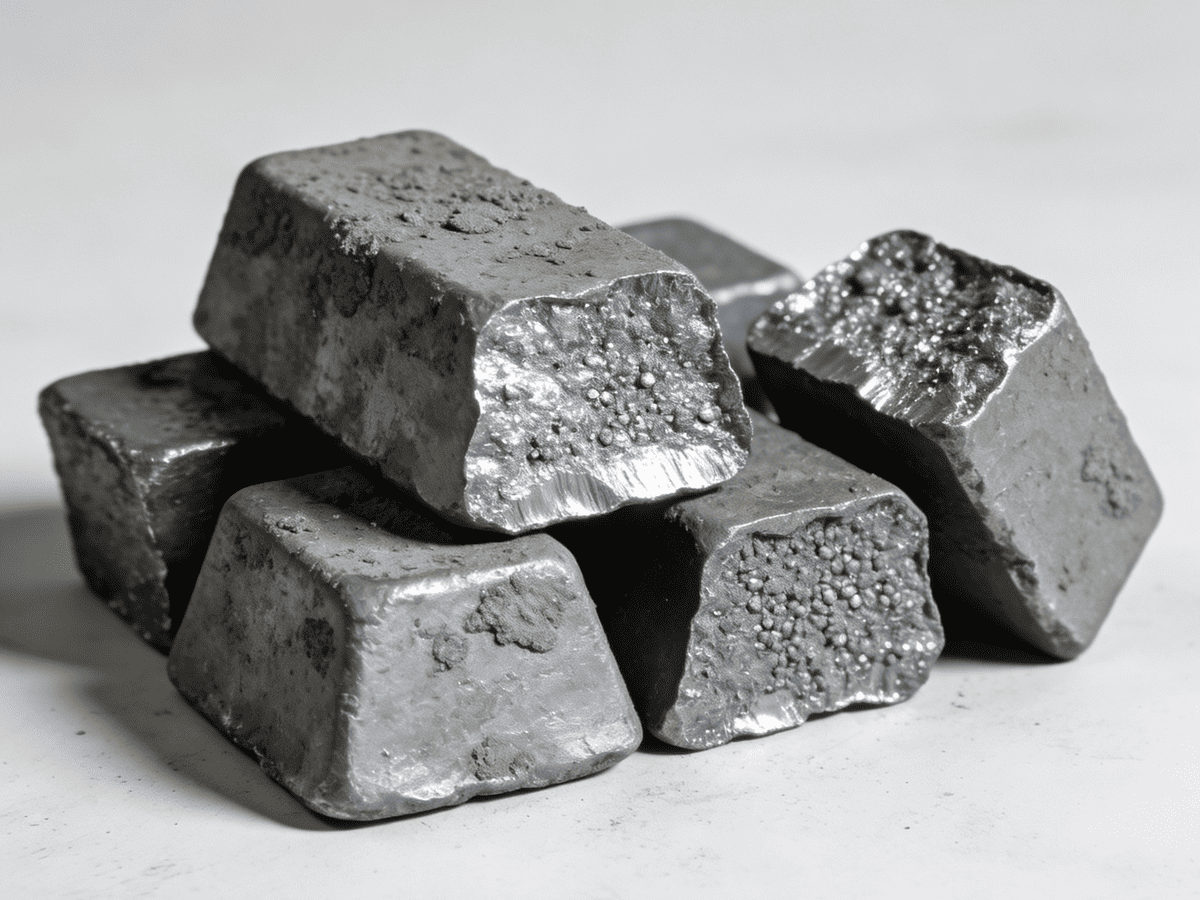
The elevated carbon level in cast iron causes carbon to precipitate as graphite or iron carbides, depending on the type of cast iron. This microstructural feature fundamentally distinguishes cast iron from steel and explains many of its unique properties.
Typical composition:
Iron (Fe): balance
Carbon (C): 2.0–4.0%
Silicon (Si): 1.0–3.0%
Minor elements: manganese, sulfur, phosphorus
Cast iron is not a single material but a category of alloys, each engineered for specific performance requirements.
Graphite appears as flakes
Excellent vibration damping
Good machinability
Relatively low tensile strength
Commonly used for machine bases, engine blocks, and housings
Graphite appears as nodules
Significantly improved ductility and toughness
Higher tensile strength than gray iron
Widely used in automotive and industrial components
Carbon exists as iron carbides
Extremely hard and wear-resistant
Very brittle
Used in abrasion-resistant applications
Heat-treated white iron
Improved ductility
Moderate strength
Used for fittings and hardware
From a manufacturing standpoint, cast iron offers several advantages:
Low melting point (approximately 1150–1200°C)
Excellent molten fluidity
Minimal shrinkage during solidification
Ability to form complex geometries and thick sections
These characteristics make cast iron particularly suitable for complex castings, large parts, and components requiring integrated features that would be costly to machine from steel billets.
Key properties of cast iron include:
High compressive strength
Good wear resistance
Excellent vibration damping
Limited tensile strength and ductility
Because of these traits, cast iron performs exceptionally well in applications where static loads, compressive forces, and vibration control are more critical than impact resistance.
Cast iron is widely used in:
Automotive engine blocks and brake components
Machine tool bases
Industrial pump housings
Valves and fittings
Heavy equipment frames
Steel is an iron–carbon alloy with a lower carbon content than cast iron, generally below 2.0%, and often enhanced with alloying elements such as chromium, nickel, molybdenum, or vanadium.with various grades offering different mechanical properties. For a deeper breakdown, see our steel material guide.
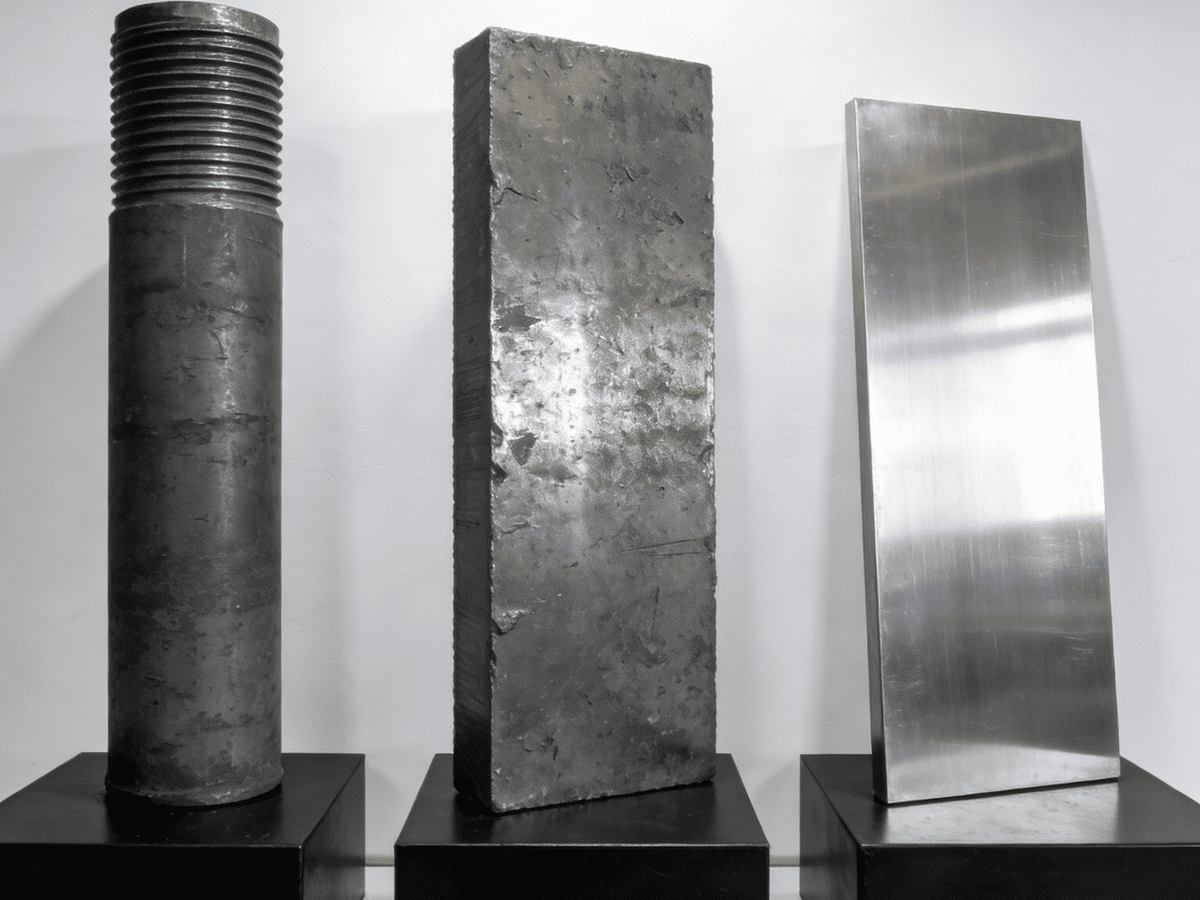
Typical steel composition:
Iron (Fe): balance
Carbon (C): 0.02–2.0%
Alloying elements: chromium, nickel, manganese, molybdenum, etc.
Lower carbon content allows steel to maintain a continuous metallic matrix, resulting in superior ductility and tensile strength compared to cast iron.
Steel encompasses a vast range of materials tailored to different engineering needs.
Simple composition
Cost-effective
Wide range of strengths
Common in structural and mechanical applications
Enhanced with specific alloying elements
Improved strength, toughness, and wear resistance
Suitable for demanding mechanical environments
Contains chromium (≥10.5%)
Excellent corrosion resistance
Used in harsh or hygienic environments
One of steel’s most significant advantages is its responsiveness to heat treatment. Through processes such as quenching, tempering, and annealing, steel properties can be precisely tuned to meet application requirements.
Steel typically offers:
High tensile strength
Excellent impact resistance
Good fatigue performance
Broad ductility range
These properties make steel ideal for load-bearing and safety-critical components.
Steel is widely used in:
Structural frameworks
Shafts, gears, and fasteners
Pressure vessels
Aerospace and automotive components
Tools and dies
Although cast iron and steel share a common base element—iron—their differences in carbon content, microstructure, and manufacturing behavior lead to fundamentally different engineering performance. Understanding these distinctions is critical for selecting the right material in real-world manufacturing scenarios.
Below is a detailed comparison across the most important technical dimensions.
Carbon content is the most defining difference between cast iron and steel.
Cast Iron:
Typically contains 2.0%–4.0% carbon, which exceeds the solubility limit of carbon in iron. As a result, carbon precipitates as graphite or carbides within the metal matrix.
Steel:
Contains 0.02%–2.0% carbon, allowing carbon to remain largely dissolved in the iron lattice.
Engineering Impact:
Higher carbon content improves castability and compressive strength but reduces ductility. Lower carbon content allows steel to achieve superior tensile strength, toughness, and flexibility.
Microstructure directly influences mechanical behavior and machinability.
Cast Iron:
Carbon exists as graphite flakes (gray iron), nodules (ductile iron), or carbides (white iron). These features act as stress concentrators but also improve vibration damping and machinability.
Steel:
Carbon remains in solution or forms controlled carbides after heat treatment, resulting in a more continuous and uniform microstructure.
Engineering Impact:
Steel’s homogeneous structure supports higher tensile and fatigue loads, while cast iron’s graphite structure enhances damping and wear resistance.
Cast Iron:
Approximately 1150–1200°C
Steel:
Approximately 1370–1500°C
Manufacturing Impact:
Lower melting point makes cast iron easier and more energy-efficient to cast. Steel casting requires higher temperatures, stricter process control, and higher operational costs.
Castability refers to how easily molten metal fills molds and solidifies without defects.Cast iron is commonly used in casting due to its excellent fluidity and moldability, making it ideal for custom metal casting services in complex part production.
Steel, while harder to cast than iron, is still widely used in iron and steel casting solutions for high-strength structural components.
Cast Iron:
Excellent fluidity, low shrinkage, and strong resistance to hot tearing.
Steel:
Lower fluidity, higher shrinkage, and increased risk of porosity and cracking.
Manufacturing Impact:
Cast iron is ideal for complex geometries, thick sections, and integrated features, while steel castings often require simpler designs or additional process controls.
Machinability significantly affects total production cost.
Cast Iron:
Generally excellent machinability due to graphite acting as a natural lubricant and chip breaker.
Steel:
Machinability varies widely by grade; high-strength or alloy steels may require specialized tooling and slower cutting speeds.
Manufacturing Impact:
Cast iron often results in lower CNC machining time and tool wear, making it cost-effective for large or complex parts.
Cast Iron:
Moderate tensile strength; ductile iron performs significantly better than gray iron.
Steel:
High to very high tensile strength, adjustable through alloying and heat treatment.
Engineering Impact:
Steel is preferred for components subjected to tensile loading, dynamic stress, or safety-critical conditions.
Cast Iron:
Extremely high compressive strength.
Steel:
High compressive strength, but generally lower than cast iron on a per-weight basis.
Engineering Impact:
This is why cast iron is widely used in machine tool bases and heavy structural supports.
Cast Iron:
Low to moderate impact resistance; gray iron is particularly brittle.
Steel:
Excellent impact resistance, especially in low-carbon and alloy steels.
Engineering Impact:
Steel is essential for applications involving shock loads, sudden impacts, or cyclic stress.
Cast Iron:
Limited fatigue resistance due to graphite-induced stress concentration.
Steel:
Superior fatigue performance, especially when properly heat treated.
Engineering Impact:
Steel is favored for rotating shafts, springs, and high-cycle components.
Cast Iron:
Exceptional vibration damping due to graphite structure.
Steel:
Poor to moderate damping characteristics.
Engineering Impact:
This property makes cast iron the material of choice for machine beds, frames, and precision equipment bases.
Cast Iron:
Good wear resistance, particularly in white and alloyed irons.
Steel:
Wear resistance depends on alloy composition and heat treatment.
Engineering Impact:
Cast iron performs well in sliding and abrasive environments with minimal lubrication.
Cast Iron:
Moderate corrosion resistance; often requires coatings.
Steel:
Wide range—from carbon steel (low) to stainless steel (excellent).
Engineering Impact:
Material selection must consider operating environment and required surface treatments.
Both materials have similar density (approximately 7.2–7.8 g/cm³), but steel often enables thinner sections due to higher strength.
Engineering Impact:
Steel can reduce component weight when strength-to-weight ratio is critical.
Cast Iron:
Limited heat treatment options; ductile iron offers some flexibility.
Steel:
Highly responsive to heat treatment, enabling precise property tuning.
Engineering Impact:
Steel offers greater design flexibility for demanding applications.
Cast Iron:
Difficult to weld; requires specialized techniques.
Steel:
Generally weldable, depending on grade.
Engineering Impact:
Steel is preferred for fabricated assemblies and welded structures.
Cast Iron:
Excellent dimensional stability, minimal distortion.
Steel:
Prone to distortion after machining or heat treatment.
Engineering Impact:
Cast iron is advantageous for precision structures requiring long-term stability.
Cast Iron:
Lower raw material cost and processing cost.
Steel:
Higher material cost and more complex processing.
Engineering Impact:
Cast iron is often more economical for large, complex, or high-volume castings.
Both materials are recyclable.
Cast iron often requires less energy to cast.
Steel may offer longer service life in high-stress environments.
Material selection should always consider downstream manufacturing processes.
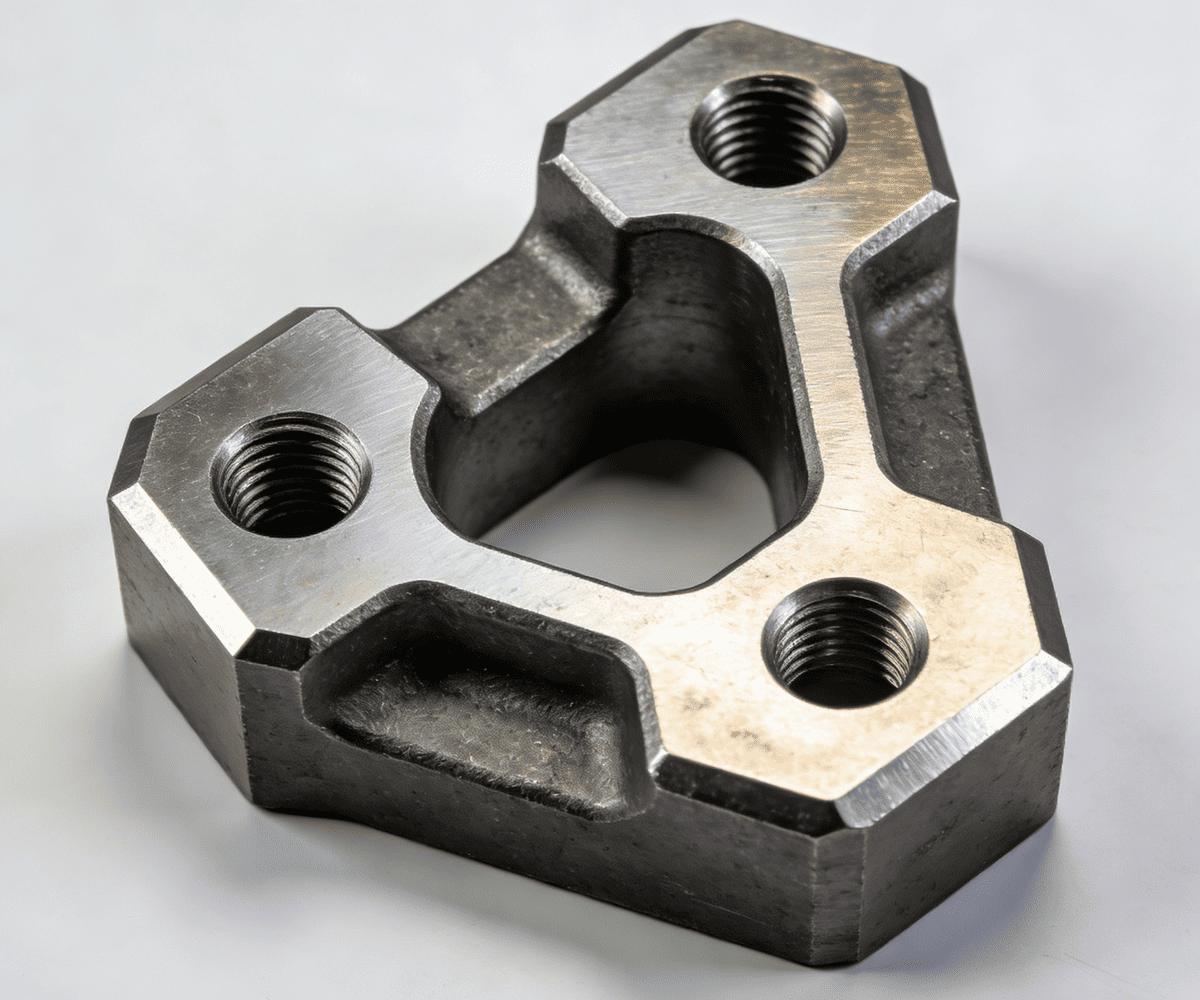
Cast iron casting is more forgiving and cost-efficient.
Steel casting requires precise gating, risering, and temperature control.
Cast iron machines faster with less tool wear.
Steel machining demands optimized parameters and higher tooling cost.
Steel supports extensive heat treatment.
Cast iron relies more on as-cast properties.
Both materials support surface treatments such as:
Painting
Powder coating
Plating
Machining finishes
Steel offers broader compatibility with advanced coatings.
While material properties provide the technical foundation, real-world material selection is ultimately driven by application requirements, operating conditions, manufacturing feasibility, and lifecycle cost. Below is an industry-by-industry comparison of how cast iron and steel are used—and why one is often favored over the other.
The automotive sector uses both cast iron and steel extensively, but for very different functional reasons.
Cast Iron Applications:
Engine blocks (especially gray and ductile iron)
Brake discs and drums
Exhaust manifolds
Differential housings
Why Cast Iron Is Used:
Excellent vibration damping reduces engine noise
High thermal stability under operating temperatures
Cost-effective for high-volume production
Good wear resistance for friction components
Steel Applications:
Crankshafts
Gears and transmission components
Suspension parts
Structural reinforcements
Why Steel Is Used:
Superior tensile and fatigue strength
High impact resistance
Better performance under dynamic loading
Engineering Insight:
Modern automotive design often combines ductile iron castings with CNC-machined steel components, balancing cost, performance, and manufacturability.
Industrial machinery prioritizes structural stability, dimensional accuracy, and long-term reliability.
Cast Iron Applications:
Machine tool beds
Press frames
Pump and compressor housings
Gearbox casings
Why Cast Iron Dominates:
Exceptional vibration damping improves machining accuracy
High compressive strength supports heavy loads
Excellent dimensional stability over time
Lower production cost for large components
Steel Applications:
Shafts and spindles
Load-bearing structural members
High-stress mechanical components
Engineering Insight:
In many industrial machines, cast iron provides the structural foundation, while steel handles motion and load transfer.
Energy systems operate under high temperature, pressure, and continuous load conditions, making material selection critical.
Cast Iron Applications:
Valve bodies
Pump housings
Pipe fittings
Steel Applications:
Pressure vessels
Turbine components
Structural supports in power plants
Material Selection Logic:
Cast iron is chosen for static, corrosion-controlled environments
Steel is essential where pressure containment and impact resistance are required
The construction industry values strength, scalability, and compliance with safety standards.
Cast Iron Applications:
Drainage systems
Manhole covers
Architectural components
Steel Applications:
Structural beams
Reinforcement elements
Load-bearing frameworks
Engineering Insight:
Cast iron excels in non-structural, wear-resistant components, while steel is indispensable for primary load-bearing structures.
Aerospace applications impose extreme requirements on materials.
Cast Iron Usage:
Very limited
Occasionally used in ground support equipment
Steel Usage:
Landing gear components
Actuation systems
High-strength fasteners
Material Selection Logic:
Steel’s strength-to-weight ratio, fatigue resistance, and reliability under cyclic loading make it the clear choice.
Precision manufacturing environments demand stability, repeatability, and vibration control.
Cast Iron Applications:
Precision machine bases
Metrology frames
Inspection equipment structures
Steel Applications:
Precision shafts
High-accuracy mechanical assemblies
Engineering Insight:
Cast iron’s vibration damping directly improves measurement accuracy and machining consistency.
Choosing between cast iron and steel is not about which material is “better,” but which material is better suited to your application.
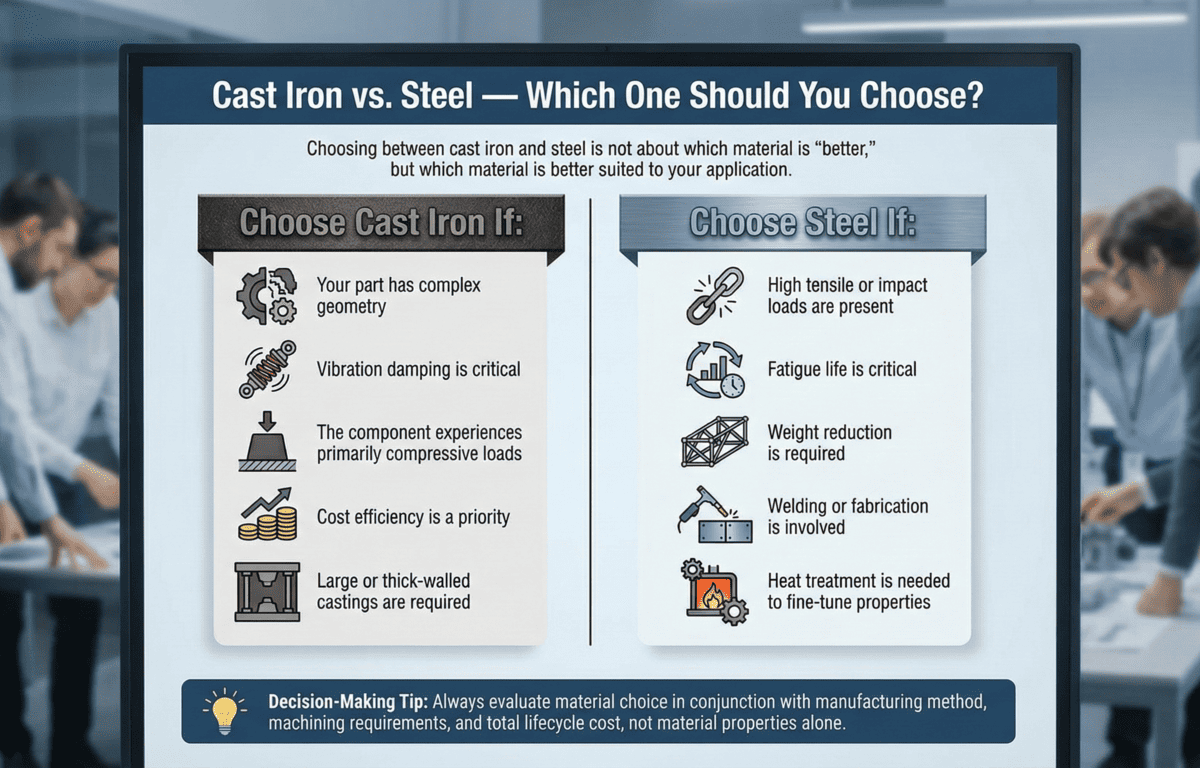
If you're selecting materials for a real-world project, factors like tolerance, production volume, and surface finish requirements are critical. Our CNC machining services for steel and iron parts can help you evaluate the best option based on your design and budget.
Your part has complex geometry
Vibration damping is critical
The component experiences primarily compressive loads
Cost efficiency is a priority
Large or thick-walled castings are required
High tensile or impact loads are present
Fatigue life is critical
Weight reduction is required
Welding or fabrication is involved
Heat treatment is needed to fine-tune properties
Decision-Making Tip:
Always evaluate material choice in conjunction with manufacturing method, machining requirements, and total lifecycle cost, not material properties alone.
Excellent castability
Superior vibration damping
High compressive strength
Good wear resistance
Cost-effective for large and complex parts
Stable dimensional performance
Lower tensile strength
Limited ductility
Poor impact resistance (especially gray iron)
Difficult to weld
Limited heat treatment options
High tensile and yield strength
Excellent impact and fatigue resistance
Wide range of alloy options
Strong heat treatment response
Good weldability (depending on grade)
Suitable for safety-critical components
Higher raw material cost
More complex casting process
Higher machining cost for hard alloys
Greater risk of distortion during heat treatment
Lower vibration damping
In practice, material selection is only the first step. Many performance issues arise not from choosing cast iron or steel, but from poor process control, inadequate tooling, or improper post-processing.
Key factors that influence final part performance include:
Casting method and mold design
Heat treatment parameters
CNC machining strategy
Surface finishing and inspection
An experienced manufacturer understands how to optimize the entire process chain, ensuring that the chosen material delivers its intended performance.
Choosing between cast iron and steel depends on your performance requirements, budget, and production process.
At NAITE TECH, we provide end-to-end manufacturing solutions, including CNC machining, casting, and surface finishing, to help you bring your designs to life.
Get in touch today to receive expert guidance and a fast quote for your project.
Gray iron, ductile iron, and steel castings
Prototyping to high-volume production
Complex geometries and tight tolerances
Precision CNC milling and turning
Secondary operations and tight tolerance finishing
Optimized machining strategies for iron and steel
Casting + machining + surface finishing
Reduced lead time and supply chain complexity
Consistent quality control
Material traceability
Dimensional inspection
Process-driven quality assurance
By combining material expertise with manufacturing execution, NAITE TECH helps customers transform engineering designs into reliable, production-ready components.
Cast iron and steel each occupy a critical role in modern manufacturing. Their differences in carbon content, microstructure, mechanical behavior, and manufacturability lead to distinct performance profiles and application suitability.
Rather than asking which material is superior, engineers should ask which material best aligns with the functional, manufacturing, and economic requirements of their project.
With the right material choice—and the right manufacturing partner—both cast iron and steel can deliver exceptional performance and long-term value.
Cast iron has higher compressive strength, while steel has significantly higher tensile and impact strength.
Cast iron is generally more cost-effective, especially for large or complex castings.
Yes. Cast iron typically offers excellent machinability with lower tool wear.
It depends on load requirements. Steel excels in impact and tensile loading, while ductile iron offers better castability and cost efficiency.
Cast iron provides superior vibration damping.
Yes. NAITE TECH supports cast iron and steel casting, CNC machining, and integrated manufacturing services.


