
- Home
- Capabilities
- Solution
- Material
- Industry
- Resources
- Request a Quote
Views: 0 Author: Site Editor Publish Time: 2025-11-26 Origin: Site
Bronze machining remains one of the most important, yet often misunderstood, specialties in modern manufacturing. Despite being one of the oldest engineered materials used by humans, bronze continues to deliver exceptional mechanical properties, corrosion resistance, and durability—particularly in applications where friction, seawater exposure, or structural reliability determine product lifespan.
This guide is designed to be the most comprehensive, engineering-driven, and manufacturing-focused bronze machining resource available online today.
Unlike typical articles that briefly list alloys, tools, or processes, this guide explores bronze machining from end to end, including:
Bronze metallurgy fundamentals and how alloy composition impacts machinability
A complete classification of bronze types tailored specifically for CNC machining
Process-level machining insights for milling, turning, drilling, grinding, EDM, and more
Mechanical behaviors such as wear resistance, galling tendencies, and chip formation
Recommended cutting parameters, tool geometry, and coating selections
Surface finish options and post-processing strategies
Quality control requirements unique to bronze
Cost analysis, real-world applications, and sourcing guidance
NAITE TECH’s specialized capabilities in high-precision bronze machining
By the end, you—not just as a reader but as an engineer, buyer, or product developer—will understand bronze machining deeply enough to make informed production decisions, optimize your designs, and avoid costly manufacturing mistakes.
Whether you are developing marine components, aerospace fittings, bushings, bearings, valves, sculptures, or precision mechanical parts, this guide provides the engineering knowledge needed to produce bronze parts with unmatched accuracy and performance.
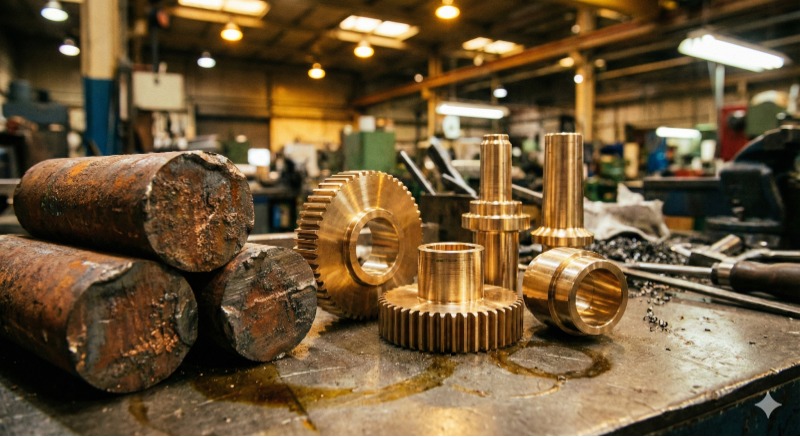
Bronze is not a single material—it is a family of copper-based alloys with tin, aluminum, silicon, manganese, nickel, and other elements carefully engineered to achieve specific performance characteristics. This makes bronze machining far more complex than machining aluminum, brass, or steel.
Here are the key attributes that make bronze unique from a machining standpoint:
Compared with brass or copper, many bronze alloys deliver superior wear resistance. This is why bronze is widely used for:
Bushings
Bearings
Gears
Worm drives
Heavy load mechanical interfaces
The alloy’s inherent low-friction properties reduce surface damage during operation and extend service life.
Bronze is famous for its ability to withstand:
Seawater
Humidity
Acids
Industrial chemicals
Oxidation
This makes bronze one of the top materials for marine hardware, shipbuilding components, and offshore platforms.
Some modern bronze alloys, especially aluminum bronze and nickel aluminum bronze, provide strength close to mild steel—while offering much better corrosion resistance.
Bronze experiences minimal thermal distortion during machining, making it suitable for:
High-precision parts
Tight-tolerance shafts
Valve housings
Aerospace mechanical components
Bronze can be engineered for:
High strength
Low friction
Electrical conductivity
Wear resistance
Cost efficiency
Anti-galling behavior
Lead-free requirements (environmental compliance)
This flexibility allows engineers to choose an alloy tailored specifically for machining and performance needs.
Despite the rise of lightweight aluminum alloys, stainless steels, and advanced composites, bronze continues to play a critical role in modern mechanical engineering. Here are the main reasons:
Especially in marine, oil & gas, and industrial machinery, bronze handles:
Seawater corrosion
Extreme friction
Cavitation
High-load wear
Better than aluminum, brass, and many steels.
Phosphor bronze and some tin bronzes offer natural lubricity, reducing wear even without external lubrication. This makes bronze essential for:
Bearings
Bushings
Sliding interfaces
Couplings
Motion-control systems
Aerospace, naval engineering, and energy systems frequently use bronze because:
It does not spark
It resists deformation under prolonged stress
It retains strength in corrosive conditions
Beyond engineering, bronze machining is heavily used in:
High-end hardware
Luxury fixtures
Sculptures
Art installations
Interior architectural elements
Due to its elegant appearance, patina behavior, and premium aesthetic qualities.
Marine engineering standards, for example, frequently specify nickel aluminum bronze and copper-nickel alloys due to:
Seawater resistance
Anti-fouling behavior
Structural strength
This creates ongoing demand for precision-machined bronze components.
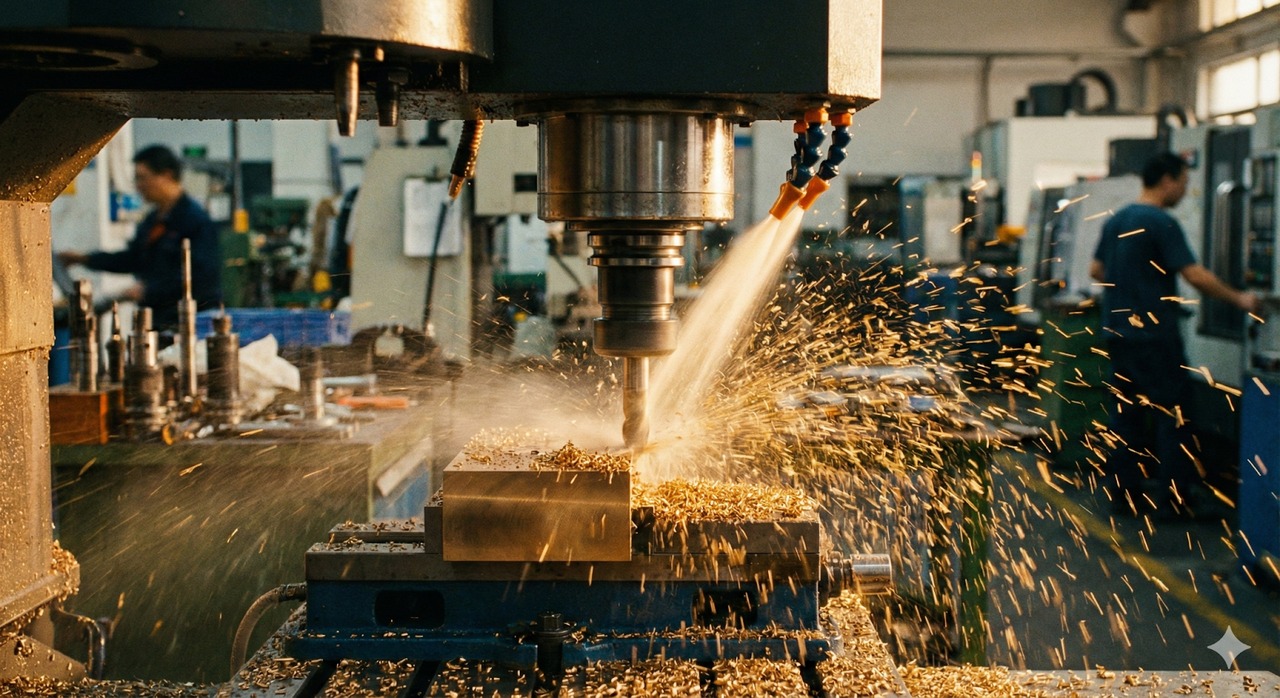
Many machinists describe bronze as “easy but not forgiving.”
Here’s why:
For example:
Phosphor bronze → excellent wear resistance but difficult to machine
Aluminum bronze → extremely strong and abrasive (hard on tools)
Leaded bronze → machines very easily, ideal for high precision
Bismuth bronze → good machinability without lead (RoHS compliant)
Tin bronze → moderate machinability but produces tough chips
A machinist must understand the specific alloy to optimize feeds, speeds, and tool selections.
Some alloys—especially aluminum bronze and manganese bronze—produce extremely abrasive chips that can:
Dull cutting tools rapidly
Create built-up edge (BUE)
Increase heat generation
Reduce surface finish quality
This requires controlled chip formation and high durability tool coatings (TiAlN, TiCN, DLC).
Certain bronzes, particularly tin bronze and phosphor bronze, work harden when machined improperly. This results in:
Tough outer layers
Increased cutting force
Vibrations
Tool chatter
Dimensional inaccuracies
Bronze retains heat, meaning:
Tools heat up faster
Roughing passes must be optimized
Coolant plays a larger role
Thermal expansion can affect tolerances
To put it simply:
Harder than brass
More complex than aluminum
More stable and predictable than stainless steel
More abrasive than copper
With the right tooling and parameters, bronze can be machined to extremely tight tolerances.
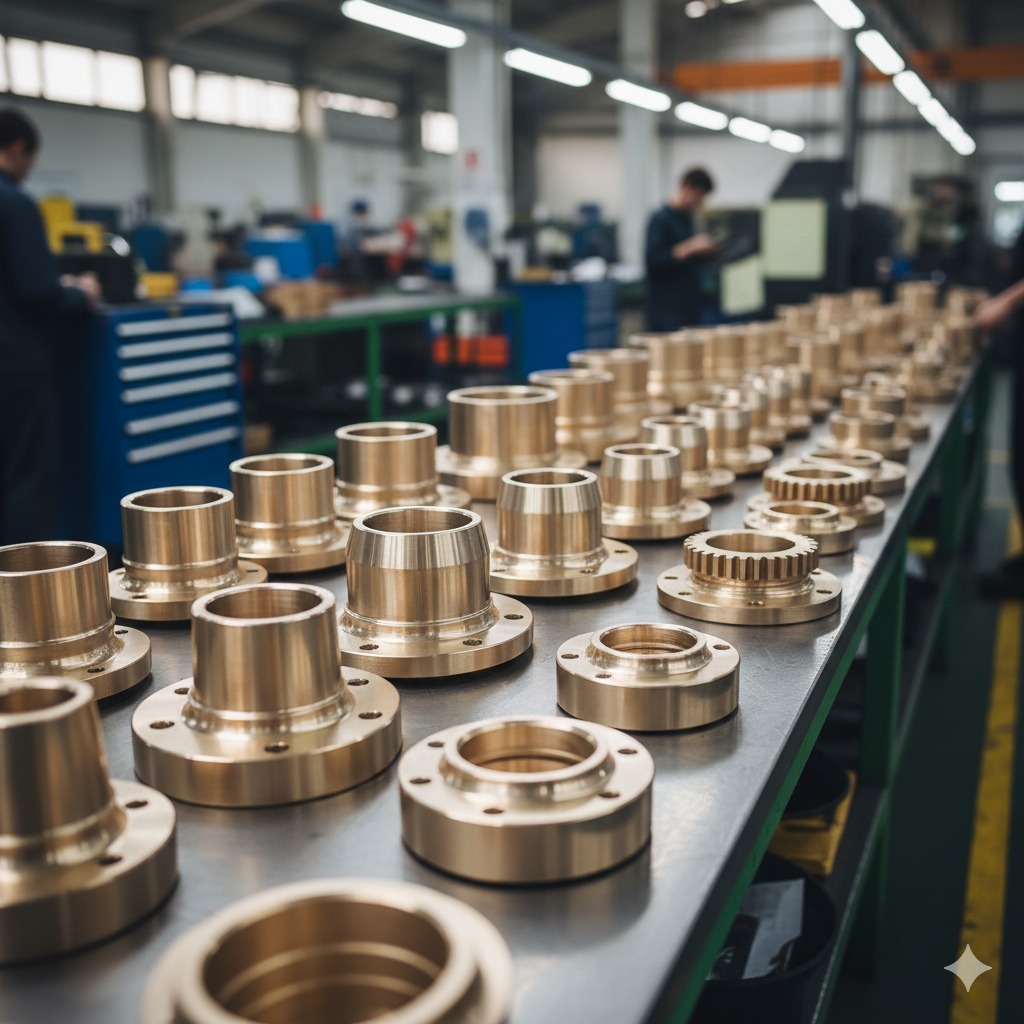
As a global manufacturing partner specializing in advanced CNC machining solutions, NAITE TECH has extensive experience machining all major bronze alloys, including:
Aluminum Bronze
Phosphor Bronze
Silicon Bronze
Manganese Bronze
Nickel Aluminum Bronze
Leaded Bronze
Tin Bronze
Bismuth Bronze
Copper-Nickel Alloys
✔ 2-axis to 5-axis CNC milling
✔ High-precision CNC turning for bearing, valve, and bushing components
✔ Specialized bronze tooling geometry & tool coatings
✔ Excellent surface finishing for architectural-grade bronze
✔ Experience with marine-spec and aerospace-spec bronze alloys
✔ Dimensional tolerances as tight as ±0.005 mm
✔ Support for both prototypes and mass production
Marine / Shipbuilding
Aerospace
Oil & Gas
Industrial Machinery
Energy Systems
Robotics
Architecture
Art and high-end luxury hardware
Extensive knowledge of bronze metallurgy
Dedicated process engineers for complex bronze parts
Professional fixture design for thin-wall components
High-repeatability machining for large production runs
Complete QC with CMM, XRF alloy testing, and surface measurement
NAITE TECH is capable of producing bronze parts that perform in harsh environments, meet strict industry regulations, and uphold aesthetic qualities where visual appearance matters.
Bronze, brass, and copper are all copper-based materials, but their mechanical, thermal, and machinability properties vary significantly. Understanding these differences is critical for engineers selecting the right material for CNC machining.
| Property | Bronze | Brass | Copper |
Composition | Cu + Sn, Al, Si, Mn, Ni, Pb, Bi | Cu + Zn | Cu ≥ 99% |
Density | 7.4–8.9 g/cm³ | 8.4–8.7 g/cm³ | 8.96 g/cm³ |
Tensile Strength | 200–900 MPa | 200–550 MPa | 210–250 MPa |
Hardness (HB) | 60–250 | 55–150 | 40–110 |
Corrosion Resistance | Excellent (marine alloys superior) | Moderate | Poor in marine/acidic conditions |
Wear Resistance | High | Moderate | Low |
Machinability | Moderate → Good (alloy dependent) | Excellent | Poor → Moderate |
Applications | Bearings, bushings, valves, marine components, artistic hardware | Decorative items, low-load mechanical parts | Electrical components, roofing, plumbing |
Engineering Insight:
Bronze is the most versatile for structural, wear, and marine applications.
Brass is easier to machine but less suitable for high-load or seawater-exposed components.
Copper is rarely used for structural machining due to softness and low wear resistance.
Bronze alloys vary widely depending on the elements added:
Tin (Sn): Increases strength and wear resistance; too much reduces machinability.
Aluminum (Al): Enhances corrosion resistance, hardness, and strength; aluminum bronze is tough on tools.
Silicon (Si): Improves strength and reduces friction; may require coated tools.
Manganese (Mn): Increases strength, wear resistance, and hardness; often used in marine alloys.
Nickel (Ni): Enhances corrosion resistance, especially for seawater; nickel-aluminum bronze is extremely hard.
Lead (Pb): Added for free-machining alloys; improves chip formation and reduces tool wear.
Bismuth (Bi): Lead-free alternative to improve machinability.
Key Takeaway: Alloy selection must balance machinability, mechanical properties, corrosion resistance, and cost.
Bronze microstructure determines how it behaves under cutting tools:
Dendritic grains: Found in high-strength aluminum bronze; can cause tool abrasion.
Fine equiaxed grains: Common in leaded bronzes; promote smooth cutting and minimal chip adhesion.
Interstitial compounds (Si, Al, Ni): Increase hardness but may accelerate BUE formation on tool edges.
Engineering Insight: High-strength structural bronzes require hard carbide tools with proper coatings; low-friction bronzes can use HSS or cermet with careful feed rate control.
Bronze exhibits excellent thermal stability compared to brass or copper:
| Alloy | Thermal Conductivity (W/m·K) | Max Operating Temp | Tribological Notes |
Aluminum Bronze | 40–45 | 400°C | Excellent wear & corrosion resistance |
Phosphor Bronze | 50–55 | 350°C | Low friction, ideal for bushings |
Leaded Bronze | 50 | 300°C | Machining-friendly, moderate wear |
Nickel Aluminum Bronze | 35 | 450°C | Extremely corrosion-resistant, tough on tools |
Tribology Insight: Selecting the right bronze for moving components reduces galling, friction, and maintenance costs.
Strengthens alloy, increases wear resistance
Excess tin → reduces machinability
Improves corrosion resistance and hardness
Aluminum bronze → requires carbide tools with TiAlN coating
Leaded bronze → easy to machine, produces short chips
Bismuth → eco-friendly lead alternative, similar machinability
Enhances corrosion resistance but reduces machinability in high concentrations
Improves strength and wear resistance
Must optimize cutting speed and feed to prevent tool damage
Bronze’s machinability is highly alloy-dependent.
Engineers must match alloy choice, tool material, and machining process to production goals.
Leaded or bismuth bronzes are preferred for high-volume precision machining, while aluminum and nickel bronzes excel in structural, marine, and high-load applications.
Understanding microstructure, thermal behavior, and tribology ensures dimensional accuracy, tool longevity, and optimized production.
NAITE TECH Edge: Our engineers analyze alloy composition and microstructure to design optimal cutting strategies, tooling selection, and coolant systems for every bronze CNC machining project.
Bronze is not a single material—it encompasses a family of alloys engineered for specific properties. Choosing the right type is crucial for machining success, performance, and cost optimization.
Structural bronzes are designed for mechanical strength, wear resistance, and corrosion protection in high-load applications. They are ideal for marine hardware, aerospace components, and industrial machinery.
Composition: Cu + 9–12% Al + Ni, Fe, Mn
Properties: Exceptional strength, corrosion resistance (especially in seawater), wear resistance
Machinability: Moderate to difficult—abrasive on tools
Recommended Machining Practices:
Use carbide tools with TiAlN or DLC coating
Moderate to low spindle speeds to reduce heat
Heavy-duty coolant flow
Climb milling preferred for surface finish
Applications: Marine propeller shafts, bushings, pump parts, heavy-duty gears
Composition: Cu + 3–6% Mn + Zn + Fe + Al
Properties: High strength, excellent wear resistance, corrosion-resistant
Machinability: Moderate—tool wear can be significant
Applications: Ship propeller shafts, valve bodies, industrial machinery
Engineering Notes: High cutting forces may require rigid workholding and stepwise roughing
Composition: Cu + 10% Al + 4–6% Ni + Fe
Properties: Exceptional corrosion resistance, particularly in marine environments, high strength
Machinability: Challenging—abrasive and heat-sensitive
Recommended Practices:
Carbide tools with high wear resistance
Reduced feed per tooth
Multi-pass roughing and finishing strategy
These alloys are tailored for bearings, bushings, and electrical contacts. They balance wear resistance, low friction, and dimensional stability.
Composition: Cu + 0.5–11% Sn + 0.01–0.35% P
Properties: Excellent wear resistance, low friction, high fatigue resistance
Machinability: Moderate—work hardening occurs if not properly controlled
Best Practices:
Sharp cutting edges and moderate speeds
Minimize dwell time in corners to prevent hardening
Consider finish passes with light feeds for tight tolerances
Applications: Electrical springs, bushings, small gears, precision instruments
Composition: Cu + 3% Si + 0.5% Mn
Properties: Corrosion-resistant, moderate strength, suitable for thin-wall parts
Machinability: Good with sharp HSS or carbide tools
Applications: Decorative components, marine hardware, electrical connectors
Composition: Cu + 5–10% Sn
Properties: Good wear resistance, corrosion-resistant, low friction
Machinability: Moderate; generates long, continuous chips
Applications: Bearings, bushings, gears, valve components
These alloys are optimized for production efficiency and minimal tool wear.
Composition: Cu + 10% Sn + 5–10% Pb
Properties: Easy to machine, good dimensional stability, moderate wear resistance
Applications: Bushings, fittings, decorative hardware
Engineering Notes: Short, discontinuous chips; reduced cutting forces; ideal for high-volume CNC production
Composition: Cu + 10% Sn + Bi
Properties: Lead-free, machinability similar to leaded bronze
Applications: Eco-friendly components, automotive parts, compliant with RoHS standards
Engineering Notes: Use standard carbide tooling; similar feeds and speeds as leaded bronze
These alloys address extreme environments, such as saltwater exposure or high-temperature service.
Composition: Cu + 10–30% Ni + Fe
Properties: Exceptional corrosion resistance, high strength, anti-fouling properties
Machinability: Difficult—abrasive and tough on tools
Applications: Marine propellers, shafts, valves, offshore fittings
Recommended Practices:
Carbide tooling with high toughness
Moderate cutting speeds
Heavy-duty fixturing to minimize vibration
Bronze Type | Machinability | Tool Recommendation | Notes |
Leaded Bronze | Excellent | HSS or carbide | Free-machining, short chips |
Bismuth Bronze | Excellent | Carbide | Lead-free alternative |
Phosphor Bronze | Moderate | Sharp HSS / coated carbide | Work hardening possible |
Tin Bronze | Moderate | Carbide | Long chips, careful chip removal |
Silicon Bronze | Moderate | Carbide | Thin-wall machining feasible |
Aluminum Bronze | Difficult | Coated carbide (TiAlN / DLC) | Abrasive, heat-sensitive |
Manganese Bronze | Difficult | Carbide | Heavy cutting forces |
Nickel Aluminum Bronze | Very Difficult | Coated carbide | Hard and tough on tools |
Copper-Nickel Bronze | Very Difficult | High toughness carbide | Abrasive, marine application |
High-volume, tight tolerance parts: Leaded bronze or bismuth bronze
Wear-resistant bearings & bushings: Phosphor bronze or tin bronze
Marine / offshore structural components: Aluminum bronze or nickel aluminum bronze
High-strength industrial machinery components: Manganese bronze
Engineering Tip: Match alloy, machining strategy, and tooling to part geometry and production volume. This ensures minimal tool wear, consistent dimensional accuracy, and optimized surface finish.
Bronze machining is versatile but requires careful consideration of alloy selection, tool geometry, feeds and speeds, and coolant strategy. Below is a detailed engineering-level guide for each primary machining method.
Milling is one of the most common methods to shape bronze parts with complex geometries and tight tolerances.
Tool Material: Carbide (coated TiAlN/DLC)
Tool Type: End mills (2–6 flutes), face mills for larger surfaces
Helix Angle: 30°–45° to reduce chip adhesion
Corner Radius: Small radius for finishing, larger radius for roughing
Tool Diameter | Spindle Speed (RPM) | Feed per Tooth (mm/tooth) | Depth of Cut (mm) | Notes |
10 mm | 1500–2500 | 0.02–0.04 | 1–2 | Roughing |
10 mm | 3000 | 0.01–0.02 | 0.3 | Finishing |
20 mm | 1200–2000 | 0.03–0.05 | 3–5 | Roughing large faces |
Engineering Tip: Always use climb milling for surface finish and chip evacuation. Continuous chips can be broken with pecking cycles or chip breakers.
Turning is ideal for cylindrical bronze components such as shafts, bushings, and spacers.
Tool Material: Carbide or Cermet
Cutting Speed: 60–150 m/min (dependent on alloy)
Feed Rate: 0.1–0.3 mm/rev
Depth of Cut: 1–3 mm for roughing, 0.2–0.5 mm for finishing
Coolant: Emulsion or high-pressure flood to prevent thermal expansion
Engineering Insight: Leaded bronze allows faster feeds; aluminum and nickel bronzes require reduced speed to prevent work hardening.
Drilling is necessary for bolt holes, channels, or blind holes.
Tool Type: Twist drill, cobalt or carbide
Spindle Speed: 800–1500 RPM
Feed Rate: 0.05–0.15 mm/rev
Coolant: Flood coolant recommended
Tips: Use peck drilling for deep holes to evacuate chips and prevent work hardening.
Grinding ensures tight tolerances and superior surface finish:
Wheel Type: Aluminum oxide or diamond-coated
Feed: Light, multiple passes
Applications: High-precision bearings, bushings, thin-wall parts
Engineering Insight: Avoid high heat; bronze can thermally expand and compromise tolerances.
Used for cutting raw bronze stock to size:
Blade Type: Bi-metal or carbide-tipped
Cutting Speed: 30–60 m/min
Feed: Moderate; continuous chips may require air blow-off
Purpose: Keyways, splines, internal slots
Materials: Leaded, bismuth, or phosphor bronze preferred
Tip: Maintain steady feed; lubrication prevents chip buildup
Applicable to: Hard alloys like aluminum bronze or nickel aluminum bronze
Advantages: Achieves complex internal geometries impossible with traditional machining
Tip: Use proper electrode material and dielectric to minimize taper
Purpose: Flat bronze sheets or thin-walled profiles
Abrasive: Aluminum oxide recommended
Advantages: No heat-affected zone, minimal deformation
Tip: Control kerf and edge finish for precision applications
High-speed machining improves productivity and surface finish, but generates thermal stress:
Recommended Speeds: Increase spindle RPM by 50–100% compared to conventional
Feeds: Slightly higher feed per tooth
Tools: Multi-flute coated carbide
Coolant Strategy: Minimum quantity lubrication (MQL) or flood coolant depending on alloy
Engineering Insight: HSM is especially effective for thin-wall aluminum bronze and phosphor bronze components, reducing vibration and tool wear.
Bronze Alloy | Coolant Type | Notes |
Leaded / Bismuth | Emulsion or light flood | Prevent chip welding |
Aluminum Bronze | Flood coolant | Abrasive alloy, heat-sensitive |
Nickel Aluminum | High-pressure coolant | Maintain tool life and surface finish |
Phosphor / Tin | Emulsion or MQL | Prevent work hardening |
Thin-wall bronze components can deflect during machining, causing tolerance issues:
Use vacuum tables or soft jaws for even pressure
Employ stepwise roughing to reduce stress
Clamp near the work area but avoid interference with tool path
Bronze machining requires alloy-specific cutting parameters to optimize tool life and surface quality.
CNC Milling and Turning are the backbone, but drilling, grinding, EDM, and waterjet complement the workflow.
Coolant, tool geometry, and fixturing are critical for precision and efficiency.
HSM and modern machining strategies significantly improve throughput without sacrificing quality.
NAITE TECH Edge: Our engineers customize machining strategies based on bronze type, part geometry, and production volume, delivering consistent high-precision parts while extending tool life.
Surface finishing is crucial for enhancing corrosion resistance, wear performance, aesthetic appeal, and dimensional accuracy in bronze components. Depending on the application—industrial, marine, or architectural—selecting the right finishing process ensures part longevity and functional reliability.
Definition: The natural surface created after machining without additional finishing
Typical Roughness: Ra 0.8–3.2 µm depending on feed and tool
Applications: Industrial parts, temporary prototypes
Engineering Insight: Minimal cost, but may require post-processing for corrosion-prone alloys
Purpose: Improve visual appearance and reduce friction
Methods: Mechanical polishing with abrasive compounds, buffing wheels
Roughness Target: Ra 0.2–0.4 µm
Applications: Decorative hardware, jewelry, aerospace bushings
Tip: Use progressive grit sequence to prevent surface scratching
Process: Abrasive brushes move across the surface to create uniform texture
Effect: Linear satin finish, hides minor machining marks
Applications: Architectural panels, marine fixtures
Engineering Insight: Provides moderate corrosion resistance, good for aesthetic uniformity
Method: Sequential use of sandpaper from coarse to fine
Applications: Thin-walled bronze components, decorative parts
Effect: Prepares surface for additional coatings, reduces stress concentrators
Tip: Combine with polishing for high-gloss finishes
Definition: Propelling fine media (glass beads, aluminum oxide) at high velocity
Purpose: Create matte surface, remove oxides, improve adhesion for coatings
Applications: Architectural bronze panels, artistic sculptures
Engineering Insight: Does not alter dimensions significantly, can improve fatigue life by reducing surface micro-cracks
Types: Clear lacquer, chemical patina, corrosion-resistant sealants
Applications: Marine hardware, decorative architectural bronze
Effect: Increases corrosion resistance and environmental durability
Engineering Tip: Must ensure surface cleanliness prior to coating to prevent peeling
Definition: Controlled chemical reaction to produce colored oxide layer
Common Finishes: Brown, green, black, antique look
Applications: Sculptures, monuments, decorative hardware
Engineering Insight: Enhances aesthetic value while providing moderate corrosion protection
Process: Depositing a thin layer of another metal (e.g., nickel, chrome) via electrolytic process
Purpose: Improve corrosion resistance, wear resistance, and appearance
Applications: Marine fittings, automotive trim, high-end decorative parts
Engineering Tip: Ensure uniform coating thickness and proper surface pre-treatment
Finish Type | Bronze Alloy Compatibility | Engineering Effect |
Lacquer / Clear Coat | All | Prevents oxidation, extends lifespan |
Nickel Plating | Aluminum / Nickel Aluminum Bronze | High corrosion and wear resistance |
Patination | Phosphor / Tin Bronze | Moderate corrosion protection + decorative |
Bead Blasting + Coating | Aluminum Bronze | Reduces micro-cracks, improves fatigue strength |
Brushed Satin: Linear texture, hides fingerprints, popular for handrails, panels
Matte / Bead Blasted: Soft matte finish for sculptures, decorative art
High Gloss Polished: Premium visual appearance for luxury fittings
Chemical Patina: Color customization for artistic and historical applications
Surface roughness impacts fatigue life: Ra < 0.8 µm for high-stress bushings and moving parts.
Compatibility with coatings: Ensure finishes are suitable for subsequent painting or electroplating.
Alloy-specific considerations: Aluminum bronzes require careful polishing and coating due to high strength and hardness.
Cost vs. Performance: Some finishes (electroplating, high-gloss polish) are more expensive but essential for functional or decorative parts.
NAITE TECH Edge: We provide end-to-end finishing services tailored to alloy type, geometry, and industry standards. Our engineering team selects the optimal finishing method to balance cost, durability, and aesthetic appeal, ensuring that bronze parts perform flawlessly in marine, aerospace, and architectural applications.
Bronze alloys are prized for their strength, corrosion resistance, wear properties, and aesthetic appeal, making them suitable for diverse industries. Selecting the right bronze type and machining process ensures long-lasting, high-performance components.
Components: Bushings, bearings, actuators, structural brackets
Alloys Used: Aluminum bronze, nickel aluminum bronze, phosphor bronze
Engineering Insight: Aerospace components demand high strength-to-weight ratio, precision tolerances, and fatigue resistance.
Machining Notes: Multi-axis CNC milling and turning ensure tight dimensional accuracy. High-speed finishing reduces micro-cracks and surface defects.
Components: Propeller shafts, rudder stocks, valves, pump housings
Alloys Used: Aluminum bronze, nickel aluminum bronze, copper-nickel bronze
Why Bronze: Exceptional resistance to seawater corrosion and biofouling
Engineering Tips:
Use heavy-duty fixturing to handle large components
Optimize coolant and tool selection to prevent work hardening
Electroplating or lacquer finishes improve corrosion resistance in critical marine environments
Components: Valves, pump sleeves, couplings, seals
Alloys Used: Aluminum bronze, nickel aluminum bronze
Engineering Insight: Parts must endure high-pressure, high-temperature, and abrasive environments.
Machining Notes: Precision EDM for complex internal geometries; surface finishing critical for sealing surfaces.
Components: Bushings, bearings, gears, linkage components
Alloys Used: Phosphor bronze, leaded bronze, bismuth bronze
Engineering Insight: Excellent wear resistance and low friction are essential for longevity.
Machining Notes: CNC turning and milling with optimized feeds prevent built-up edge and work hardening.
Components: Bearings, valve guides, wear pads, conveyor parts
Alloys Used: Phosphor bronze, tin bronze, aluminum bronze
Engineering Insight: Bronze parts reduce maintenance downtime due to self-lubricating properties.
Machining Notes: High-precision CNC milling ensures accurate fits with minimal vibration during operation.
Components: Connectors, springs, switches, terminals
Alloys Used: Phosphor bronze, beryllium bronze (specialty)
Engineering Insight: Low electrical resistance and spring-back properties critical for performance.
Machining Notes: Micro-milling and grinding required for small, precise features.
Applications: Decorative panels, statues, handrails, architectural fittings
Alloys Used: Aluminum bronze, silicon bronze, tin bronze
Engineering Insight: Aesthetic finishes (patination, polishing, brushing) enhance visual appeal without compromising corrosion resistance.
Machining Notes: Combination of CNC milling and manual finishing for fine surface textures.
| Industry | Common Bronze Alloys | Key Components | Critical Properties |
Aerospace | Aluminum, Phosphor | Bearings, Brackets | Fatigue resistance, precision |
Marine | Aluminum, Ni-Al, Cu-Ni | Shafts, Valves | Corrosion resistance, wear |
Oil & Gas | Aluminum, Ni-Al | Pump Sleeves, Couplings | High pressure, abrasion resistance |
Automotive | Phosphor, Leaded | Bushings, Gears | Low friction, wear resistance |
Industrial Machinery | Phosphor, Tin | Bearings, Valve Guides | Self-lubrication, durability |
Electronics | Phosphor, Beryllium | Connectors, Terminals | Electrical conductivity, spring-back |
Art & Architecture | Aluminum, Tin, Silicon | Panels, Sculptures | Aesthetic finish, corrosion resistance |
Alloy Selection: Match the alloy to environmental demands (marine vs. industrial vs. aesthetic).
Surface Finish: Critical for corrosion resistance, friction reduction, and appearance.
Tolerance Strategy: Maintain tight tolerances for mating parts using precision CNC machining.
Maintenance Considerations: Self-lubricating bronzes reduce operational downtime in machinery and marine parts.
Prototype to Production: Use engineering prototypes to validate fit, function, and machining parameters before mass production.
NAITE TECH Edge: With decades of experience, our engineers help select the optimal bronze alloy, machining strategy, and surface finish for each application. From marine propellers to aerospace bushings, NAITE TECH delivers high-precision parts ready for demanding environments.
Bronze is a versatile material, but machining it presents unique challenges due to its metallurgical properties. Understanding these challenges allows engineers to optimize processes, reduce defects, and extend tool life.
Problem: Bronze alloys, especially aluminum and nickel aluminum bronzes, are abrasive and can accelerate tool wear.
Symptoms: Dull cutting edges, poor surface finish, dimensional inaccuracies
Engineering Solutions:
Use coated carbide tools (TiAlN, TiCN, DLC)
Maintain correct cutting speeds and feed rates
Optimize tool geometry for chip evacuation
Problem: Certain bronze alloys, such as phosphor bronze, can harden quickly when machined, increasing cutting forces.
Symptoms: Increased spindle load, chatter, premature tool failure
Engineering Solutions:
Employ shallow cuts with multiple passes
Use sharp, high-rake-angle tools
Ensure adequate lubrication (flood coolant or MQL)
Problem: Bronze tends to stick to the tool, forming a built-up edge, which degrades surface finish.
Symptoms: Rough surfaces, inaccurate dimensions, excessive vibration
Engineering Solutions:
Use high-helix, polished flutes for end mills
Apply appropriate cutting fluid to reduce adhesion
Consider interrupted cuts to break chip formation
Problem: Bronze expands when heated, which can cause dimensional errors, especially in thin-walled components.
Engineering Solutions:
Minimize heat by optimizing spindle speed and feed rate
Use intermittent cooling strategies
Clamp strategically to allow uniform expansion without distortion
Problem: Thin-wall components can deflect or vibrate, affecting tolerances.
Engineering Solutions:
Use soft jaws, vacuum tables, or sacrificial supports
Perform stepwise roughing instead of full-depth cuts
Avoid high-feed finishing passes that can induce spring-back
Problem: Copper-rich alloys can gall during machining, causing surface damage and tool wear.
Engineering Solutions:
Use coated tools and sharp cutting edges
Apply lubricants or emulsions for high-friction alloys
Monitor cutting temperatures closely
Problem: Long, continuous chips can tangle in the workpiece or spindle, causing damage.
Engineering Solutions:
Use chip breakers or segmented tool paths
Employ air or coolant jets to evacuate chips
Consider pecking cycles for drilling
Bronze machining challenges are primarily material-driven, including tool wear, work hardening, and galling.
Correct tool selection, cutting parameters, fixturing, and coolant strategies can prevent most issues.
Understanding alloy-specific behaviors is crucial for thin-wall, high-precision, and high-speed applications.
NAITE TECH Edge: Our engineering team applies alloy-specific machining strategies, customized fixturing, and optimized tool paths to mitigate these challenges, ensuring high-precision bronze parts every time.
Machining bronze efficiently requires a combination of material knowledge, tool selection, process optimization, and safety considerations. Following best practices ensures consistent high-quality parts, extended tool life, and predictable outcomes.
Spindle Speed & Feed Rate:
Aluminum Bronze: moderate spindle speed, high feed for chip breaking
Phosphor Bronze: lower speed, higher feed to reduce work hardening
Leaded/Bismuth Bronze: can tolerate higher speeds due to free-machining properties
Depth of Cut:
Use light finishing passes for thin walls or high-precision surfaces
Employ stepwise roughing for deep features to avoid deflection
Engineering Tip: Always perform a trial run for new alloys to fine-tune parameters
Bronze Alloy | Recommended Tool Material | Notes |
Aluminum Bronze | Carbide (TiAlN coated) | Handles abrasive nature, maintains sharpness |
Phosphor Bronze | HSS or Carbide | Minimize work hardening |
Leaded/Bismuth Bronze | HSS, Carbide optional | Free-machining, less tool stress |
Copper-Nickel Bronze | Carbide | High strength, use coated tools |
Tip: Carbide tools with coatings outperform HSS in wear resistance and surface finish for high-strength bronzes.
TiAlN (Titanium Aluminum Nitride): Ideal for aluminum bronzes, high thermal stability
TiCN (Titanium Carbonitride): Low friction, reduces built-up edge
DLC (Diamond-Like Carbon): Best for thin-wall and high-speed applications
Engineering Insight: Coatings reduce adhesion, heat buildup, and tool wear.
Thin-Walled Parts: Use soft jaws, vacuum fixtures, or sacrificial supports
Heavy Components: Heavy-duty clamps and stability-optimized tables prevent deflection
Vibration Mitigation: Maintain short overhangs, use damping materials, and optimize cutting strategies
Water-Soluble Coolants: For general machining of aluminum and phosphor bronzes
Oil-Based Coolants: For free-machining bronzes to improve surface finish
Mist / Flood Coolant: Helps chip evacuation and temperature control
Engineering Insight: Correct coolant reduces work hardening, BUE, and thermal expansion issues
Personal Protective Equipment (PPE): Eye protection, gloves, and hearing protection
Chip Management: Long bronze chips can tangle in machinery—use chip guards or vacuum extraction
Handling High-Speed Tools: Carbide and coated tools may shatter if mishandled
Environmental Considerations: Proper ventilation when using coolants or coatings
Parameter Optimization: Tailor spindle speed, feed, and depth to alloy type and geometry
Tooling Strategy: Choose appropriate materials, coatings, and geometry for efficient machining
Fixturing & Cooling: Prevent part deflection, thermal expansion, and work hardening
Safety: Essential to prevent injury and maintain process integrity
NAITE TECH Edge: Our engineering team integrates cutting parameter optimization, advanced tooling, and fixturing strategies to consistently produce bronze components meeting strict tolerances, superior surface finishes, and industry-specific performance standards.
Quality control (QC) is critical in bronze machining, particularly for high-precision, high-performance, and thin-walled components. Without robust QC processes, dimensional inaccuracies, surface defects, and material inconsistencies can compromise both functionality and longevity.
Methods:
Coordinate Measuring Machines (CMM) for 3D measurements
Calipers and micrometers for simpler geometries
Critical Aspects:
Tolerance verification against design specifications
Ensuring fit with mating parts, especially in bushings and bearings
NAITE TECH Approach: Automated CMM inspection with real-time feedback ensures ±0.01 mm precision for most CNC bronze components.
Importance: Surface finish affects friction, wear, corrosion, and assembly
Techniques:
Contact profilometers (Ra, Rz, Rmax)
Non-contact laser scanning for complex geometries
Engineering Tip: Critical for sliding components such as bearings, bushings, and shafts.
NAITE TECH Advantage: Customized surface roughness standards based on alloy and application.
Purpose: Confirm the correct bronze type and composition
Methods:
Spectroscopy (XRF or OES) for chemical composition
Hardness testing to verify mechanical properties
Engineering Insight: Alloy verification prevents unexpected tool wear, dimensional changes, and failure in service.
General Practices:
Standard tolerances: ±0.1 mm for non-critical features
Critical features: ±0.01 mm, often achieved with precision CNC finishing passes
Thin-Wall Components: Use intermediate supports and staged cutting to maintain dimensional integrity
NAITE TECH Edge: Adaptive tolerance strategies for multi-alloy machining, ensuring consistent performance.
As-Machined: Ra 1.6–3.2 µm typical
Polished/Brushed: Ra 0.4–1.2 µm achievable
Special Coatings: Patination, electroplating, and chemical treatments add corrosion resistance without exceeding dimensional tolerance
Engineering Insight: Different industries require customized surface roughness standards, e.g., aerospace vs. marine.
First Article Inspection (FAI): Ensures initial batch meets all specifications
In-Process Checks: Periodic verification to detect tool wear or process drift
Final Inspection: Complete dimensional and surface verification before shipment
Documentation: Detailed QC reports including material certificates, tolerance verification, and surface finish measurements
Precision Verification: Dimensional and surface quality inspections prevent functional failures.
Material Confirmation: Alloy verification avoids machining errors and ensures reliability.
Tolerance Management: Critical for thin-wall, high-performance, and mating components.
Process Integration: NAITE TECH integrates QC throughout the machining process, not just at the end, ensuring consistent and reliable bronze parts.
NAITE TECH Edge: Our multi-layered QC system guarantees every bronze part meets or exceeds design expectations, from mechanical performance to surface aesthetics, making NAITE TECH a trusted partner for engineers worldwide.
Understanding the cost of bronze machining is crucial for design engineers, procurement teams, and manufacturers. Costs vary depending on alloy selection, part complexity, production volume, and finishing requirements. Proper analysis ensures budget adherence without compromising quality.
Material Type
High-strength aluminum bronze and nickel aluminum bronze are more expensive due to alloying elements and production complexity.
Free-machining bronzes like leaded or bismuth bronze cost less but may have limitations in strength or corrosion resistance.
Part Geometry
Complex shapes with thin walls, deep cavities, or tight tolerances require multi-axis machining, special fixturing, and longer cycle times.
Simple geometries can often be milled or turned quickly, reducing labor and machine time.
Production Volume
Low-volume production increases per-part cost due to setup time and tooling amortization.
High-volume runs reduce per-part cost but require careful planning for tool life, machine capacity, and process consistency.
Machining Operations
Processes like EDM, precision grinding, and broaching add significant cost.
Standard milling and turning are less expensive but may not meet all tolerance or surface finish requirements.
Surface Finishing
Polishing, brushing, bead blasting, patination, or electroplating increase both labor and material costs.
Functional coatings (corrosion-resistant finishes) may be required for marine or aerospace applications.
Additional Costs
Inspection and QC: Dimensional checks, alloy verification, and roughness measurements add to total cost.
Setup & Tooling: Custom fixtures, jigs, and specialty tools are one-time costs but affect low-volume projects significantly.
Shipping & Handling: Bronze components can be heavy, and protective packaging may add to expenses.
| Material | Relative Material Cost | Machinability | Typical Applications | Notes |
Aluminum Bronze | High | Moderate | Aerospace, Marine | Requires carbide tooling, high corrosion resistance |
Phosphor Bronze | Medium | Good | Automotive, Electronics | Excellent wear resistance, low friction |
Leaded/Bismuth Bronze | Low | Excellent | General Engineering | Free-machining, limited high-strength applications |
Brass | Low-Medium | Very Good | Decorative, General Engineering | Lower strength, easier machining |
Aluminum | Medium | Very Good | Lightweight applications | Lower corrosion resistance compared to bronze |
Thin-walled parts: Increase cycle time due to careful roughing/finishing
Deep cavities: Require long tools and slower feed rates
Complex features: May require multi-axis machining and specialized tooling
Tolerance sensitivity: Tighter tolerances increase inspection time and may necessitate additional finishing operations
Alloy Selection: Choose the lowest-cost alloy that meets mechanical and environmental requirements
Design for Manufacturability (DFM): Simplify geometry to reduce tool changes and fixturing
Batch Production: Group parts to spread setup and QC costs across multiple units
Surface Finish Planning: Apply high-cost finishes only where necessary
Tooling & Fixturing Reuse: Design fixtures for multiple projects to reduce amortized cost
Outsource Strategically: Partner with experienced bronze machining specialists, like NAITE TECH, to reduce scrap and rework
Material choice, geometry, and volume are the primary cost drivers.
Advanced machining operations, tight tolerances, and specialized finishes increase total cost.
Early planning, DFM, and leveraging expert machining partners reduce costs without sacrificing quality.
NAITE TECH’s experience enables precise cost estimation and process optimization for high-precision bronze parts.
NAITE TECH Edge: With decades of experience, NAITE TECH provides transparent cost breakdowns, DFM consultations, and turnkey machining solutions, ensuring competitive pricing and high-quality results for bronze components.
Outsourcing bronze machining is common, particularly for high-precision, complex, or high-volume projects. Choosing the right partner ensures quality, efficiency, and compliance, while reducing risk and cost.
Material Expertise:
Ensure the shop has experience with various bronze alloys—aluminum bronze, phosphor bronze, leaded/bismuth bronze, and marine bronzes.
Check for alloy verification capabilities and proven machining strategies for high-strength or thin-walled components.
Process Capabilities:
Multi-axis CNC milling and turning
Precision grinding and EDM
Surface finishing: polishing, patination, electroplating, bead blasting
High-speed machining and thin-wall machining expertise
Quality Assurance:
ISO or industry-specific certifications (ISO 9001, AS9100, etc.)
In-process inspections and final inspection reports
Advanced measurement equipment (CMM, profilometers, spectrometry)
Tooling & Fixturing Resources:
Custom fixtures for thin walls or complex parts
Adequate tooling stock for carbide, HSS, and coated tools
Challenges: Bronze can cause tool wear, galling, and chip adhesion issues, especially for hard or high-strength alloys.
Many shops: Avoid difficult bronze jobs to reduce machine downtime and scrap.
NAITE TECH Advantage: We have engineering knowledge, tailored toolpaths, and process strategies to consistently machine bronze efficiently, even for challenging alloys and geometries.
Compliance is essential for aerospace, marine, automotive, and medical industries.
Ensure your partner can provide:
Material certificates (composition and hardness)
Traceability documentation
Surface finish and tolerance certifications
Shipping: Bronze components are heavy; proper packaging prevents deformation or surface damage.
Tolerances: Clearly communicate critical dimensions and surface finish requirements upfront.
Order Quantities: Discuss batch sizes—smaller runs may incur setup fees, while larger volumes reduce per-part cost.
NAITE TECH Edge: We provide logistics optimization, precision packing, and full documentation for hassle-free delivery.
Partner Selection: Verify material expertise, process capabilities, and QC systems.
Specialization Matters: NAITE TECH’s experience in challenging bronze machining allows us to handle parts that many shops avoid.
Compliance & Documentation: Proper certifications ensure your parts meet industry standards and regulatory requirements.
Logistics Planning: Proper packaging and communication reduce risk during shipment.
NAITE TECH Edge: With advanced capabilities, certified processes, and engineering support, NAITE TECH is a trusted bronze machining partner for demanding industries worldwide.
NAITE TECH has positioned itself as a leading provider of CNC bronze machining solutions, delivering high-precision parts for engineering-critical applications across aerospace, marine, automotive, and industrial sectors. Our services combine advanced manufacturing expertise, rigorous quality control, and customized solutions tailored to client requirements.
CNC Milling & Turning: Multi-axis CNC machining for complex geometries
Precision Grinding & Broaching: Achieve tight tolerances and excellent surface finishes
EDM & Waterjet Cutting: For hard-to-machine features and intricate patterns
Thin-Wall & High-Strength Part Machining: Optimized fixturing and toolpaths to prevent deflection and surface defects
High-Speed Machining (HSM): Reduced cycle times while maintaining dimensional accuracy
NAITE TECH engineers apply process optimization and simulation to ensure repeatable quality, even for challenging alloys like aluminum bronze or nickel aluminum bronze.
Bronze Type | Typical Applications | Key Features |
Aluminum Bronze | Aerospace, Marine | High strength, corrosion-resistant |
Phosphor Bronze | Automotive, Electronics | Low friction, wear-resistant |
Leaded Bronze | General Engineering | Free-machining, easy to mill |
Bismuth Bronze | Lead-Free Applications | Eco-friendly, excellent machinability |
Silicon Bronze | Decorative & Functional Parts | Moderate strength, corrosion-resistant |
Nickel Aluminum Bronze | Marine & High-Stress Applications | High strength, excellent fatigue resistance |
Copper-Nickel Bronze | Marine & Offshore | Corrosion-resistant in saline environments |
As-Machined: For functional applications
Polished & Brushed: Enhanced appearance, reduced friction
Sanding & Bead Blasting: Uniform matte surfaces
Chemical Coating & Patination: Corrosion resistance and aesthetic finishes
Electroplating: Decorative or functional layer with precise thickness control
Custom Finishes: Tailored for aerospace, marine, or artistic applications
Marine Valve Components: Nickel aluminum bronze parts meeting ISO corrosion resistance standards
Aerospace Bushings: Aluminum bronze parts with ±0.01 mm tolerances and precision surface finish
Industrial Bearings: Phosphor bronze with optimized low-friction surfaces
Architectural Sculptures: Silicon bronze with custom patination and finishing
Each case demonstrates NAITE TECH’s engineering approach, ensuring materials, machining processes, and finishing techniques meet both functional and aesthetic requirements.
Engineering-Driven Approach: Tailored machining strategies for alloy, geometry, and surface finish
High-Precision Capabilities: Tolerances as tight as ±0.01 mm, verified with advanced CMM and inspection tools
Material Expertise: Handling challenging bronzes that many shops avoid
Quality Assurance: Multi-layered inspection system including dimensional, surface, and alloy verification
Customization & Support: Design for manufacturability (DFM) consultation and process optimization
NAITE TECH Promise: Reliable, high-quality bronze machining services that deliver engineered precision, consistent performance, and optimized costs.
Bronze machining remains a cornerstone of high-precision engineering and manufacturing, combining material versatility, corrosion resistance, and mechanical reliability. Across industries—from aerospace to marine, automotive to art—bronze components play critical roles in durability, performance, and aesthetics.
Key takeaways from this guide:
Material Expertise Matters: Choosing the right bronze alloy (aluminum, phosphor, leaded, nickel-aluminum, silicon, or copper-nickel bronze) directly impacts machinability, cost, and final performance.
Process Precision: From CNC milling and turning to grinding, EDM, and waterjet cutting, process optimization ensures dimensional accuracy, surface quality, and minimal tool wear.
Surface Finish Selection: Functional and aesthetic finishes—polishing, patination, electroplating, bead blasting—enhance performance and visual appeal.
Quality Control: Dimensional inspection, surface roughness measurement, and alloy verification prevent defects and ensure compliance with industry standards.
Cost Optimization: DFM strategies, batch planning, and expert outsourcing reduce costs while maintaining high-quality standards.
NAITE TECH Advantage: Engineers and procurement teams rely on NAITE TECH for expertise, certified processes, multi-alloy capabilities, and turnkey solutions.
Final Insight: Bronze machining is not just about cutting metal—it’s about engineering reliability, functional precision, and tailored solutions. Partnering with experts like NAITE TECH ensures your bronze components meet both technical requirements and business goals.
1. What is bronze machining?
Bronze machining is the process of shaping bronze alloys using techniques such as CNC milling, turning, grinding, drilling, EDM, and sawing to produce functional components.
2. Which bronze alloys are easiest to machine?
Leaded bronze and bismuth bronze are generally the easiest due to low tool wear and free-machining characteristics.
3. Is aluminum bronze difficult to machine?
Yes, aluminum bronze is high-strength and requires carbide tooling and optimized cutting parameters.
4. Can thin-walled bronze parts be machined without deformation?
Yes, with proper fixturing, staged cuts, and optimized toolpaths, thin-walled parts can maintain dimensional accuracy.
5. What are common applications of machined bronze?
Aerospace bushings, marine valve components, automotive bearings, industrial machinery parts, electronics components, and architectural sculptures.
6. How do I select the right surface finish?
Choose based on functionality (friction, wear, corrosion resistance) and aesthetics (polished, brushed, patination, electroplating).
7. What is the recommended cutting speed for bronze?
Depends on alloy, tool material, and operation type. For example, aluminum bronze often uses lower speeds with carbide tooling to reduce tool wear.
8. How do I prevent chip adhesion on bronze?
Use sharp tools, proper feed rates, coolant, and chip breakers to minimize built-up edge (BUE).
9. What quality control measures are essential?
Dimensional inspection, surface roughness measurement, alloy verification, and tolerance checks are critical.
10. Can NAITE TECH handle complex or high-precision bronze parts?
Yes, NAITE TECH specializes in multi-axis CNC machining, thin-wall, high-strength, and free-machining bronzes, with tight tolerances and certified QC.
11. How is EDM used in bronze machining?
EDM is suitable for intricate shapes, internal cavities, and hard-to-reach areas without inducing mechanical stress.
12. What are the most cost-effective bronze alloys?
Leaded bronze and bismuth bronze reduce tooling wear and machining time, making them ideal for budget-sensitive projects.
13. How does alloy selection affect machining parameters?
Stronger alloys like aluminum or nickel aluminum bronze require slower speeds, higher rigidity, and specialized tooling.
14. How do I optimize bronze machining costs?
Consider batch production, simplified geometry, material choice, and outsourcing to experienced partners.
15. Are bronze parts suitable for high-speed machining (HSM)?
Yes, with optimized toolpaths, carbide tools, and coolant strategies, HSM can reduce cycle times while maintaining accuracy.
16. What fixturing techniques are recommended?
Use custom jigs, supports for thin walls, and vacuum or magnetic fixturing where applicable.
17. How do you control thermal expansion during machining?
Maintain consistent coolant flow, tool selection, and proper feeds/speeds to prevent heat-induced deformation.
18. Can NAITE TECH provide finished bronze components ready for assembly?
Yes, including machining, surface finishing, and inspection to meet turnkey requirements.
19. What are the environmental considerations for bronze machining?
Use lead-free bronzes, proper coolant disposal, and low-waste machining strategies.
20. How long does it take to machine custom bronze parts?
Lead time depends on complexity, batch size, and finishing, typically from a few days for prototypes to several weeks for high-volume production.
21. Can bronze components be plated or coated?
Yes, electroplating, chemical coatings, and patination are common for aesthetic and functional purposes.
22. How is bronze machining different from brass or aluminum machining?
Bronze is harder, stronger, and more corrosion-resistant, requiring specialized tooling and process parameters.
23. Does NAITE TECH offer consultation on design for manufacturability (DFM)?
Yes, engineers provide guidance on geometry, tolerance, alloy selection, and finishing, ensuring cost-effective production.
24. How do you prevent galling or friction issues?
Select appropriate alloy, lubrication, and surface finish, especially for sliding components.
25. Are bronze machined parts inspected before shipping?
Yes, all parts undergo full QC including dimensional checks, surface roughness, and alloy verification, with documentation provided.
Summary of FAQs: This section addresses common engineering, cost, and production questions, providing a comprehensive resource for engineers, designers, and procurement teams considering bronze components.


