
- Home
- Capabilities
- Solution
- Material
- Industry
- Resources
- Request a Quote
Views: 0 Author: Site Editor Publish Time: 2026-03-02 Origin: Site
Modern product development demands speed, flexibility, and continuous innovation. Companies are expected to transform ideas into testable products faster than ever while minimizing cost and development risk. Rapid prototyping in 3D printing has emerged as a powerful solution to this challenge, enabling engineers and designers to quickly convert digital concepts into physical parts for evaluation and iteration. By leveraging additive manufacturing technologies, teams can validate designs, optimize performance, and accelerate decision-making long before full-scale production begins.
Today, 3D printing–based rapid prototyping is widely used across industries such as aerospace, automotive, medical devices, robotics, and consumer electronics. From early concept models to functional engineering prototypes, this approach helps bridge the gap between design and manufacturing, allowing businesses to shorten product development cycles and bring innovative products to market more efficiently.
Rapid prototyping in 3D printing refers to the process o
f quickly creating physical prototypes directly from digital 3D models using additive manufacturing technologies. By building parts layer by layer, engineers and product developers can validate designs, test functionality, and iterate concepts significantly faster than with traditional manufacturing methods.
Unlike conventional prototyping processes that often require tooling or machining setup, 3D printing enables fast design revisions with minimal preparation time. This makes rapid prototyping an essential approach in modern product development, where speed, flexibility, and cost efficiency are critical to innovation.
Rapid prototyping uses 3D printing to transform CAD designs into physical parts quickly.
Parts are produced through layer-by-layer additive manufacturing, eliminating the need for molds or tooling.
Engineers can test form, fit, and function early in the development cycle.
Faster iteration reduces development risk, shortens time-to-market, and lowers overall product costs.
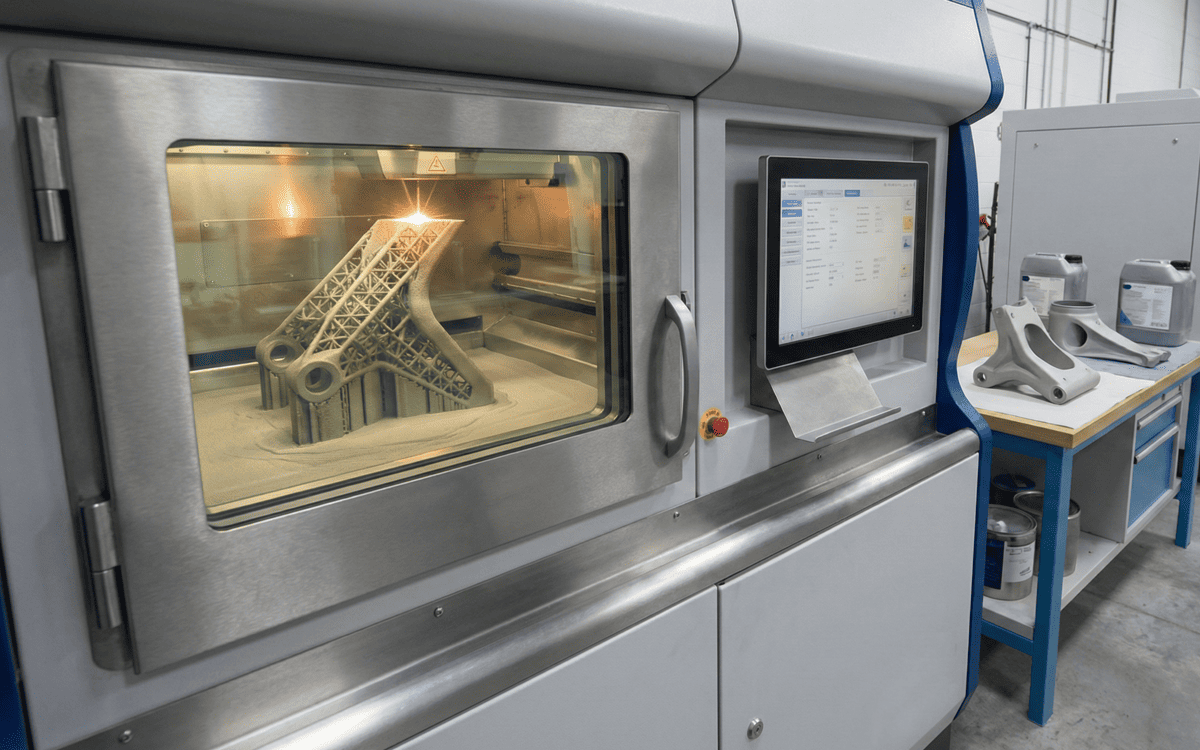
Traditional prototype manufacturing typically relies on subtractive or tooling-based processes such as CNC machining or injection molding. While these methods offer high precision and production-grade properties, they often require longer preparation times, higher upfront costs, and limited flexibility during early design stages.
3D printing changes this workflow by allowing prototypes to be produced directly from digital files without dedicated tooling. Design modifications can be implemented immediately, enabling multiple iterations within days rather than weeks. This rapid feedback loop helps engineering teams identify design flaws earlier and refine products before committing to full-scale manufacturing.
As a result, rapid prototyping in 3D printing is widely used not only for visual models but also for functional testing, ergonomic evaluation, and early-stage engineering validation across industries ranging from aerospace to consumer electronics.
In today’s competitive manufacturing landscape, product development cycles are becoming increasingly compressed. Companies must validate ideas, refine designs, and launch products faster while maintaining performance, quality, and cost control. Traditional development workflows, which often relied on lengthy prototype fabrication and tooling preparation, struggle to keep pace with modern innovation demands. Rapid prototyping enabled by 3D printing fundamentally changes this process.
One of the biggest challenges in product development is the gap between digital design and real-world performance. A design that appears functional in CAD software may reveal ergonomic issues, structural weaknesses, or assembly conflicts once physically produced. Rapid prototyping allows engineers to quickly create multiple design iterations, evaluate them in real conditions, and implement improvements within short development cycles.
Instead of waiting weeks for a prototype manufactured through conventional methods, teams can often produce test parts within hours or days. This rapid iteration capability enables continuous improvement and reduces the likelihood of costly redesigns later in production.

Early-stage design errors are significantly more expensive to correct once tooling or mass production begins. By producing prototypes early and frequently, companies can identify problems before committing to expensive manufacturing investments.
3D printing minimizes upfront costs because it eliminates molds, fixtures, and specialized tooling during the validation phase. Engineers can test multiple variations without substantial financial risk, making experimentation more practical and data-driven.
Rapid prototyping also improves collaboration between engineering, design, and business teams. Physical prototypes provide a shared reference that stakeholders can evaluate more effectively than digital models alone. Designers can assess aesthetics, engineers can verify functionality, and decision-makers can better understand product feasibility.
This shared understanding accelerates approvals and shortens decision-making timelines, which is critical in industries where speed-to-market directly influences competitiveness.
Modern product development increasingly follows agile and iterative methodologies rather than linear workflows. Rapid prototyping aligns naturally with this approach by allowing continuous testing and refinement throughout the design process.
Teams can validate assumptions step by step, incorporate user feedback earlier, and adapt designs quickly in response to changing requirements. As a result, products reach production with higher confidence, improved performance, and reduced uncertainty.
Rapid prototyping in 3D printing follows a structured digital-to-physical workflow that transforms a concept into a tangible part within a short timeframe. Unlike traditional manufacturing processes that require tooling preparation, additive manufacturing builds components directly from digital data, enabling faster production and iteration.
Although specific workflows vary depending on the printing technology and material used, the overall process typically consists of four key stages.
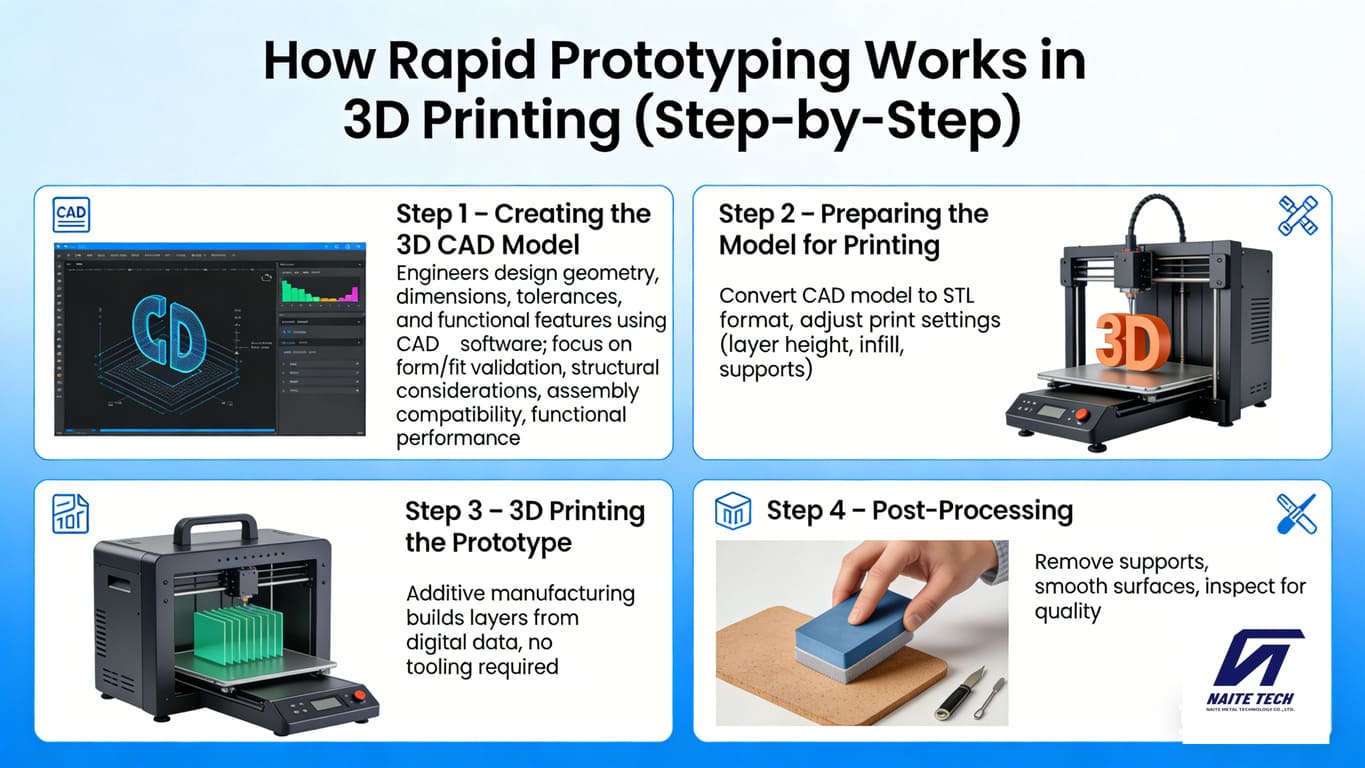
The rapid prototyping process begins with a three-dimensional digital model created using CAD (Computer-Aided Design) software. Engineers design the geometry, dimensions, tolerances, and functional features of the part according to product requirements.
At this stage, designers often focus on:
Form and fit validation
Structural considerations
Assembly compatibility
Functional performance requirements
Because 3D printing allows complex geometries without additional tooling cost, designers have greater freedom to experiment with lightweight structures, internal channels, and optimized shapes that would be difficult to manufacture using conventional methods.
Once the CAD model is completed, it must be converted into a format compatible with 3D printing systems, typically STL or 3MF files. Specialized slicing software then divides the model into hundreds or thousands of thin horizontal layers.
During this preparation phase, engineers define key printing parameters such as:
Layer thickness
Build orientation
Support structures
Infill density or material distribution
Proper setup is critical because printing orientation and parameter selection directly influence surface finish, mechanical strength, dimensional accuracy, and printing time.
After file preparation, the 3D printer fabricates the prototype by depositing, curing, or sintering material layer by layer according to the sliced digital instructions.
Depending on the technology used:
Thermoplastic filament may be extruded (FDM)
Liquid resin may be cured using light (SLA)
Powder materials may be fused using lasers or thermal energy (SLS or MJF)
Each new layer bonds to the previous one until the complete geometry is formed. This additive approach minimizes material waste and allows the creation of highly complex structures without molds or machining operations.
Once printing is complete, prototypes typically undergo post-processing to improve usability and appearance. Common post-processing steps include:
Support removal
Cleaning or curing
Surface finishing or polishing
Heat treatment (for certain materials)
Dimensional inspection
After finishing, prototypes can be evaluated for form, fit, and function. Engineers may conduct mechanical testing, assembly trials, or usability assessments before refining the design for the next iteration or transitioning toward production manufacturing.
This structured workflow enables rapid feedback loops, allowing multiple prototype versions to be produced and tested within a single development cycle—one of the primary reasons 3D printing has become a cornerstone of modern rapid prototyping.
Different 3D printing technologies offer unique advantages depending on prototype requirements such as accuracy, material properties, surface quality, and mechanical performance. Selecting the appropriate technology is essential to ensure that prototypes accurately represent the final product’s design intent and functional behavior.
Below are the most widely used additive manufacturing technologies for rapid prototyping.
Fused Deposition Modeling (FDM) is one of the most accessible and cost-effective 3D printing methods. It works by heating thermoplastic filament and extruding it through a nozzle, depositing material layer by layer to build the part.
Key Advantages
Low manufacturing cost
Fast setup and production
Suitable for early concept validation
Wide range of thermoplastic materials
Limitations
Visible layer lines
Lower surface quality compared to resin-based methods
Limited dimensional accuracy for fine features
Best Use Cases
Concept models
Design validation prototypes
Basic functional testing
FDM is commonly used during early development stages when speed and affordability are more important than precision finishing.
Stereolithography (SLA) uses a laser or light source to cure liquid photopolymer resin into solid layers. This technology is known for producing prototypes with exceptional surface finish and fine detail resolution.
Key Advantages
High dimensional accuracy
Smooth surface quality
Excellent detail reproduction
Ideal for visual and aesthetic prototypes
Limitations
Resin parts may be more brittle
Post-curing required
Material options are more limited than thermoplastics
Best Use Cases
Appearance models
Medical and dental prototypes
Small precision components
SLA is often chosen when visual realism or tight tolerances are required.
Selective Laser Sintering (SLS) uses a laser to fuse powdered polymer materials, typically nylon, into solid parts. Because unfused powder supports the structure during printing, complex geometries can be produced without support structures.
Key Advantages
Strong functional parts
Complex internal geometries possible
No support structures required
Good mechanical performance
Limitations
Rougher surface finish compared to SLA
Higher equipment cost
Additional finishing may be needed
Best Use Cases
Functional prototypes
Snap-fit assemblies
Mechanical testing components
SLS prototypes are frequently used when engineers need parts that closely simulate end-use mechanical behavior.
Multi Jet Fusion (MJF) is an advanced powder-based technology that selectively fuses material using thermal energy and binding agents. It is known for consistent mechanical properties and efficient batch production.
Key Advantages
Excellent strength and durability
Uniform material properties
Faster production for multiple parts
Suitable for low-volume manufacturing
Limitations
Limited material variety compared to some processes
Industrial-level equipment required
Best Use Cases
Functional prototypes
End-use testing parts
Bridge production runs
MJF bridges the gap between prototyping and small-scale production due to its repeatability and performance.
Metal additive manufacturing technologies such as Direct Metal Laser Sintering (DMLS) or Selective Laser Melting (SLM) enable rapid prototyping using engineering metals including aluminum, stainless steel, and titanium.
Key Advantages
Production-grade metal properties
Complex internal structures
Lightweight optimization opportunities
Functional testing under real conditions
Limitations
Higher production cost
Longer post-processing requirements
Specialized engineering considerations
Best Use Cases
Aerospace prototypes
Automotive performance parts
Medical implants and high-performance components
Metal 3D printing is typically used when prototypes must closely replicate final production materials and mechanical performance.
By understanding the strengths and limitations of each technology, engineers can select the most appropriate process based on prototype objectives, budget constraints, and required performance characteristics.
Material selection plays a critical role in rapid prototyping because it directly affects mechanical performance, surface quality, durability, and testing accuracy. Different prototype objectives—such as visual validation, functional testing, or engineering evaluation—require different material characteristics.
Modern 3D printing technologies support a wide range of plastics, engineering polymers, elastomers, and metals, allowing prototypes to closely simulate real production conditions.
Concept validation prototypes are primarily used to evaluate shape, size, and basic design intent rather than mechanical performance. These materials are typically affordable and fast to print, making them ideal for early-stage development.
Common Materials
PLA (Polylactic Acid) — Easy to print and suitable for visual models
Standard Resin — Smooth surface finish for presentation prototypes
Basic ABS-like materials — Improved durability compared to PLA
Typical Applications
Design reviews
Ergonomic evaluation
Marketing or display models
These materials help teams quickly confirm whether a design direction is viable before investing in functional testing.
Functional prototypes must withstand mechanical stress, assembly testing, and real-world handling. Materials in this category provide improved strength and durability while maintaining relatively fast production times.
Common Materials
ABS — Balanced strength and impact resistance
Nylon (PA6 / PA12) — Excellent toughness and wear resistance
PETG — Good chemical resistance and dimensional stability
Tough Resin — Simulates injection-molded plastic behavior
Typical Applications
Snap-fit testing
Mechanical assemblies
Enclosure prototypes
Structural evaluation
Functional materials allow engineers to validate performance before transitioning to manufacturing processes such as CNC machining or injection molding.
Engineering prototypes require materials with predictable mechanical properties, thermal resistance, or specialized performance characteristics. These materials are often used when prototypes must closely represent final-use conditions.
Common Materials
Glass-filled or carbon fiber–reinforced nylon
High-temperature resins
TPU (Thermoplastic Polyurethane) for flexible components
Engineering photopolymers with enhanced strength
Typical Applications
Load-bearing components
Heat-resistant parts
Flexible seals and protective elements
Industrial equipment prototypes
These materials support advanced testing scenarios where performance validation is essential.
When prototypes must replicate final production materials or operate under demanding conditions, metal 3D printing becomes a practical solution.
Common Materials
Aluminum alloys — Lightweight structural prototypes
Stainless steel — Corrosion-resistant components
Titanium alloys — High strength-to-weight ratio applications
Tool steels — Functional testing in tooling environments
Typical Applications
Aerospace components
Automotive performance parts
Medical devices
High-temperature or high-load testing
Metal prototypes enable engineers to evaluate real mechanical behavior before committing to expensive tooling or full-scale manufacturing.
Selecting the appropriate material ensures that rapid prototypes provide meaningful testing results rather than serving only as visual models. Matching material properties with testing objectives is therefore one of the most important decisions in the rapid prototyping workflow.
Rapid prototyping through 3D printing offers significant advantages compared with traditional prototype manufacturing methods. By enabling fast, flexible, and cost-efficient part production, additive manufacturing helps engineering teams validate ideas earlier and reduce uncertainty throughout the product development lifecycle.
The benefits can be understood across three key dimensions: engineering performance, business efficiency, and design innovation.
From an engineering perspective, rapid prototyping allows teams to evaluate real physical parts rather than relying solely on digital simulations. This leads to more accurate validation and faster technical decision-making.
Key Engineering Advantages
Faster iteration cycles — Multiple design versions can be tested within days.
Functional validation — Engineers can verify form, fit, and mechanical performance early.
Complex geometry capability — Internal channels, lattice structures, and lightweight designs become feasible.
Reduced manufacturing constraints — Fewer limitations compared to traditional machining or tooling processes.
These capabilities help identify design flaws before production, reducing downstream engineering risks.
Beyond technical advantages, rapid prototyping significantly improves overall business efficiency and product development economics.
Key Business Advantages
Lower upfront investment — No molds or tooling required during early development.
Shorter time-to-market — Faster validation accelerates product launch timelines.
Reduced development risk — Early testing prevents costly late-stage changes.
Improved decision-making — Physical prototypes support clearer stakeholder evaluation.
For companies operating in competitive markets, faster product validation often translates directly into commercial advantage.
3D printing removes many traditional manufacturing constraints, allowing designers to explore innovative concepts without significant cost penalties.
Key Design Advantages
Greater design freedom — Complex organic shapes and optimized structures are achievable.
Rapid experimentation — Designers can test multiple variations quickly.
User-centered refinement — Ergonomics and usability can be evaluated early.
Customization capability — Design adjustments can be made without retooling.
This flexibility encourages innovation by allowing teams to experiment more freely while maintaining development efficiency.
Overall, rapid prototyping in 3D printing transforms product development from a linear process into an iterative cycle of testing and improvement. By combining engineering validation with business agility and design flexibility, it enables organizations to develop higher-quality products with greater confidence before entering production.
While rapid prototyping in 3D printing offers exceptional speed and flexibility, it is not universally suitable for every application. Understanding the limitations of additive manufacturing helps engineers choose the right prototyping method and avoid unrealistic expectations during product development.
Recognizing these constraints is essential for selecting the most effective manufacturing strategy and ensuring prototypes provide meaningful testing results.
One of the primary challenges of 3D printed prototypes is anisotropy—mechanical properties can vary depending on print orientation. Because parts are built layer by layer, bonding strength between layers may differ from strength within a layer.
Implications include:
Reduced strength along the Z-axis
Potential delamination under high stress
Different fatigue behavior compared to molded or machined parts
For load-bearing or safety-critical testing, engineers must carefully evaluate printing orientation or consider alternative prototyping methods.
Although some technologies provide high resolution, many 3D printing processes produce visible layer lines or slightly rough surfaces compared to CNC machining or injection molding.
Common challenges include:
Post-processing requirements for smooth finishes
Tolerance limitations for precision assemblies
Surface porosity in certain powder-based processes
When tight tolerances or cosmetic surfaces are required, additional finishing processes or hybrid manufacturing approaches may be necessary.
Despite rapid advancements, 3D printing still supports fewer certified engineering materials than traditional manufacturing processes.
Limitations may include:
Restricted material grades
Limited long-term durability data
Reduced temperature or chemical resistance in some polymers
As a result, prototypes may not always perfectly replicate final production material performance.
3D printing is highly efficient for low-volume production and iterative prototyping, but costs increase relative to traditional methods as production volume grows.
Typical considerations:
Slower production speed for large batches
Higher per-part cost compared to injection molding at scale
Machine capacity limitations
For medium- to high-volume manufacturing, processes such as CNC machining, casting, or molding often become more economical.
Many users assume 3D printing produces finished parts directly from the machine. In reality, most prototypes require additional processing steps such as:
Support removal
Cleaning or curing
Surface finishing
Heat treatment (for metals)
These steps add time and must be considered when planning project timelines.
Understanding these limitations does not reduce the value of rapid prototyping; instead, it allows engineers to apply 3D printing strategically—using it where it delivers the greatest advantage while integrating other manufacturing methods when necessary.
Although 3D printing has become a dominant rapid prototyping technology, it is not the only solution available. Engineers often evaluate multiple manufacturing methods depending on prototype requirements such as accuracy, material performance, cost, and production volume.
Understanding how 3D printing compares with other prototyping approaches helps teams select the most efficient process for each stage of product development.
| Factor | 3D Printing | CNC Machining | Injection Molding (Prototype Tooling) |
|---|---|---|---|
| Setup Time | Very low | Moderate | High |
| Lead Time | Fast (hours–days) | Medium (days) | Slow (weeks) |
| Upfront Cost | Minimal | Medium | High tooling cost |
| Design Flexibility | Excellent | Limited by tooling | Limited after tooling |
| Material Options | Moderate | Very wide | Production-grade plastics |
| Dimensional Accuracy | Medium–High | Very high | Very high |
| Best Production Volume | Low | Low–medium | Medium–high |
Each method serves a different purpose within the product development lifecycle rather than directly replacing one another.
3D printing excels in early-stage prototyping where design flexibility and rapid iteration are priorities. Complex geometries can be produced quickly without tooling constraints, making it ideal for concept validation and early functional testing.
CNC machining, on the other hand, removes material from solid blocks to achieve high precision and excellent surface quality. Machined prototypes often provide better mechanical properties because they use fully dense engineering materials identical to production parts.
Choose 3D Printing When:
Designs change frequently
Complex internal structures are required
Speed is more important than precision finishing
Choose CNC Machining When:
Tight tolerances are required
Production-grade materials must be tested
Surface finish and accuracy are critical
In many real-world projects, companies combine both methods—using 3D printing for early iterations and CNC machining for final functional prototypes.
Injection molding prototypes typically require tooling, which increases initial cost and preparation time. However, once molds are created, parts closely replicate final mass-production components.
3D Printing Advantages
No tooling investment
Faster design changes
Ideal for low quantities
Injection Molding Advantages
Consistent part quality
Production-level material behavior
Cost-effective for larger quantities
Injection molding becomes practical only after the design is largely finalized, whereas 3D printing supports experimentation and iterative development.
Rather than selecting a single technology, modern product development often follows a staged approach:
Concept Stage → 3D printing for rapid iteration
Engineering Validation → CNC machining or high-performance printing
Pre-Production → Bridge manufacturing methods
Mass Production → Injection molding or casting
This hybrid workflow allows teams to balance speed, cost, and performance throughout the development lifecycle.
Although 3D printing is highly versatile, it delivers the greatest value when applied to the right stage of product development and the appropriate engineering objectives. Understanding when to use additive manufacturing helps teams maximize efficiency while avoiding unnecessary costs or technical limitations.
Below are the most common scenarios where 3D printing rapid prototyping provides clear advantages.
During the initial phase of product development, designs change frequently as teams explore different concepts and configurations. Producing prototypes quickly is more important than achieving production-level precision.
3D printing is ideal at this stage because:
No tooling preparation is required
Design modifications can be implemented immediately
Multiple variations can be tested simultaneously
Engineers and designers can quickly evaluate size, proportions, ergonomics, and overall feasibility before investing in advanced manufacturing processes.
Traditional manufacturing methods often impose geometric constraints due to tooling accessibility or machining limitations. 3D printing removes many of these restrictions by building parts layer by layer.
It is particularly effective for prototypes featuring:
Internal channels or lattice structures
Lightweight optimized designs
Organic or topology-optimized shapes
Integrated assemblies that reduce part count
When geometry complexity increases, additive manufacturing often becomes the fastest and most practical prototyping solution.
When only a small number of parts are required, creating molds or extensive machining setups may not be economically justified.
3D printing works best for:
One-off prototypes
Small validation batches
Custom or personalized components
Pre-production evaluation samples
This makes it especially useful for startups, R&D teams, and innovation-driven projects.
Modern product development increasingly follows iterative workflows where feedback is continuously incorporated into design improvements. Rapid prototyping enables teams to test, learn, and refine designs within short timeframes.
Typical agile workflows include:
Weekly design updates
Continuous functional testing
User feedback integration
Incremental performance optimization
By shortening iteration cycles, companies can reach validated designs faster and reduce development uncertainty.
3D printing prototypes often serve as a decision-making tool before transitioning to production manufacturing methods. Engineers can validate functionality and identify necessary design adjustments before selecting processes such as CNC machining, casting, or injection molding.
Using 3D printing at this stage helps ensure smoother production transitions and reduces the risk of costly redesigns later.
In practice, the most effective product development strategies combine 3D printing with other manufacturing technologies, using each method where it delivers the highest value throughout the lifecycle.
Rapid prototyping in 3D printing is widely adopted across industries that require fast innovation, precision engineering, and continuous product improvement. By enabling quick validation of ideas and functional testing, additive manufacturing supports both early-stage development and advanced engineering applications.
Below are some of the most common real-world use cases.
The aerospace sector relies heavily on rapid prototyping due to strict performance requirements and complex component geometries. Engineers frequently use 3D printing to evaluate lightweight structures and aerodynamic designs before committing to expensive production processes.
Typical Applications
Lightweight structural components
Airflow and aerodynamic testing models
Brackets and housings
Design validation for complex assemblies
Rapid prototyping helps aerospace teams reduce development risk while maintaining high performance standards.
Automotive manufacturers use rapid prototyping extensively to accelerate vehicle development cycles and refine component designs before tooling investment.
Typical Applications
Interior and exterior component prototypes
Functional engine bay parts
Assembly validation fixtures
Ergonomic and user-interface testing
Fast iteration allows engineers to test multiple design variations during tight development timelines.
In the medical industry, customization and precision are critical. 3D printing enables patient-specific solutions and rapid evaluation of medical device concepts.
Typical Applications
Surgical planning models
Medical device housings
Prosthetic and orthotic prototypes
Ergonomic testing for handheld instruments
Rapid prototyping improves collaboration between engineers and healthcare professionals by providing accurate physical models for evaluation.
Robotics development often involves complex mechanical integration and frequent design revisions. Rapid prototyping allows engineers to quickly refine moving components and test assemblies.
Typical Applications
Robot end-effectors
Sensor housings
Mechanical joints and brackets
Custom automation components
The ability to iterate rapidly is particularly valuable in automation projects where performance optimization is ongoing.
Consumer electronics companies rely on rapid prototyping to balance aesthetics, functionality, and manufacturability within short product launch cycles.
Typical Applications
Product enclosures
Wearable device prototypes
Button and interface testing
Assembly and fit verification
Physical prototypes enable teams to validate user experience and product feel before mass production begins.
Across these industries, rapid prototyping serves as a critical bridge between digital design and real-world manufacturing, enabling faster innovation while reducing development uncertainty.
Rapid prototyping is only the first step in a successful product development journey. While 3D printing enables fast design validation and early functional testing, most products eventually transition to manufacturing processes better suited for durability, scalability, and cost efficiency.
Understanding how prototypes evolve into production parts helps companies plan manufacturing strategies earlier and avoid delays during commercialization.
At the beginning of development, the primary objective is to confirm whether a design works as intended. 3D printing allows teams to quickly transform digital models into physical parts for evaluation.
During this stage, prototypes are typically used to validate:
Overall geometry and proportions
Ergonomics and user interaction
Assembly compatibility
Early functional concepts
Because design changes are frequent, flexibility and speed are more important than production-level material performance.
Once the core design stabilizes, prototypes must demonstrate real mechanical performance. Engineers begin testing strength, tolerance accuracy, and functional reliability.
At this stage, development may incorporate additional manufacturing methods such as:
High-performance 3D printing materials
CNC machining using production-grade metals or plastics
Hybrid prototyping approaches
Engineering verification ensures that parts behave consistently under real operating conditions before moving toward manufacturing investment.
Before mass production begins, companies often require small batches for market testing, certification, or pilot production runs. This phase is commonly referred to as bridge manufacturing.
Typical objectives include:
Functional testing in real environments
Customer feedback collection
Regulatory or certification validation
Supply chain preparation
Processes such as CNC machining, vacuum casting, or advanced additive manufacturing are frequently used to produce limited quantities with consistent quality.
After validation is complete, manufacturing transitions to scalable processes optimized for efficiency and cost.
Common production methods include:
Injection molding for plastic components
Die casting for metal parts
CNC machining for precision components
Sheet metal fabrication for structural assemblies
Because rapid prototyping identified potential issues earlier, production can begin with reduced risk and fewer design revisions.
One of the biggest challenges companies face is switching suppliers between prototyping and production. Each transition introduces risks such as design misinterpretation, quality variation, and additional lead time.
An integrated workflow—where the same engineering team supports prototyping through production—helps ensure:
Design continuity
Faster manufacturing scaling
Consistent quality standards
Reduced communication gaps
By aligning rapid prototyping with long-term manufacturing strategy, companies can shorten development cycles and bring products to market more efficiently.
Rapid prototyping in 3D printing is the process of quickly creating physical models from digital 3D designs using additive manufacturing technologies. Parts are built layer by layer without tooling, allowing engineers to test design concepts, evaluate functionality, and make rapid improvements before moving into production manufacturing.
Depending on part size, geometry, and technology, 3D printed prototypes can typically be produced within a few hours to several days. Compared with traditional prototyping methods that may require weeks for tooling or machining setup, 3D printing significantly shortens development cycles and enables faster design iteration.
Yes, many modern 3D printing materials provide sufficient strength and durability for functional testing. Technologies such as SLS, MJF, and metal 3D printing can produce parts capable of mechanical evaluation, assembly testing, and real-world performance validation, although final production properties may still differ.
Common materials include PLA and standard resins for visual models, ABS and nylon for functional testing, engineering polymers for performance validation, and metals such as aluminum or stainless steel for high-strength prototypes. Material selection depends on testing goals, environmental conditions, and required mechanical performance.
Rapid prototyping eliminates tooling requirements, reduces upfront costs, and allows faster design iteration. Engineers can identify problems earlier, test multiple variations quickly, and shorten time-to-market while minimizing development risk compared to conventional manufacturing approaches.
3D printing is ideal when designs change frequently, complex geometries are required, or only small quantities are needed. CNC machining is typically preferred when tight tolerances, superior surface finish, or production-grade material performance are critical for testing or validation.
In some cases, yes. Certain technologies such as MJF or metal 3D printing can produce end-use parts or low-volume production batches. However, for large-scale manufacturing, processes like injection molding or CNC machining are usually more cost-efficient.
By enabling early physical testing, rapid prototyping helps engineers detect design flaws before expensive tooling or mass production begins. Early validation reduces redesign costs, shortens development timelines, and improves confidence in final manufacturing decisions.
Rapid prototyping in 3D printing has transformed how products are designed, tested, and brought to market. By enabling fast conversion from digital models to physical parts, additive manufacturing allows engineers and designers to validate ideas earlier, iterate more efficiently, and reduce uncertainty throughout the development process.
Compared with traditional prototyping approaches, 3D printing provides unmatched flexibility during early design stages. Teams can explore complex geometries, test multiple concepts, and refine products without the delays and costs associated with tooling. As a result, companies can accelerate innovation while maintaining greater control over development risks and budgets.
However, rapid prototyping is most effective when integrated into a broader manufacturing strategy. While 3D printing excels in concept validation and early functional testing, other processes such as CNC machining, casting, and injection molding often play critical roles as products move toward production. Combining these technologies allows organizations to balance speed, performance, and scalability across the entire product lifecycle.
Today, rapid prototyping is no longer simply a design aid—it has become a foundational element of modern manufacturing workflows. Businesses that leverage rapid prototyping strategically can shorten development cycles, improve product quality, and respond more quickly to evolving market demands.


