
- Home
- Capabilities
- Solution
- Material
- Industry
- Resources
- Request a Quote
Views: 0 Author: Site Editor Publish Time: 2025-12-08 Origin: Site
Swiss machining is a specialized manufacturing method designed for producing high-precision, small-diameter, and long-slender components with exceptional dimensional consistency. Originally developed to meet the demanding requirements of the Swiss watchmaking industry, Swiss machining has evolved into one of the most critical technologies for modern precision manufacturing across medical, aerospace, electronics, and high-end mechanical industries.
Unlike conventional CNC turning, Swiss machining fundamentally rethinks how cutting forces, material support, and tool engagement interact during machining. Instead of holding the workpiece stationary and allowing it to extend unsupported from the chuck, Swiss machines support the material directly at the cutting zone using a guide bushing while the bar stock continuously feeds through the spindle. This structural difference enables levels of precision, stability, and repeatability that are difficult—or physically impossible—to achieve with traditional lathes when machining slender parts.
This guide provides a comprehensive engineering-level explanation of Swiss machining, focusing not only on what it is, but why it exists, when it should be used, and how engineers and manufacturers can leverage it effectively in real-world production environments.
Swiss machining, often referred to as Swiss-type CNC machining or Swiss turning, is a manufacturing process specifically developed to overcome the limitations of conventional turning when machining long, thin, or high-precision components.
At its core, Swiss machining exists to solve a mechanical problem: workpiece deflection caused by cutting forces.
From an engineering standpoint, Swiss machining is not simply a variation of CNC turning. It is a mechanical system designed to control cutting forces at their source.
In conventional CNC lathes, the workpiece is clamped at one end and extends outward as a cantilever. As cutting forces increase—especially when machining small diameters or long lengths—the unsupported section of material begins to bend, vibrate, or chatter. Even minimal deflection can lead to dimensional inaccuracies, poor surface finishes, and inconsistent results.
Swiss machining addresses this issue by introducing a guide bushing positioned extremely close to the cutting tool. The bar stock passes through this bushing, and only a very short section of material is exposed to cutting forces at any moment. By reducing the unsupported length to near zero, Swiss machines dramatically improve stability during machining.
This design allows Swiss machining to achieve tight tolerances, excellent surface finishes, and highly repeatable results, even on parts with extreme length-to-diameter ratios.
Many machining articles describe Swiss machining as a “type of lathe.” While technically accurate, this description understates its true significance.
Swiss machining represents a structural redesign of the machining process itself. Instead of attempting to compensate for deflection through reduced feed rates, lighter cuts, or secondary operations, Swiss machines eliminate the root cause of the problem through mechanical support.
In engineering terms, conventional turning treats the workpiece as a cantilever beam, where bending moments increase with length. Swiss machining converts this setup into a supported beam system, drastically reducing bending moments and vibration. This shift enables predictable, stable machining behavior—even under aggressive cutting conditions.
Because of this, Swiss machining is often selected not for convenience, but out of necessity in applications where traditional CNC turning simply cannot meet functional or quality requirements.
While Swiss machines and conventional CNC lathes may appear similar at first glance, their operational principles differ in several critical ways.
In a conventional CNC lathe, the workpiece remains stationary while tools move along it. The unsupported length increases as machining progresses. In contrast, Swiss machines move the material axially while cutting occurs near the guide bushing, keeping the unsupported length constant and minimal throughout the process.
Conventional lathes distribute cutting forces across a longer unsupported section of material, leading to higher bending stress. Swiss machines localize cutting forces at a fixed, supported point, significantly reducing force-induced deformation.
Traditional CNC turning can achieve high accuracy under ideal conditions, particularly for short, rigid parts. However, maintaining that accuracy across long runs or complex geometries is challenging. Swiss machining excels in repeatability and process stability, delivering consistent dimensional results over thousands or even millions of parts with minimal drift.
Workpiece stability is the single most important advantage offered by Swiss machining. Without adequate stability, even the most advanced CNC controls and high-performance tooling cannot prevent dimensional variation.
The guide bushing supports the material immediately adjacent to the cutting zone, acting as a physical constraint against lateral movement. This prevents deflection, vibration, and chatter, even when machining extremely slender geometries.
Because the cutting zone remains fixed relative to the bushing, dimensional accuracy is maintained regardless of part length.
Length-to-diameter (L/D) ratio is a critical parameter in turning operations. As the L/D ratio increases beyond approximately 10:1, conventional turning becomes increasingly unstable without additional support mechanisms. Swiss machining allows stable machining at significantly higher L/D ratios, making it the preferred solution for micro-shafts, pins, medical components, and precision connectors.
Precision machining is not defined solely by how tight a tolerance can be achieved on a single part, but by how consistently that tolerance can be maintained across production runs.
Swiss machining shines in environments where thousands of identical components must perform reliably in assembly or functional systems. High repeatability reduces downstream inspection costs, minimizes assembly issues, and improves overall production yield.
Thanks to its stable cutting conditions, Swiss machining delivers consistent results with minimal tool deflection, wear-induced drift, or thermal variation. This makes it particularly suitable for regulated industries such as medical devices and aerospace, where consistency is just as important as absolute accuracy.
Although Swiss machining involves more complex setups compared to conventional turning, it often delivers higher overall efficiency in appropriate applications.
Swiss machines are capable of performing multiple machining operations simultaneously using front-working and back-working tools, live tooling, and synchronized axes. Turning, milling, drilling, threading, and cutoff operations can often be completed in a single cycle without repositioning the part.
Swiss machining becomes increasingly cost-effective in medium-to-high volume production where cycle time reduction, yield consistency, and elimination of secondary operations offset the higher setup effort.
By machining parts close to net shape and minimizing errors caused by deflection or vibration, Swiss machining significantly reduces scrap rates. Higher yield not only lowers material costs but also improves delivery reliability and scheduling accuracy.
Industry Practice Note
Precision manufacturers such as NAITE TECH utilize Swiss CNC machining specifically to achieve long-term dimensional stability and repeatability in demanding production environments, rather than relying on post-machining corrections.
Understanding Swiss machining at a deeper level requires examining why it emerged, how it evolved, and what problems it was originally designed to solve. Unlike many modern manufacturing methods that evolved primarily through automation, Swiss machining evolved through mechanical necessity.

Swiss machining traces its origins back to the late 19th and early 20th centuries in Switzerland, where the watchmaking industry demanded unprecedented levels of precision for extremely small and slender components.
Watch parts such as balance staffs, pinions, shafts, and screws often featured extreme length-to-diameter ratios and tight tolerances measured in microns. Conventional lathes of the time were unable to machine these parts reliably due to severe deflection, vibration, and dimensional inconsistency.
To address this, Swiss machinists developed a unique approach:
The workpiece would move axially
The cutting tools would remain relatively fixed
A guide bushing would support the material immediately next to the cutting point
This sliding headstock concept allowed machinists to machine delicate components with minimal deflection, enabling the precision required for mechanical timekeeping devices. The success of this approach established the foundation for what would later become Swiss-type machining.
For decades, Swiss machines relied entirely on mechanical cams to control tool motion. While capable of high precision, cam-operated Swiss machines required extensive setup time and offered limited flexibility.
The transition to CNC technology marked a major turning point. CNC Swiss machines replaced fixed mechanical cam profiles with programmable motion control, allowing:
Rapid changeover between part designs
Greater complexity without mechanical redesign
Integration of live tooling and milling operations
This evolution transformed Swiss machining from a niche watchmaking process into a versatile, high-precision manufacturing solution suitable for a wide range of industries.
Today’s Swiss CNC machines represent highly advanced manufacturing systems rather than simple turning centers. Modern machines integrate:
Multi-axis CNC control
Front and back working spindles
Live tooling capabilities
Automated bar feeders
In-process monitoring and feedback systems
These advancements allow Swiss machining to produce complex, multi-featured components in a single setup, maintaining tight tolerances while maximizing throughput. As manufacturing demands grow more stringent, Swiss machining continues to expand beyond its original applications into medical, aerospace, electronics, and energy sectors.
Industry Insight
Modern precision manufacturers, including NAITE TECH, rely on CNC Swiss machining not because it is traditional, but because it remains one of the most mechanically stable and predictable solutions for small, complex, high-precision parts.
The performance of Swiss machining is not derived from a single feature, but from the interaction of several key components working as a unified mechanical system. Understanding these components explains why Swiss machining delivers results that conventional lathes often cannot.
Unlike fixed-headstock lathes, Swiss machines use a sliding headstock that moves the bar stock longitudinally through the spindle and guide bushing.
Instead of the tool traveling along a stationary workpiece, the material itself advances toward the tools. This approach keeps the cutting zone fixed relative to the guide bushing, ensuring constant support throughout machining.
By moving the workpiece rather than extending it outward, Swiss machining prevents the increase of unsupported length. This is especially critical when machining slender parts, where even minimal extensions can lead to instability and dimensional error.
The guide bushing is the defining feature that distinguishes Swiss machining from all other turning processes.
Positioned immediately adjacent to the cutting tools, the guide bushing supports the bar stock and prevents lateral movement during cutting. This creates a stable cutting environment where cutting forces are absorbed by the bushing rather than transmitted into the unsupported portion of the part.
Because the cutting zone remains fixed relative to the guide bushing, Swiss machining neutralizes bending moments before they can affect part geometry. This allows aggressive cutting conditions without sacrificing dimensional integrity.
Guide bushings are manufactured to extremely tight tolerances. Proper alignment between the bushing, spindle, and tooling is essential for maintaining accuracy. Well-maintained bushings contribute directly to surface finish quality, tool life, and overall repeatability.
Modern Swiss machines support extensive tooling configurations, including:
Axial and radial turning tools
Live milling cutters
Cross-drilling and tapping units
Back-working tools for secondary operations
These tools enable simultaneous machining on multiple faces of the part, reducing cycle time and eliminating the need for secondary setups.
Advanced CNC controls synchronize tool motion across multiple axes and spindles. This allows overlapping operations that dramatically increase productivity without compromising precision.
While Swiss machining may appear complex at first glance, its working principles follow a highly structured and repeatable manufacturing logic. Each stage of the process is designed to maintain workpiece stability, control cutting forces, and ensure dimensional consistency from the first part to the last.
Swiss machining begins with bar stock loading through an automated bar feeder. The bar material is fed directly into the spindle and passes through the guide bushing before reaching the cutting tools.
Unlike conventional turning, where the workpiece remains fixed and gradually extends outward, Swiss machining advances the material axially. Only a short segment of the bar—typically just a few millimeters—is exposed beyond the guide bushing at any time.
This controlled exposure ensures that the material remains fully supported throughout the machining process.
The initial alignment between the bar stock, spindle, and guide bushing is critical. Any misalignment can translate into runout or surface defects. For this reason, precision bar preparation and accurate setup play a significant role in achieving optimal results.
As machining progresses, the guide bushing continuously supports the bar stock adjacent to the cutting zone. This real-time support prevents lateral deflection regardless of cutting depth, feed rate, or tool engagement.
Because the guide bushing is positioned extremely close to the cutting tools, it effectively absorbs cutting forces before they can propagate into the unsupported portion of the material. This allows Swiss machines to maintain stable cutting conditions even when producing parts with extreme length-to-diameter ratios.
From a physical perspective, the guide bushing transforms the machining setup into a constrained system, minimizing vibration and enabling consistent material removal.
One of the defining strengths of Swiss machining lies in its ability to perform multiple machining operations simultaneously.
Modern Swiss CNC machines are equipped with both front-working and back-working tool stations. While one tool performs turning operations on the primary spindle, another tool may simultaneously drill, mill, or tap features elsewhere on the part.
This parallel processing approach significantly reduces cycle time compared to sequential operations performed on conventional lathes.
The presence of live tooling further expands machining capability, enabling complex geometries such as flats, slots, cross-holes, and threaded features without removing the part from the machine.
Once machining is complete, the finished part is separated from the bar stock using a cut-off tool and ejected automatically. The machine immediately advances the bar stock to begin machining the next part.
This continuous production cycle minimizes downtime between parts and enables highly efficient, unattended operation—particularly when combined with automated bar feeders and part handling systems.
Over long production runs, this repeatability allows Swiss machining to maintain exceptionally tight dimensional tolerances with minimal operator intervention.
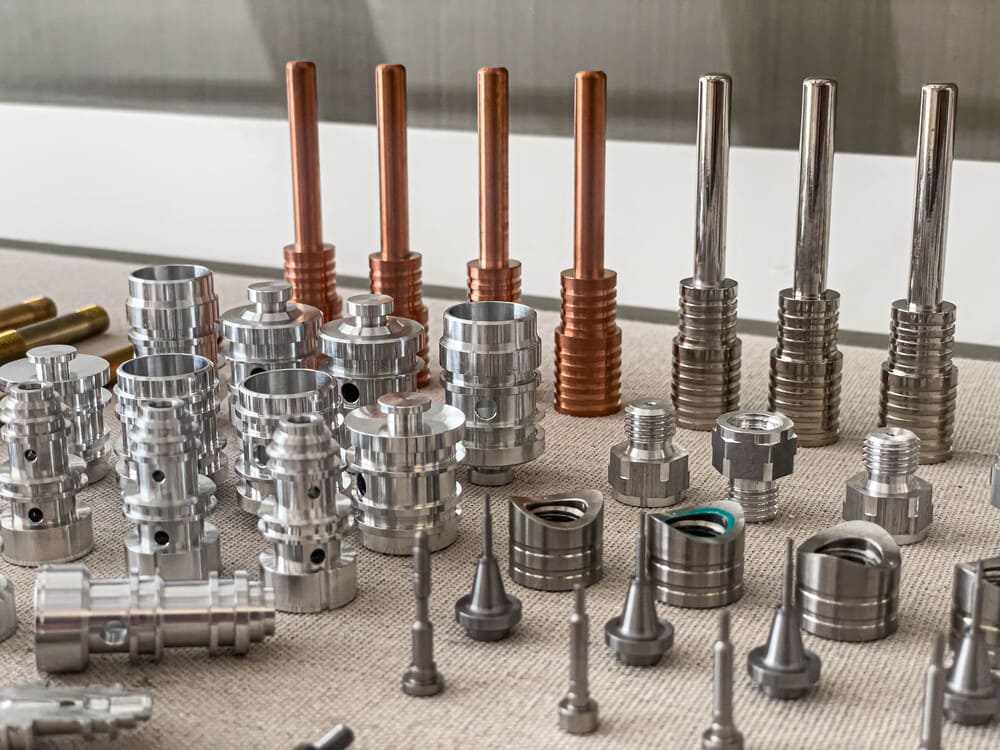
Manufacturing Practice Note
In high-volume precision environments, manufacturers like NAITE TECH utilize Swiss machining to combine multi-operation capability with predictable, uninterrupted production cycles—reducing both labor dependency and dimensional variation.
Swiss machining offers a combination of mechanical stability, precision, and efficiency that is difficult to replicate with other machining methods. These advantages make it a preferred choice for applications where dimensional control and repeatability are non-negotiable.
The ability to support material at the cutting zone allows Swiss machining to produce long, slender parts with excellent dimensional accuracy. This capability is particularly valuable for components such as shafts, pins, guide rods, and medical instruments where deflection would otherwise compromise quality.
Stable cutting conditions reduce vibration and chatter, which in turn lowers tool wear and extends tool life. Consistent tool engagement also minimizes dimensional drift over extended production runs.
This stability leads to predictable machining behavior, allowing manufacturers to optimize cutting parameters without risking part quality.
Swiss machining excels in environments where tight tolerances must be maintained consistently. Repeatability ensures that each part conforms to specification, reducing the need for extensive inspection and rework.
This advantage is particularly critical in regulated industries such as medical devices and aerospace manufacturing.
Because Swiss machining minimizes vibration and maintains controlled cutting forces, it often produces superior surface finishes. In many cases, this eliminates the need for secondary finishing processes such as grinding or polishing.
Swiss machining is not a universal solution; its benefits become significant only under specific engineering conditions. Understanding when to select Swiss machining allows engineers and manufacturers to optimize cost, cycle time, and part quality.
Swiss machining excels when producing long, slender, or small-diameter components. Typical criteria include:
Length-to-diameter ratio (L/D) greater than 10:1
Diameters ranging from fractions of a millimeter to a few centimeters
Parts that require high aspect ratio precision, such as shafts, pins, or micro-connectors
Parts that meet these criteria benefit from the guide bushing support, which prevents deflection and vibration during cutting, ensuring dimensional integrity.
Swiss machining is optimal for parts requiring:
Tight tolerances (±0.005 mm or better)
High surface finish quality (low Ra values without secondary finishing)
Complex multi-feature geometries produced in a single setup
When functional requirements demand both dimensional accuracy and surface integrity, Swiss machining reduces the risk of scrap, secondary operations, and inspection costs.
While setup for Swiss machining can be more involved than conventional turning, the process becomes highly cost-effective in medium-to-high volume production. This is due to:
Reduced cycle times through multi-tool operations
Minimized part handling and secondary operations
Consistent yield and repeatability over long runs
In regulated industries like medical device manufacturing, electronics, and aerospace, these advantages directly translate into lower overall production risk.
Swiss machining provides exceptional precision, but it is not the optimal choice for every component. Understanding its limitations helps avoid unnecessary costs or complexity.
Parts that are short or have large diameters do not require the mechanical support provided by a guide bushing. In these cases, conventional CNC lathes offer simpler setups and sufficient precision at lower cost.
Components that do not require tight tolerances, surface finishes, or complex multi-feature geometries are better suited for traditional turning or milling. Using Swiss machining for these parts introduces unnecessary setup time and operational complexity.
For small batch prototypes or one-off parts, the setup and calibration of Swiss CNC machines may outweigh the benefits of precision. Traditional CNC turning or additive manufacturing can deliver faster turnaround at lower cost.
Practical Insight
NAITE TECH engineers often evaluate each part’s geometry, tolerance requirements, and production volume before deciding between Swiss and conventional CNC machining, ensuring the most efficient and cost-effective approach.
The choice of material directly affects Swiss machining performance. Different alloys present unique challenges in terms of cutting force, tool wear, and surface finish.
Common materials include 303, 304, 316, and 17-4PH stainless steels. High corrosion resistance and hardness may require:
Optimized cutting parameters to prevent work hardening
Specific tool coatings (e.g., TiN, TiAlN) to extend tool life
Adequate cooling strategies to control thermal expansion
Titanium and other biocompatible alloys are frequently used in medical devices and aerospace components. Swiss machining provides:
Stable support to minimize deflection
Reduced chatter and vibration to prevent surface defects
Multi-tool capability to produce complex geometries in a single setup
These materials are easier to machine but still benefit from Swiss machining for small, precision components. Reduced vibration and precise control ensure repeatable features and high-quality surface finishes.
Swiss machines are increasingly used to produce precision polymer components, including PEEK, Delrin, and PTFE, where dimensional stability and surface quality are critical.
Swiss machines are increasingly used to produce precision polymer components, including PEEK, Delrin, and PTFE, where dimensional stability and surface quality are critical.
Cutting parameters in Swiss machining must be carefully optimized to leverage the mechanical advantages of guide bushing support while maintaining tool life, surface quality, and dimensional accuracy. Unlike conventional turning, Swiss machining allows more aggressive cutting conditions due to superior workpiece stability.
| Material | Typical Applications | Challenges | Recommended Tooling | Cutting Speed (m/min) | Feed Rate (mm/rev) | Coolant Strategy | Example Part & Size | Achieved Tolerance / Surface Finish |
|---|---|---|---|---|---|---|---|---|
| 316L Stainless Steel | Medical shafts, surgical instruments | Work hardening, moderate toughness | TiAlN-coated carbide inserts, micro-turn HSS | 80–150 | 0.01–0.05 | Flood or MQL | Surgical shaft Ø2 mm × 50 mm | ±0.005 mm, Ra 0.2 μm |
| Ti-6Al-4V Titanium | Aerospace pins, implants | Low thermal conductivity, prone to work hardening | Ultra-fine carbide, PCD micro-milling | 30–60 | 0.005–0.02 | High-pressure flood cooling | Aerospace pin Ø3 mm × 70 mm | ±0.003 mm |
| Brass / Copper | Micro-connectors, electrical terminals | Soft, tends to gum and form burrs | Uncoated carbide, HSS for very small features | 150–250 | 0.02–0.06 | Light flood or mist | Connector pin Ø1.2 mm × 15 mm | ±0.005 mm, burr-free |
| PEEK / Delrin / PTFE | Precision polymer components, gears | Thermal expansion, soft, low modulus | Sharp uncoated carbide tools | 200–400 | 0.05–0.15 | Air or low-pressure mist | Micro-gear Ø5 mm × 10 mm | ±0.01 mm, no deformation |
| 17-4PH Stainless Steel | Automotive shafts, precision mechanical parts | High strength, work hardening | Coated carbide, live tooling | 80–120 | 0.015–0.04 | Flood cooling | EV motor shaft Ø5 mm × 40 mm | ±0.01 mm |
Tip:Engineers at NAITE TECH use such material-specific tables to pre-select tooling, optimize feeds and speeds, and ensure predictable high-precision results for Swiss CNC machined components.
The guide bushing support fundamentally changes how cutting parameters can be selected. In conventional turning, cutting forces cause deflection that limits feed rates and cutting speeds. Swiss machining minimizes deflection, allowing engineers to:
Use higher cutting speeds without inducing chatter
Apply greater feed rates while maintaining surface finish
Take deeper cuts on slender geometries without dimensional drift
However, optimizing cutting parameters still requires balancing tool life, cycle time, surface finish, and dimensional accuracy.
Cutting speed, measured in meters per minute (m/min), represents the relative velocity between the cutting tool edge and the workpiece surface. It is one of the most critical parameters affecting tool wear, heat generation, and surface finish.
Material-Specific Cutting Speed Guidelines:
Stainless Steels (303, 304, 316): 60–120 m/min
High-Strength Stainless (17-4PH): 40–80 m/min
Titanium Alloys: 30–60 m/min
Aluminum Alloys: 200–400 m/min
Brass and Free-Cutting Alloys: 150–300 m/min
Engineering Plastics (PEEK, Delrin): 100–250 m/min
Cutting speed directly impacts heat generation at the tool-workpiece interface. Higher speeds increase productivity but accelerate tool wear. Proper coolant delivery is essential when operating at elevated cutting speeds.
Feed rate, measured in millimeters per revolution (mm/rev), determines how far the cutting tool advances per spindle rotation. It significantly affects chip formation, surface roughness, and cycle time.
Typical Feed Rate Ranges:
Roughing operations: 0.1–0.3 mm/rev
Semi-finishing: 0.05–0.15 mm/rev
Finishing operations: 0.02–0.08 mm/rev
Higher feed rates increase material removal rates but can degrade surface finish. Swiss machining's stability allows slightly higher feed rates compared to conventional turning for equivalent surface quality.
Depth of cut, measured in millimeters, represents the thickness of material removed in a single pass. Swiss machining's guide bushing support allows deeper cuts on slender parts without the deflection issues encountered in conventional turning.
Recommended Depth of Cut:
Roughing passes: 1.0–3.0 mm
Semi-finishing passes: 0.3–0.8 mm
Finishing passes: 0.05–0.2 mm
When machining high L/D ratio parts, Swiss machines can maintain dimensional accuracy even with aggressive roughing depths that would cause significant deflection on conventional lathes.
Spindle speed, measured in revolutions per minute (rpm), determines how fast the workpiece rotates. It is directly related to cutting speed through the workpiece diameter.
Relationship Between Cutting Speed and Spindle Speed:
n = (Vc × 1000) / (π × D)
Where:
n = spindle speed (rpm)
Vc = cutting speed (m/min)
D = workpiece diameter (mm)
For small-diameter parts typical in Swiss machining, spindle speeds can reach 8,000–12,000 rpm or higher to achieve optimal cutting speeds.
Tool geometry and coatings significantly influence cutting performance and parameter selection:
Tool Coatings for Swiss Machining:
TiN (Titanium Nitride): General-purpose coating, suitable for steels and aluminum
TiAlN (Titanium Aluminum Nitride): High-temperature stability, ideal for stainless steels and hardened materials
AlTiN (Aluminum Titanium Nitride): Excellent wear resistance for high-speed machining
Diamond Coatings: Optimal for aluminum, brass, and non-ferrous materials
Tool Geometry Considerations:
Positive rake angles reduce cutting forces and are preferred for materials prone to work hardening
Sharp cutting edges minimize heat generation and improve surface finish
Chip breaker geometry must be selected based on feed rate and material to ensure proper chip evacuation
Effective coolant delivery is essential in Swiss machining to:
Remove heat from the cutting zone
Prevent thermal expansion and dimensional drift
Extend tool life
Improve surface finish
Facilitate chip evacuation
Coolant Application Methods:
Flood cooling: High-volume coolant flow over the cutting zone
High-pressure coolant (HPC): Directed coolant jets at 50–100 bar for improved chip breaking and heat removal
Through-spindle coolant: Coolant delivered through the tool directly to the cutting edge
Minimum quantity lubrication (MQL): Micro-droplet lubrication for environmentally sensitive applications
Material-specific coolant selection improves performance. Water-soluble emulsions work well for steels, while straight oils are often preferred for aluminum and brass to prevent built-up edge formation.
Stainless Steel 303/304:
| Operation | Cutting Speed (m/min) | Feed Rate (mm/rev) | Depth of Cut (mm) |
|---|---|---|---|
| Roughing | 80–100 | 0.15–0.25 | 1.5–2.5 |
| Finishing | 100–120 | 0.05–0.10 | 0.1–0.3 |
Aluminum 6061:
| Operation | Cutting Speed (m/min) | Feed Rate (mm/rev) | Depth of Cut (mm) |
|---|---|---|---|
| Roughing | 300–400 | 0.2–0.3 | 2.0–3.0 |
| Finishing | 350–450 | 0.08–0.15 | 0.1–0.2 |
Titanium Ti-6Al-4V:
| Operation | Cutting Speed (m/min) | Feed Rate (mm/rev) | Depth of Cut (mm) |
|---|---|---|---|
| Roughing | 40–60 | 0.1–0.2 | 1.0–2.0 |
| Finishing | 50–70 | 0.05–0.10 | 0.1–0.2 |
Brass (Free-Cutting):
| Operation | Cutting Speed (m/min) | Feed Rate (mm/rev) | Depth of Cut (mm) |
|---|---|---|---|
| Roughing | 200–300 | 0.2–0.3 | 2.0–3.0 |
| Finishing | 250–350 | 0.08–0.15 | 0.1–0.3 |
Successful Swiss machining requires iterative parameter optimization based on real-world results:
Signs That Parameters Need Adjustment:
Excessive tool wear: Reduce cutting speed or feed rate
Poor surface finish: Reduce feed rate, increase cutting speed, or adjust tool geometry
Chatter or vibration: Adjust spindle speed to avoid resonance frequencies
Dimensional drift: Check thermal stability, reduce cutting forces, verify coolant effectiveness
Chip evacuation issues: Modify feed rate, adjust coolant pressure, or change chip breaker geometry
Swiss machines often run multiple tools simultaneously. Cutting parameters must be coordinated to:
Balance cutting forces across front-working and back-working tools
Prevent interference between simultaneous operations
Optimize cycle time without compromising dimensional accuracy
Ensure consistent coolant distribution across all active cutting zones
Industry Practice Note
Precision manufacturers such as NAITE TECH continuously refine cutting parameters based on material behavior, tool wear patterns, and real-time feedback to maintain optimal productivity and quality throughout production runs.
Swiss machining is widely applied across industries that require small, precise, and complex components.
Surgical instruments, implants, catheters, and micro-tools
Tight tolerances and smooth surfaces are mandatory for performance and regulatory compliance
High-precision pins, shafts, and connectors
Critical tolerance adherence ensures proper assembly and function in high-stress environments
Micro-connectors, precision terminals, and sensor components
Repeatable production is essential for automated assembly and device reliability
Fuel injection components, valve parts, electric motor shafts
Swiss machining enables tight tolerances for mechanical efficiency and longevity
Successful Swiss machining requires careful design-for-manufacturing (DFM) principles. Even with the mechanical advantages of Swiss machines, improper design can lead to poor surface finishes, excessive tool wear, or infeasible operations.
Swiss machining is not simply “turn it like a lathe”; it requires considering workpiece support, tool accessibility, and feature sequence.
Maintain minimum wall thickness to avoid deformation during cutting.
Rounded corners and fillets reduce stress concentrations and allow smooth tool paths.
Ensure spacing between features allows simultaneous use of multiple tools when needed.
Following these principles minimizes vibration, reduces burr formation, and ensures that tolerances can be reliably achieved.
Specify tolerances based on functional necessity, not over-engineering.
Consider stacked tolerances for multi-feature components; Swiss machining excels at repeatability, which helps meet tight cumulative tolerances.
Factor in thermal expansion and cutting forces for long slender parts.
Swiss machining minimizes burr formation due to short unsupported length and controlled cutting.
Surface finishes are often superior, potentially eliminating secondary operations.
When secondary processes are required, plan tool sequence to reduce handling and maintain dimensional consistency.
Industry Tip
At NAITE TECH, engineers routinely review designs for DFSM compliance before production, ensuring that both machining efficiency and part quality are optimized from the earliest stage.
Understanding the economics of Swiss machining is critical for making informed production decisions.
Swiss machining typically involves higher setup costs due to:
Precise alignment of guide bushings
Tooling calibration for multi-axis operations
Program verification for complex sequences
However, these initial costs are offset by lower unit cost in medium-to-high volume production, thanks to reduced cycle time and fewer secondary operations.
Live tooling and multi-axis machining reduce total machining time.
Tool life is extended due to stable cutting conditions.
Material waste is minimized because parts are machined near-net-shape with minimal deflection-induced scrap.
Stable machining ensures predictable outcomes, reducing inspection and rework.
Continuous bar feeding and automated part ejection lower labor costs.
Optimizing tool paths and sequencing reduces overall production cycle without sacrificing precision.
Practical Insight
Precision manufacturers like NAITE TECH analyze part geometry, production volume, and tolerance requirements to determine whether Swiss machining delivers a true cost advantage over conventional CNC turning.
Swiss machining continues to evolve, integrating automation, smart technology, and new materials to meet the demands of modern manufacturing.
Fully automated bar feeding reduces manual labor.
Lights-out operation allows extended production cycles with minimal supervision.
Continuous monitoring ensures consistent quality throughout long production runs.
Sensors track spindle load, vibration, and temperature in real time.
Adaptive control systems adjust cutting parameters automatically to maintain precision.
Data collection supports predictive maintenance and production optimization.
Increased demand for high-precision, small, complex components drives Swiss machining adoption.
Emerging sectors like electric vehicle motors, microelectronics, and implantable medical devices benefit from the unmatched stability and repeatability of Swiss CNC machines.
Forward-Looking Note
NAITE TECH continuously invests in automation and smart Swiss machining technology to serve industries where both precision and reliability are non-negotiable.
Swiss machining represents a mechanical philosophy rather than just a type of machine. By supporting material directly at the cutting zone and enabling multi-tool, multi-axis operations, Swiss machines deliver precision, stability, and repeatability that conventional lathes cannot achieve for long or slender parts.
Its applications span medical devices, aerospace, electronics, automotive, and high-precision mechanical assemblies, with advantages including:
Minimal workpiece deflection
High repeatability over long production runs
Improved surface finishes and fewer secondary operations
Optimized material usage and reduced scrap
Industry Closing Note
Manufacturers such as NAITE TECH leverage Swiss machining not only to produce parts, but to ensure consistent, high-quality, and cost-effective production across complex and demanding industries. Its continued relevance in modern manufacturing demonstrates that Swiss machining remains one of the most critical technologies for achieving high-precision results worldwide.


